8 If the starter motor still does not operate,
remove it (see Section 21). The brushes and
commutator may be checked (Section 22), but
if the fault persists, the motor should be
renewed, or taken to an auto-electrician for
testing and repair.
9 If the starter motor cranks the engine at an
abnormally-slow speed, first make sure that
the battery is charged, and that all terminal
connections are tight. If the engine is partially
seized, or has the wrong viscosity oil in it, it
will crank slowly.
10 If the engine is known to be OK, and with
the correct viscosity oil, but the cranking
speed is still slow, the solenoid contacts are
burned, the motor is faulty, or there is a poor
internal connection.
21 Starter motor -
removal and refitting
1
4-cylinder engines
Note: On some models, the starter motor is
positioned under the inlet manifold, and
access is severely limited. No further
information was available at the time of writing.
Removal
1 Disconnect the battery negative terminal.
(Refer to Section 1 before doing this).
2 Refer to the relevant Part of Chapter 4 and
remove the air cleaner air intake trunking as
necessary to gain access to the starter motor.
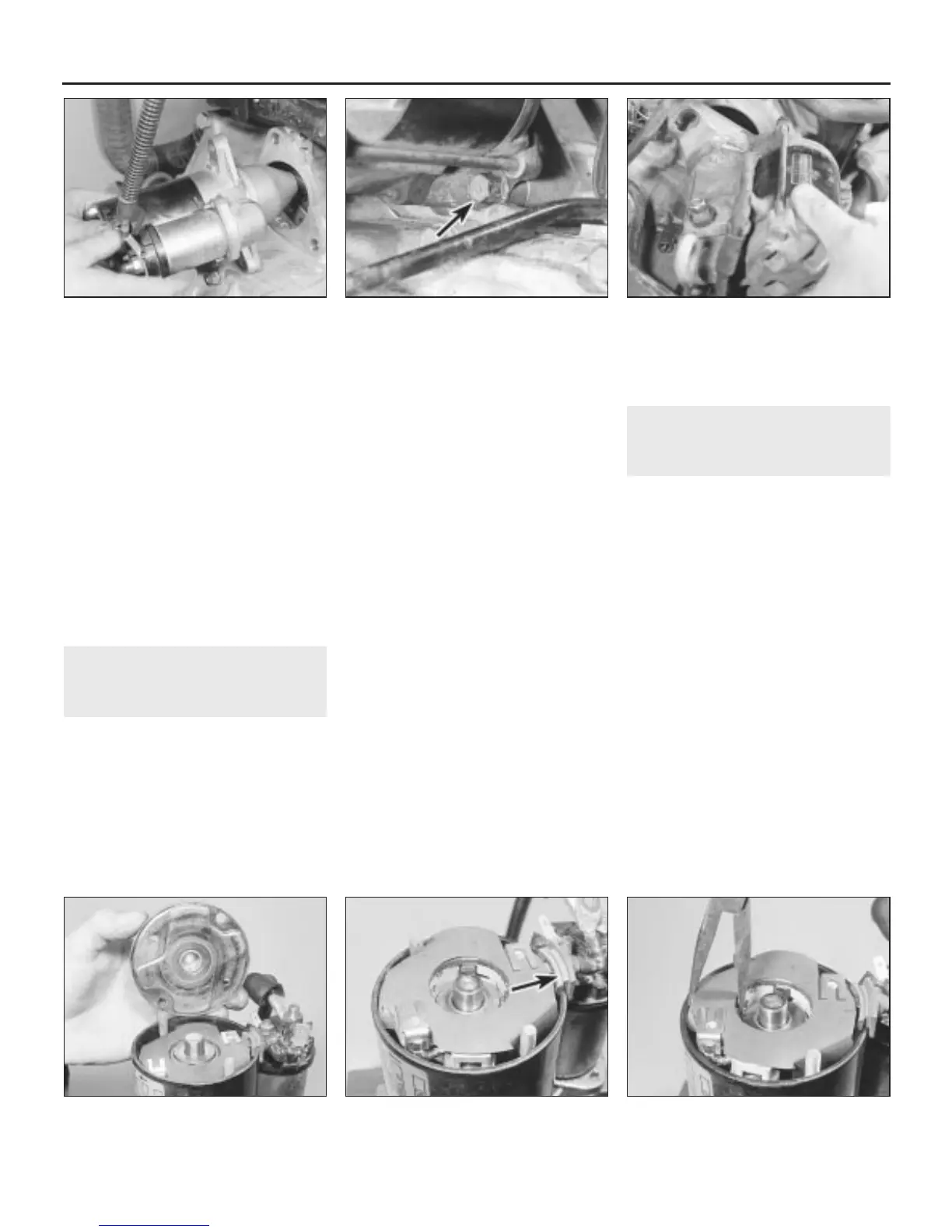
3 Disconnect the main feed cable and the
Lucar spade connector at the solenoid.
4 Support the weight of the engine/
transmission with a jack, then unscrew and
remove the starter motor retaining bolts.
Withdraw the starter motor from the
transmission (see illustration).
Refitting
5 Refitting is a reversal of removal, but tighten
the retaining bolts to the specified torque.
V6 engines
Removal
6 Disconnect the battery negative (earth) lead
(refer to Section 1 before doing this).
7 Undo the nut and remove the washer and
main feed cable from the solenoid terminal
stud.
8 Disconnect the smaller Lucar connector
from the other solenoid terminal.
9 Apply the handbrake, prise off the left-hand
front wheel trim and slacken the wheel nuts.
Jack up the front of the car and support it on
axle stands. Remove the front roadwheel.
10 Undo the three retaining bolts and remove
the access panel from under the front wing.
11 Unscrew and remove the two starter motor
retaining bolts and withdraw the starter motor
from the transmission (see illustrations).
Refitting
12 Refitting is a reversal of removal.
22 Starter motor -
brush renewal
3
M78R starter motor - 4-cylinder
engines
1 Remove the starter motor from the car as
described in Section 21.
2 Undo the nut and detach the feed wire from
the solenoid terminal stud.
3 Undo the two nuts and two screws then
withdraw the commutator end bracket from
the yoke (see illustration).
4 Release the rubber grommet from the side
of the yoke and withdraw the brush holder
assembly complete with brushes (see
illustration).
5 Remove the brush springs from the brush
holder.
6 Unclip the earth brushes from the brush
holder.
7 Remove the insulator plate and withdraw
the remaining brushes complete with their
connector lead.
8 Clean and inspect the brush assemblies. If
the brushes have worn beyond (or down to)
the specified minimum length they must be
renewed as a set.
5•12 Engine electrical systems
22.10 Using pointed-nose pliers to
compress the brushes
22.4 Release the rubber grommet
(arrowed) and remove the brush holder
22.3 Withdraw the commutator end
bracket
21.11b Removing the starter motor on
V6 engines
21.11a V6 engine starter motor lower
retaining bolt (arrowed)
21.4 Removing the starter motor on
4-cylinder engines
1380 Rover 800 Series Remake


 To Next Page
 Loading...