wrench to tighten the new plugs to the
specified torque (see illustration).
3 To remove the spark plugs, first open the
bonnet; the plugs are easily reached at the
top of the engine or on the front and rear
facing sides. Note how the spark plug (HT)
leads are routed and secured by clips, and on
some engines, how they’re positioned along
the channel in the cylinder head cover. To
prevent the possibility of mixing up spark plug
(HT) leads, it is a good idea to work on one
spark plug at a time.
4 If the marks on the original-equipment
spark plug (HT) leads cannot be seen, mark
the leads 1 to 4 (or 1 to 6), to correspond to
the cylinder the lead serves (No 1 cylinder is at
the timing belt end of the engine on 4-cylinder
engines, and at the timing belt end of the
engine on the rear bank under the brake
master cylinder on V6 engines).
5 On 4-cylinder engines, undo the bolts
securing the spark plug cover to the centre of
the cylinder head, noting the accelerator cable
support bracket on early engines. Lift off the
cover and again, on early engines, release the
HT lead grommet from the end of the cover.
6 On all engines, pull the leads from the plugs
by gripping the rubber boot, not the lead,
otherwise the lead connection may be
fractured.
7 Unscrew the spark plugs, ensuring that the
socket is kept in alignment with each plug - if
the socket is forcibly moved to either side, the
porcelain top of the plug may be broken off. If
any undue difficulty is encountered when
unscrewing any of the spark plugs, carefully
check the cylinder head threads and tapered
sealing surfaces for signs of wear, excessive
corrosion or damage; if any of these
conditions is found, seek the advice of a
dealer as to the best method of repair.
8 As each plug is removed, examine it as
follows - this will give a good indication of the
condition of the engine. If the insulator nose of
the spark plug is clean and white, with no
deposits, this is indicative of a weak mixture.
9 If the tip and insulator nose are covered
with hard black-looking deposits, then this is
indicative that the mixture is too rich. Should
the plug be black and oily, then it is likely that
the engine is fairly worn, as well as the mixture
being too rich.
10 If the insulator nose is covered with light
tan to greyish-brown deposits, then the
mixture is correct, and it is likely that the
engine is in good condition.
11 If you are renewing the spark plugs,
purchase the new plugs, then check each of
them first for faults such as cracked insulators
or damaged threads. Note also that,
whenever the spark plugs are renewed as a
routine service operation, the spark plug (HT)
leads should be checked as described below.
12 The spark plug electrode gap is of
considerable importance as, if it is too large or
too small, the size of the spark and its efficiency
will be seriously impaired. The gap should be
set to the value given in the Specifications
Section of this Chapter. New plugs will not
necessarily be set to the correct gap, so they
should always be checked before fitting.
13 Special spark plug electrode gap
adjusting tools are available from most motor
accessory shops.
14 To set the electrode gap, measure the gap
with a feeler gauge or adjusting tool, and then
bend open, or closed, the outer plug electrode
until the correct gap is achieved (see
illustrations). The centre electrode should
never be bent, as this may crack the insulation
and cause plug failure, if nothing worse. If the
outer electrode is not exactly over the centre
electrode, bend it gently to align them.
15 Before fitting the spark plugs, check that
the threaded connector
sleeves at the top of the plugs are tight, and
that the plug exterior surfaces and threads are
clean. Brown staining on the porcelain,
immediately above the metal body, is quite
normal, and does not necessarily indicate a
leak between the body and insulator.
16 On installing the spark plugs, first check
that the cylinder head thread and sealing
surface are as clean as possible; use a clean
rag wrapped around a paintbrush to wipe
clean the sealing surface. Apply a smear of
copper-based grease or anti-seize compound
to the threads of each plug, and screw them
in by hand where possible.
17 When each spark plug is started correctly
on its threads, screw it down until it just seats
lightly, then tighten it to the specified torque
wrench setting.
18 Reconnect the spark plug (HT) leads in
their correct order, using a twisting motion on
the boot until it is firmly seated. On 4-cylinder
engines, refit the spark cover.
Spark plug (HT) lead and
distributor cap check
19 The spark plug (HT) leads should be
inspected one at a time, to prevent mixing up
1•14 Every 12 000 miles
11.14c . . . then use the end of the special
tool to adjust the gap
11.14b . . . or adjusting tool . . .11.14a Measure the spark plug gap with a
feeler gauge . . .
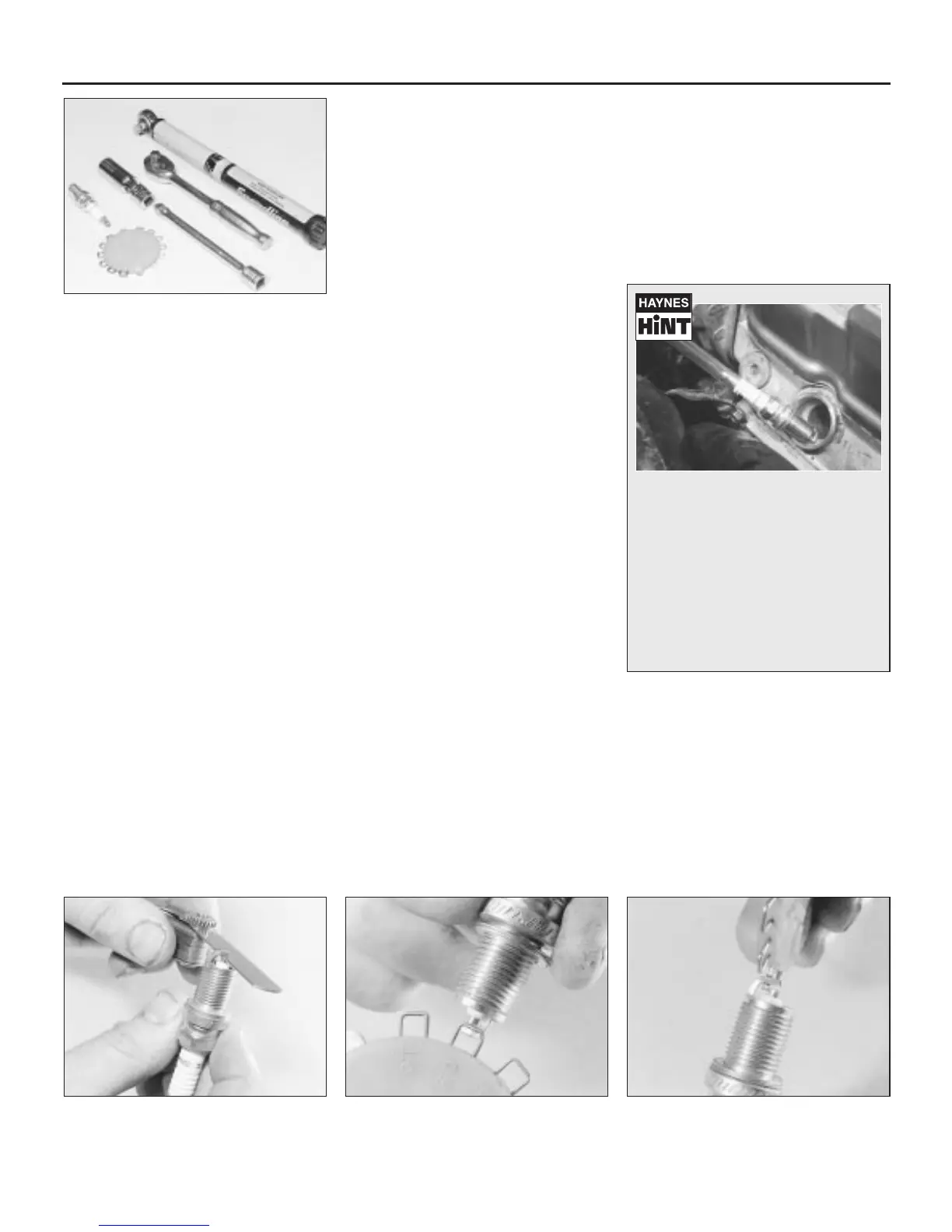
11.2 Tools required for spark plug
removal, gap adjustment and refitting
1380 Rover 800 Series Remake
Take extra care to enter the plug
threads correctly, as the cylinder head
is of aluminium alloy - it’s often difficult
to insert spark plugs into their holes
without cross-threading them. To avoid
this possibility, fit a short piece of hose
over the end of the spark plug. The
flexible hose acts as a universal joint,
to help align the plug with the plug
hole. Should the plug begin to cross-
thread, the hose will slip on the spark
plug, preventing thread damage.


 To Next Page
 Loading...