15 If any of the cylinder bores are badly
scuffed or scored, or if they are excessively-
worn, out-of-round or tapered, the usual
course of action would be to have the cylinder
block/crankcase rebored, and to fit new,
oversized, pistons on reassembly. See a
dealer or engine reconditioning specialist for
advice.
16 If the bores are in reasonably good
condition and not excessively-worn, then it
may only be necessary to renew the piston
rings.
17 If this is the case, the bores should be
honed, to allow the new rings to bed in
correctly and provide the best possible seal.
Honing is an operation that will be carried out
for you by an engine reconditioning specialist.
18 After all machining operations are
completed, the entire block/crankcase must
be washed very thoroughly with warm soapy
water to remove all traces of abrasive grit
produced during the machining operations.
When the cylinder block/crankcase is
completely clean, rinse it thoroughly and dry
it, then lightly oil all exposed machined
surfaces, to prevent rusting.
19 The cylinder block/crankcase should now
be completely clean and dry, with all
components checked for wear or damage,
and repaired or overhauled as necessary.
Refit as many ancillary components as
possible, for safekeeping. If reassembly is not
to start immediately, cover the block with a
large plastic bag to keep it clean, and protect
the machined surfaces as described above to
prevent rusting.
16 Piston/connecting rod
assemblies - inspection
4
Note: Always check first what replacement
parts are available before planning any
overhaul operation. A Rover dealer, or a good
engine reconditioning specialist/automotive
parts supplier may be able to suggest
alternatives which will enable you to overcome
the lack of replacement parts.
1 Before the inspection process can be
carried out, the piston/connecting rod
assemblies must be cleaned, and the original
piston rings removed from the pistons. The
rings should have smooth, polished working
surfaces, with no dull or carbon-coated
sections (showing that the ring is not sealing
correctly against the bore wall, so allowing
combustion gases to blow by) and no traces
of wear on their top and bottom surfaces. The
end gaps should be clear of carbon, but not
polished (indicating a too-small end gap), and
all the rings (including the elements of the oil
control ring) should be free to rotate in their
grooves, but without excessive up-and-down
movement. If the rings appear to be in good
condition, they are probably fit for further use;
check the end gaps (in an unworn part of the
bore). If any of the rings appears to be worn or
damaged, or has an end gap significantly
different from the specified value, the usual
course of action is to renew all of them as a
set. Note: While it is usual always to renew
piston rings when an engine is overhauled,
this of course assumes that rings are available
separately - if not, it follows that great care
must be taken not to break or damage any of
the rings during the following procedures, and
to ensure that each ring is marked on removal
so that it is refitted only the original way up,
and only to the same groove.
2 Using a piston ring installation tool,
carefully remove the rings from the pistons. If
such a tool is not available, the rings can be
removed by hand, expanding them over the
top of the pistons. The use of two or three old
feeler blades will be helpful in preventing the
rings dropping into empty grooves. Be careful
not to nick or gouge the pistons in the
process, and mark or label each ring as it is
removed, so that its original top surface can
be identified on reassembly, and that it can be
returned to its original groove.
3 Scrape all traces of carbon from the top of
the piston. A hand-held wire brush or a piece
of fine emery cloth can be used, once the
majority of the deposits have been scraped
away. Do not, under any circumstances, use a
wire brush mounted in a drill motor to remove
deposits from the pistons - the piston material
is soft, and may be eroded away by the wire
brush.
4 Use a piston ring groove-cleaning tool to
remove carbon deposits from the ring
grooves. If a tool isn’t available, but
replacement rings have been found, a piece
broken off the old ring will do the job. Be very
careful to remove only the carbon deposits -
don’t remove any metal, and do not nick or
scratch the sides of the ring grooves. Protect
your fingers - piston rings are sharp!
5 Once the deposits have been removed,
clean the piston/rod assemblies with solvent,
and dry them with compressed air (if
available). Make sure the oil return holes in the
back sides of the ring grooves, and the oil
hole in the lower end of each rod, are clear.
6 If the pistons and cylinder walls aren’t
damaged or worn excessively, and if the
cylinder block/crankcase is not rebored, new
pistons won’t be necessary. Normal piston
wear appears as even vertical wear on the
piston thrust surfaces, and slight looseness of
the top ring in its groove.
7 Carefully inspect each piston for cracks
around the skirt, at the pin bosses, and at the
ring lands (between the ring grooves).
8 Look for scoring and scuffing on the thrust
faces of the skirt, holes in the piston crown,
and burned areas at the edge of the crown. If
the skirt is scored or scuffed, the engine may
have been suffering from overheating and/or
abnormal combustion, which caused
excessively-high operating temperatures. The
cooling and lubrication systems should be
checked thoroughly. A hole in the piston
crown is an indication that abnormal
combustion (pre-ignition) was occurring.
Burned areas at the edge of the piston crown
are usually evidence of spark knock
(detonation). If any of the above problems
exist, the causes must be corrected, or the
damage will occur again. The causes may
include intake air leaks, incorrect fuel/air
mixture or incorrect ignition timing.
9 Corrosion of the piston, in the form of small
pits, indicates that coolant is leaking into the
combustion chamber and/or the crankcase.
Again, the cause must be corrected, or the
problem may persist in the rebuilt engine.
10 Check the piston-to-rod clearance by
twisting the piston and rod in opposite
directions. Any noticeable play indicates
excessive wear, which must be corrected. On
4-cylinder “T”-series engines and V6 engines,
the piston/connecting rod assemblies should
be taken to a Rover dealer or engine
reconditioning specialist to have the pistons,
gudgeon pins and rods checked, and new
components fitted as required.
11 On these engines, don’t attempt to
separate the pistons from the connecting rods
(even if non-genuine replacements are found
elsewhere). This is a task for a Rover dealer or
similar engine reconditioning specialist, due to
the special heating equipment, press,
mandrels and supports required to do the job.
If the piston/connecting rod assemblies do
require this sort of work, have the connecting
rods checked for bend and twist, since only
such engine repair specialists will have the
facilities for this purpose.
12 On 4-cylinder “M” series engines, the
gudgeon pins are retained by circlips and the
pistons and connecting rods can be
separated.
13 To remove the pistons from the
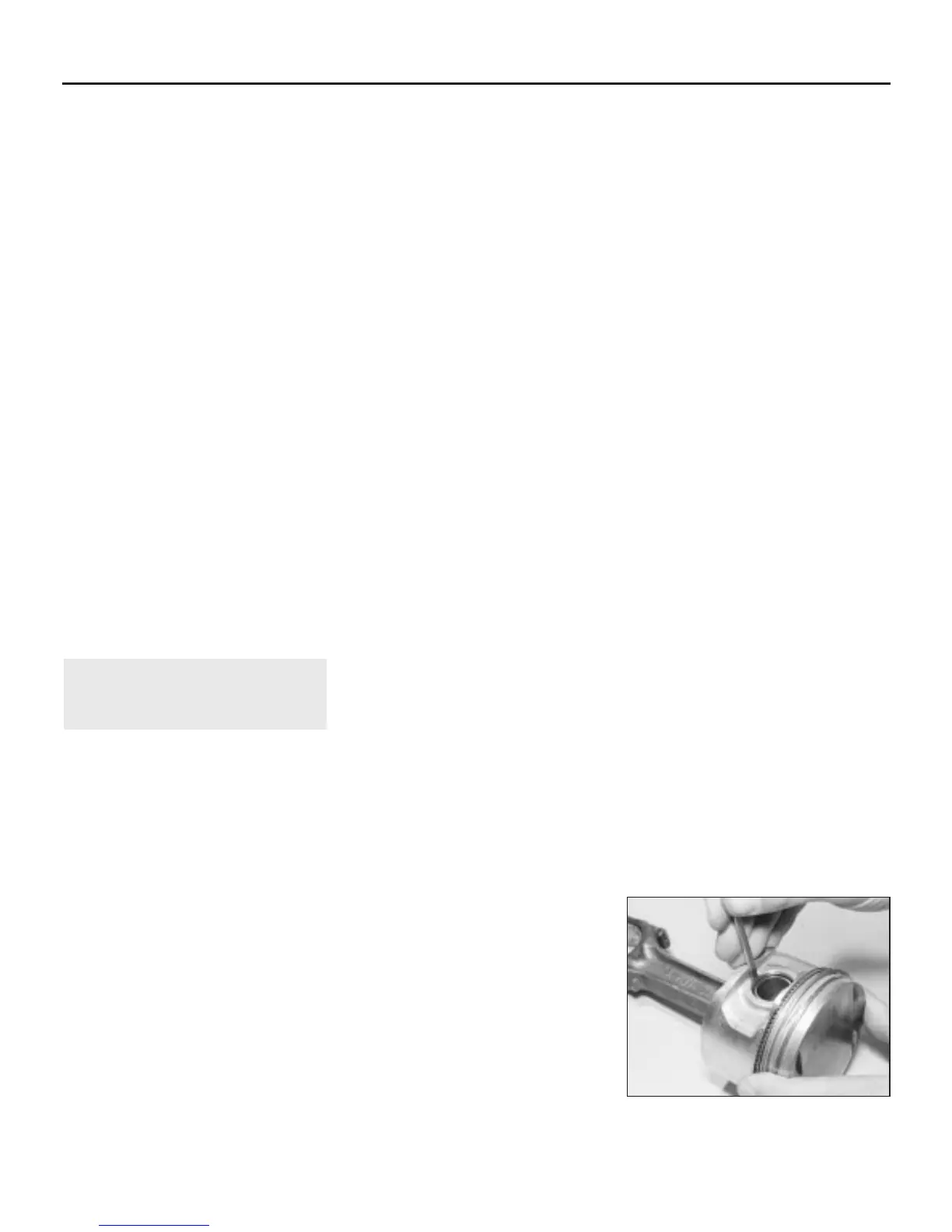
connecting rods, extract the two gudgeon pin
retaining circlips, using a small screwdriver,
then push out the gudgeon pin (see
illustration). If the pin is tight, warm the
piston in hot water, which will expand the
piston slightly, enabling the gudgeon pin to be
pushed out. As each piston is removed, mark
it on the inside with a punch, indicating its
cylinder number.
14 Check the connecting rods for cracks and
other damage. Also on 4-cylinder engines,
check that the oilway in the base of the
2C•14 Engine removal and general engine overhaul procedures
16.13 Using a small screwdriver to extract
the gudgeon pin circlip
1380 Rover 800 Series Remake


 To Next Page
 Loading...