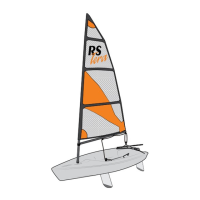
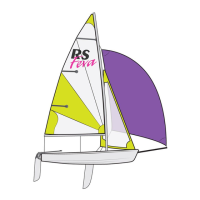
The secret to getting the best out of the RS100 rigs is to understand the
versatility and being practiced at “changing gear”.
2. Control set-up:
1. Main halliard: It is absolutely essential to ensure the sail is hoisted fully and stays
there: Tie the halliard to the sail with a “knot on a Knot” as per the manual, and pull it
really hard before ensuring it is located firmly in the cleat.
2. The mainsheet bridle: Holding it vertically, 400mm, also vertically, from top of
rudder turret to apex of bridle: the bridle is just fwd of the rudder turret, so sight in
line from tape measure to apex of bridle. The other way is to pull the bridle fwd on
the centreline of the boat and apex of bridle (not the block) should come to 60mm aft
of the non-slip edge: then the knots should be positioned 430mm from the point at
which the bridle goes through the transom flange.
Another check here is that the bridle block should align with the cockpit floor/sidetank
corner when in use and lying against the knot.
Conceptually the bridle has to be flat enough for the block to travel out to the
knots all the time, thus giving you a consistent inner most sheeting angle.
Much narrower and the rig will feel stalled, and wider and you will struggle for
height in the light –medium windstrengths
3. Cunningham: This should be rigged for maximum travel: When the sail is fully
hoisted the cunningham block should be adjacent to (even slight pulled into!) the
cringle. When maxed-out (certainly on 10.2) it will still be right down to the boom.
4. Gnav/Kicker: Again rigged for maximum travel: Set up the lines so the blocks are
up by the roller when the sail still has 6-9 inches to hoist: Thus the final hoist will
slightly bend the mast – that is fine as you will use more mast bend than this even in



 To Next Page