2.3 Stepping the Mast
Before you step the mast, check that the main halyard and gennaker halyard ends
are near the base of the mast. Also, check that the bottom of the mast well is free
from any debris and sand that will cause premature wear of the mast well. Likewise
ensure the mast base plug is free from sand and grit, and taped in place.
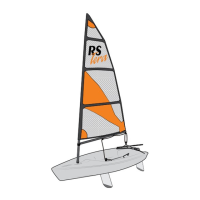
The RS100 mast only requires one person to step it. However, if you are stepping it
for the first time, or if it is windy, it would be wise to have another person with you in
case of any difficulty.
1. Stand the mast upright beside the boat. Remember to keep the base plug
clean
2. Lift the mast up and pass the base of the mast through the hole in the mast
gate organiser.
3. Pass the mast down, until it reaches the bottom of the mast well. Take care to
avoid all lines and shockcord as it passes the gennaker sock, and ensure the
recess in the base plug sits securely over the steel peg at the bottom of the
mast well. The mast will now stand up on its own.
4. Wind the mast gate to the furthest aft position. This will ease the pinning of
the shrouds – usually around hole 2 or 3 – but as far down as you can easily
get without help. Now as you wind the mast gate back to a central position,
you will find the shrouds are gently tensioned.
HINT
A central position for the mast gate is a good starting point, but further aft (more
mast rake) helps in the breeze and further forward (less mast rake or more upright)
helps in the light winds. It is worth remembering that more mast rake will mean
less room under the boom when tacking and gybing!
Useful tip:
Your mast will come with a band of very light stainless steel or some high-
resistance ware tape at deck level – this is advisable to stop ware on the mast at
the deck collar. The tape is easily replaceable and also helps to reduce any “slop”
in the mast gate. Useful to make sure you have a couple of lengths in the toolbox!!



 To Next Page