2
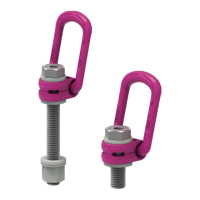
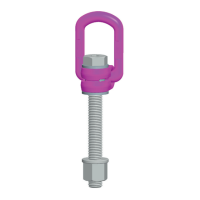
VLBG
Please read user instruction before in-
itial operation of the bolt-on lifting point
VLBG. Make sure that you have com-
prehend all subjected matters.
Non observance can lead to serious per-
sonal injuries and material damage and
eliminates warranty.
1 Safety instructions
ATTENTION
Wrong assembled or damaged VLBG as
well as improper use can lead to injuries
of persons and damage of objects when
load drops.
Please inspect all VLBG before each use.
• Remove all body parts (fingers, hands, arms,
etc.) out of the hazard area (danger of crushing or
squeezing) during the lifting process.
• The VLBG must be used only by authorised and
trained people in adherence to BGR/DGUV regu-
lations 100-500, Chapter 2.8 and, outside Germa-
ny, when observing the relevant specic national
regulations.
• The VLBG must be used only by authorised and
trained people in adherence to BGR/DGUV regu-
lations 100-500, Chapter 2.8 and, outside Germa-
ny, when observing the relevant specic national
regulations.
• Do not exceed the working load limit (WLL) indi-
cated on the lifting point.
• VLBG must be rotatable in the screwed tight status
through 360 °.
• No technical alterations must be implemented on
the VLBG.
• No people may stay in the danger zone.
• Jerky lifting (strong impacts) should be prevented.
• Always ensure a stable position of the load when
lifting. Swinging must be prevented.
• Damaged or worn VLBG must never be utilised.
2 Intended use
VLBGs must only be used for the assembly of the
load or at load accepting means
Their usage is intended to be used as lifting means.
The VLBGs can also be used as lashing points for
the xture of lashing means.
The VLBGs must only be used in the here described
usage purpose.
3 Assembly- and instruction manual
3.1 General information
• Effects of temperature:
Due to the DIN/EN bolts that are used in the VLBG,
the working load limit must be reduced accordingly:
-40°C to 100°C --> no reduction (-40°F to 212°F)
100°C to 200°C minus 15 % (212°F to 392°F)
200°C to 250°C minus 20 % (392°F to 482°F)
250°C to 350°C minus 25 % (482°F to 662°F)
Temperatures above 350°C (662°F) are not
permitted.
Please observe the maximum usage tempe-
rature of the supplied nuts (optionally):
• Clamping nuts according to DIN EN ISO 7042
(DIN 980) must only be used up to +150°C at
the max (302°F).
• Collar nuts according to DIN 6331 can be used
up to +300°C. Please note also the reduction
factors (572°F).
• RUD-Lifting points must not be used under chemi-
cal inuences such as acids, alkaline solutions and
vapours e.g. in pickling baths or hot dip galvanising
plants. If this cannot avoided, please contact the
manufacturer indicating the concentration, period
of penetration and temperature of use.
• The places where the lifting points are xed should
be marked with colour.
• RUD lifting points are delivered with a 100 % crack
tested bolt (length up to lmax please see table 3).
• When using your own bolts, the bolts have to
be 100 % crack tested.
The average notch bar impact test value at the de-
epest allowed usage temperature must be at least
36 J. This is required in the test fundamentals for
lifting points GS MO 15-04 (Point 6.4.1).
HINT
The min. quality of the hexagon bolt has to
be 10.9 accord. EN 24014 (DIN 931) with
the nominal diameter.
HINT
The dismantling / assembling for the ex-
change or inspecting of the bolt may only be
executed by a competent person (compare
with Section 3.4 Dismantling / Assembling
the RUD bolt).
Versions
• VLBG lifting points are either supplied with bolts
of strength class 10.9 or with „ICE“ material bolts.
Original bolts are available as a spare part from
RUD.
• The type VLBG 7 t M36 is only delivered with
a special bolt, therefore it is not possible to
use a DIN/EN-bolt.


 To Next Page
 Loading...