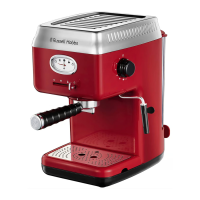
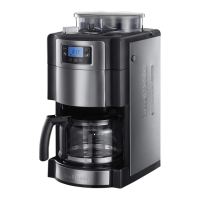
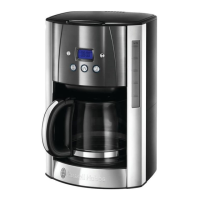
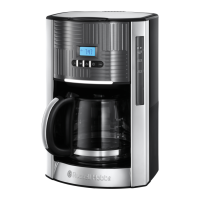
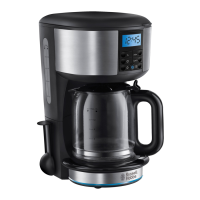
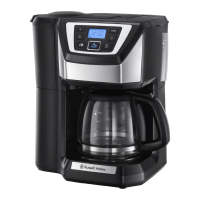
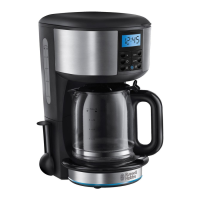
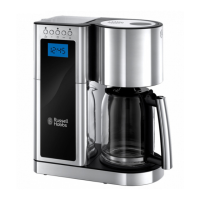
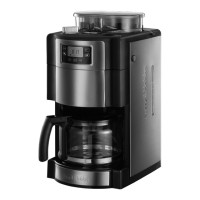
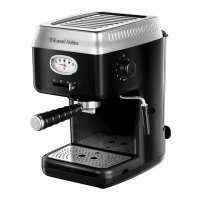
This document describes the Russell Hobbs espresso maker, model 28251, a household appliance designed for making espresso and other coffee-based drinks, as well as for steaming milk and dispensing hot water.
Function Description
The Russell Hobbs espresso maker is designed to produce single or double shots of espresso, which can be enjoyed on their own or used as a base for various coffee beverages like Latte, Cappuccino, and Americano. It features a brewing system that includes a portafilter and sieves for ground coffee or ESE pods. The machine incorporates a pre-infusion step during brewing, where a small amount of water is pumped into the filter before a pause, to ensure maximum flavor extraction.
Beyond espresso, the appliance offers steam and hot water functions. The steam function is primarily used for heating and frothing milk, allowing users to create creamy textures for cappuccinos and lattes. It can also be used to heat other cooled drinks. The hot water function provides hot water for various purposes, such as warming cups or making Americanos.
The machine includes an auto-shutoff feature, which turns off the espresso maker after 25 minutes of inactivity to conserve energy. It also has a status gauge and indicator lights to show the current operational status, such as heating up, ready for brewing, or ready for steaming. A descaling indicator light alerts users when maintenance is required.
Usage Features
Preparation and Filling:
Before first use, or after a long period of inactivity, the portafilter, sieves, and measure/tamper should be washed in warm soapy water. The appliance itself should be run through a cleaning cycle without coffee, following the brewing instructions. The water tank, located at the back of the unit, is removable for easy filling. It should be filled with cold, fresh water up to the "max" marking. The portafilter is fitted with either a 1-shot (smaller) sieve for single espressos or ESE pods, or a 2-shot (larger) sieve for double espressos. Ground coffee should be measured using the supplied tamper/measure (1 measure for a single shot, 2 for a double), ensuring it is level and not heaped. The coffee should then be lightly tamped into the portafilter to create resistance for proper extraction.
Brewing Espresso:
To brew, the portafilter is inserted into the machine with the handle facing left, then pushed upwards and turned right until it locks into place. Cups are placed on the drip tray beneath the portafilter outlet. The steam control must be in the off position. The unit is switched on, and the status gauge will indicate when it has preheated and is ready. The control is then moved to the brew position. The machine will perform a pre-infusion, then dispense coffee. Users must manually stop the brewing process by returning the control to the on or off position once the desired volume (typically 30ml for a single, 60ml for a double) is reached. The portafilter and its contents will be hot after brewing, requiring careful handling.
Steaming and Frothing Milk:
For steaming milk, the control is moved to the steam position. Once the unit heats up and the gauge indicates readiness, a small jug filled with milk is held under the steam nozzle, with the nozzle submerged. Turning the steam/hot water control counterclockwise releases steam, with more steam produced as it's turned further. For frothing, the nozzle can be held just under the surface for large bubbles or fully submerged for microfoam, while making circular motions with the jug. Once satisfied, the control is turned clockwise to the off position. The steam nozzle should be cleaned immediately after each use.
Hot Water Dispensing:
To dispense hot water, the control is moved to the on position. After heating, a suitable container is placed under the steam nozzle. The steam/hot water control is turned fully counterclockwise to release hot water for up to 90 seconds, then turned clockwise to the off position.
Tips for Use:
The cup warming plate on top of the unit can be used to gently warm espresso cups. To achieve a hotter espresso, the portafilter can be pre-warmed by running a brewing cycle with the sieve fitted but no coffee, then removing and using it as normal. After using the steam function multiple times, the machine may become too hot to brew immediately; the hot water function can be used to speed up cooling.
Maintenance Features
Cleaning:
Regular cleaning is essential for maintaining the appliance. After use, the unit should be unplugged and allowed to cool. Exterior surfaces and the steam nozzle should be wiped with a damp cloth and dried. The steam nozzle tip can be pulled downwards for separate washing. The portafilter and sieve should be removed, emptied of coffee grounds, washed under running water, and dried. The area where the portafilter fits on the machine should also be wiped. The drip tray should be emptied when full or after each use. A cleaning tool is provided to unblock openings in the portafilter. The steam nozzle, sieves, drip tray, and drip tray cover are dishwasher-safe.
Cleaning the Steam Nozzle:
Immediately after each use, the steam nozzle and swivel arm should be cleaned. This involves immersing the nozzle in a cup of clean water, turning the steam/hot water control counterclockwise to let steam escape into the water for several seconds, and repeating if necessary. Finally, the nozzle should be carefully removed and wiped with a clean damp cloth before being replaced.
Descaling:
The espresso maker will indicate when descaling is needed (approximately every 500 cycles) by illuminating a red light. It is crucial to use a descaling product specifically recommended for appliances with plastic parts, avoiding mineral acid-based descalers like sulphuric acid, hydrochloric acid, sulphamic acid, or acetic acid (vinegar), as these can damage the machine. The descaling process involves pouring fresh water and the specified amount of decalcifier into the water tank, then repeatedly running the brewing and hot water processes until the tank is empty. After descaling, the product should be rinsed several times by brewing water without coffee to remove any residue. To reset the descaling light, the unit is turned on, and the steam/hot water control is rotated counterclockwise and back to the off position twice within 5 seconds while the unit is preheating. Regular descaling is important, with frequency depending on water hardness and usage.


 To Next Page
 General