
 Need help?
Do you have a question about the Russell Hobbs RH50FF145 and is the answer not in the manual?
Essential safety guidelines for operating the appliance, including electrical hazards, ventilation, and proper usage.
Steps to prepare the appliance before initial power-up, including cleaning and positioning the distance guide.
Information on checking all parts are present and how to contact customer service for missing items or spares.
Guidance on setting the correct temperature for the fridge and freezer compartments based on ambient conditions.
Details on activating and using the Super Freeze mode for rapid cooling of fresh food.
Tips for storing frozen food, including packaging, contact with other foods, and maximum storage times.
Guide for cleaning the refrigerator and freezer cavity and accessories using specific solutions.
Instructions for washing the outer cabinet and cleaning the rear of the appliance.
Steps to take when the appliance will be unused for extended periods to prevent damage and odours.
Identifies causes of unpleasant smells and how to resolve them, including checking food and drainage.
Explains potential reasons why doors may not close correctly and how to fix them.
Describes common sounds like bubbling, gurgling, or compressor noise and their normality.
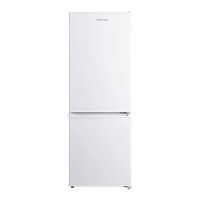
This document is an instruction manual for a 50cm Wide Low Frost Fridge Freezer manufactured by Russell Hobbs. It provides comprehensive guidance on the installation, operation, maintenance, and troubleshooting of the appliance.
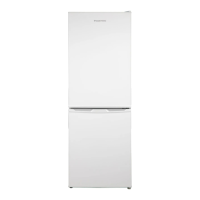
The Russell Hobbs 50cm Wide Low Frost Fridge Freezer is a household appliance designed for storing fresh and frozen food items. It features a fridge compartment and a freezer compartment, each with specific temperature ranges suitable for different types of food. The "Low Frost" designation indicates that it is designed to minimize frost build-up in the freezer, reducing the frequency of manual defrosting. The appliance utilizes natural refrigerant gas (R600a Isobutene) as part of its cooling system, which is environmentally friendly.
The fridge freezer is controlled by a temperature control dial, or thermostat, located inside the fridge compartment. This dial allows users to regulate the internal temperature, with settings ranging from 1 (warmest) to 5 (coldest). For most UK homes, a setting of 4 is recommended under normal conditions. The temperature setting may need adjustment based on the ambient room temperature; a colder setting (between 4 and 5) might be necessary in high ambient temperatures (summer), while a warmer setting (around 3) could be suitable in low ambient temperatures (winter).
A "Super Freeze" switch is available to activate a rapid freezing mode. This feature should be turned on 24 hours before placing fresh food in the freezer to maximize freezing capacity. To save energy, it is recommended to turn off the Super Freeze switch 24 hours after the fresh food has been placed in the freezer.
The standard operating temperature for the fridge compartment is between 0°C and 4°C, and for the freezer compartment, it is between -18°C and -25°C. The temperature of freshly stored food and the frequency of door openings can affect the internal temperature, necessitating adjustments to the thermostat setting.
The appliance is designed for adult use, and children should not be allowed to play with it or hang on the door. It is suitable for use in various domestic and similar applications, including staff kitchen areas, farmhouses, hotels, motels, bed and breakfast establishments, and catering services.
The manual also provides detailed instructions for door reversal, allowing users to change the opening direction of both the fridge and freezer doors to suit their kitchen layout. This process requires tilting the appliance backward by no more than 45 degrees and involves removing and reattaching hinges and door stoppers. A cross-headed screwdriver and a flat-headed screwdriver are required for this task.
Food storage guidelines are provided to help users properly store different types of food in the refrigerator and freezer compartments. For instance, raw meat, poultry, and fish should be stored on the bottom shelf of the fridge, while dairy products and eggs are suitable for the middle shelf. The crisper drawer is designated for fruits, herbs, and vegetables, with specific advice against storing bananas, onions, potatoes, and garlic in the refrigerator. Freezer storage advice includes using airtight containers or wraps, placing pre-frozen food quickly, and processing fresh vegetables and fruits to prevent frost damage. Suggested maximum storage times at -18°C for various frozen foods are also listed.
Maintenance and cleaning instructions are crucial for the longevity and efficient operation of the appliance. Before any cleaning, the appliance must be disconnected from the power supply.
Internal Cleaning: The interior cavity should be cleaned periodically with a solution of bicarbonate of soda and lukewarm water (5ml to 0.5 litre of water), using a damp cloth. Accessories should be cleaned separately with soap and water and should not be placed in a dishwasher. Abrasive products, detergents, or soaps should not be used. After washing, the interior should be rinsed with clean water and dried carefully. The plug should only be reconnected with dry hands.
External Cleaning: The outer cabinet can be washed with warm soapy water, avoiding abrasive products. Care should be taken when cleaning the underside of the product due to sharp edges. The rear of the appliance and the compressor should be dusted once or twice a year with a brush or vacuum cleaner to prevent dust accumulation, which can affect performance and increase energy consumption.
Defrosting: Although the appliance is "Low Frost," if defrosting is needed, users should consume as much food as possible from the freezer beforehand. Any remaining food should be wrapped in newspaper and set aside. The appliance must be switched off and unplugged, and the freezer door opened. A container should be placed to collect defrosted water. The vaporisation container at the rear of the appliance (above the compressor) should be removed and cleaned with soapy water at regular intervals to prevent odors. After defrosting, the interior should be cleaned and dried before switching the appliance back on and returning frozen food. The manual explicitly warns against using sharp metal tools or electrical heaters to accelerate defrosting, as this can damage the appliance or cause electric shock.
Replacing the Light: The appliance uses an energy-efficient, long-life LED light. If replacement is ever needed, it must be carried out by a qualified engineer. Customer service should be contacted for assistance.
Energy Saving Advice: To optimize energy consumption, users are advised to:
Power Failure: In case of a power failure, the freezer door should be kept closed. If the freezer temperature rises, the condition of frozen food should be checked before refreezing. Specific guidance is given for various food types, such as discarding thawed ice cream, cooking soft fruits and vegetables, and quickly refrigerating shellfish and cooked dishes.
Troubleshooting: A troubleshooting section helps users diagnose and resolve common issues, such as the appliance not working, insufficient cooling, excessive cooling, or unusual noises. Solutions range from checking power connections and thermostat settings to ensuring proper food placement and door closure. Condensation issues are also addressed, advising users to dry internal and external surfaces carefully. Normal operational noises, like bubbling and gurgling sounds from the coolant fluid or water flowing during defrosting, are explained as typical.
 General
| Child lock | No |
|---|---|
| Door hinge | Right |
| Control type | - |
| Product color | White |
| Housing material | Metal, Plastic |
| Reversible doors | Yes |
| Shelves material | Glass |
| Appliance placement | Freestanding |
| EAN | 5056233802466 |
| Net weight | 40000 g |
| Gross weight | 42500 g |
| Overall height | 1450 mm |
| Total capacity | 173 L |
| Control position | Internal |
| Country of origin | Turkey |
| Number of drawers | 3 drawer(s) |
| Star rating | 4* |
| Freezer position | Bottom-placed |
| Freezing capacity | 3.2 kg/24h |
| Freezer net capacity | 61 L |
| Storage time during power failure | 11 h |
| Noise level | 39 dB |
| Climate class | N |
| Minimum operating temperature | 16 °C |
| Cord length | 2 m |
| Power source | Electric |
| Power plug type | Type G |
| AC input voltage | 220-240 V |
| AC input frequency | 50 Hz |
| Energy efficiency scale | A+ to G |
| Annual energy consumption | 245 kWh |
| Lamp type | LED |
| Fridge net capacity | 113 L |
| Number of vegetable drawers | 1 |
| Package depth | 590 mm |
| Package width | 540 mm |
| Package height | 1520 mm |
| Package weight | Weight of the packaged product in gram. |
| Quantity per pack | 1 pc(s) |
| Commodity Classification Automated Tracking System (CCATS) | 8418108091 |
 Weight and Dimensions
| Depth | 560 mm |
|---|---|
| Width | 497 mm |

 To Next Page