
 Need help?
Do you have a question about the Russell Hobbs RHTTLF1B and is the answer not in the manual?
Essential safety guidelines for using the refrigerator safely.
Proper steps for setting up and powering on the refrigerator.
Overview of the refrigerator's parts and internal compartments.
Guidance on operating the refrigerator and its features.
How to adjust the refrigerator's internal temperature for optimal cooling.
Procedures for keeping the refrigerator clean and well-maintained.
Technical details and dimensions of the refrigerator.
Instructions for safely connecting the refrigerator to the electrical power supply.
Guidelines for safely moving and transporting the refrigerator.
Advice on choosing the optimal location for the refrigerator.
Steps to change the direction the refrigerator door opens.
Solutions for common problems encountered with the refrigerator.
Information regarding the product's warranty period and conditions.
Identification of the various components of the kettle.
Initial preparation steps before the first use of the kettle.
Instructions on how to properly fill the kettle with water.
Steps for operating the kettle to heat water.
How to turn off the kettle manually or when boiling is complete.
Guidance on what happens and how to handle low water levels.
Procedures for cleaning and maintaining the kettle.
Information on responsible disposal of electrical products.
How to contact customer service for support or repairs.
Details on the product's warranty and coverage.
This document contains user manuals for two distinct Russell Hobbs products: a refrigerator and a kettle.
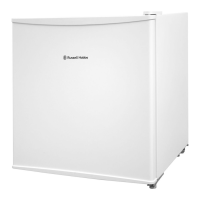
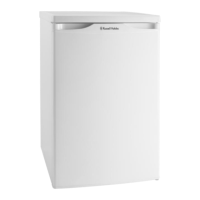
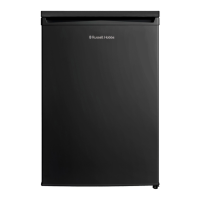
This appliance is a freestanding table top larder fridge designed for domestic use. It functions to keep food fresh by maintaining a cool internal temperature. The fridge uses R600a (Isobutene) as a natural refrigerant gas, which is environmentally friendly but combustible, requiring careful handling during transport and installation to avoid damaging refrigeration circuit components. In case of damage, it's crucial to avoid naked flames or ignition sources and to ventilate the room.
The refrigerator's internal temperature is automatically regulated by a thermostat. Users can adjust the temperature by rotating a knob from position "1" (lowest cooling) to "6" (highest cooling). The "OFF" position indicates the thermostat is closed and no cooling is active. For short-term food storage, the knob can be set between minimum and medium positions (1-4), while for long-term storage, a medium position (4-6) is recommended. It's important to note that ambient temperature, the temperature of freshly stored food, and the frequency of door openings can affect the internal temperature, so adjustments may be necessary. When first switched on, the appliance should operate continuously for 24 hours to reach a sufficient cooling temperature, during which frequent door openings or placing large amounts of food inside should be avoided. If the unit is switched off or unplugged, a minimum 5-minute waiting period is required before restarting to prevent compressor damage. The fridge is designed to operate within specific ambient temperature intervals based on its climate class, and operating outside these limits may affect cooling effectiveness.
The appliance should be placed on a flat, firm surface, ideally indoors, and not exposed to direct sunlight or rain. It should be positioned at least 500 mm away from heat sources like stoves or ovens. If placed next to other freezers or refrigerators, a minimum 50 mm gap is recommended to prevent humidity on the outer surface. A 300 mm clear space above the appliance is needed for proper ventilation, and 50 mm clearance is advised when placed next to kitchen cabinets. The rear of the appliance should be at least 60 mm from the back wall. It should not be placed on a carpeted surface as this hinders adequate ventilation. Hot food or containers should not be placed in the fridge as this can cause damage. The appliance has an adjustable foot at the front for leveling.
The door of the fridge is reversible. To reverse the door, the top plastic hinge cover and two screws from the metal bracket need to be removed. The three plastic inserts on the opposite side of the fridge and door are then removed, and the top door bracket is fixed to this side using the previously removed screws. The plastic hinge cover is then replaced. The adjustable foot at the bottom of the fridge is removed, and the two screws holding the bottom door hinge are unscrewed and moved to the opposite side, ensuring the door is carefully supported as it will be loose. Finally, the adjustable foot is screwed into the new position on the opposite side.
Before cleaning, the appliance must be disconnected from the power supply. Water should not be poured directly over or onto the appliance. The refrigerator compartment should be cleaned periodically using a solution of bicarbonate of soda and lukewarm water. Abrasive products, detergents, or soaps should not be used. After cleaning, the surfaces should be wiped down with a damp, clean cloth. It's important to ensure hands are dry before reconnecting to the power.
The cooling gas circulating in the refrigerator circuit may produce a slight bubbling noise, which is normal. If unusual noises persist, users should check if the appliance is level and if anything is touching its rear. If problems continue, customer service should be contacted. A compressor protection function is activated after sudden power breakdowns or unplugging, allowing the gas in the cooling system to stabilize before restarting, which is normal. If the appliance is not used for a long period, it should be unplugged, cleaned, and the door left open to prevent humidity and bad odors.
This appliance is a plastic kettle designed for boiling water for household use. It features rapid boil zones for efficient heating and a water level gauge for easy monitoring.
Before first use, the kettle should be filled to its maximum capacity, boiled, the water discarded, and then rinsed. This process should be repeated twice to remove any manufacturing dust. To fill, the lid is opened, and water is added, ensuring it is at least one cup but not above the maximum mark. For specific quantities, there are 1, 2, or 3 cup marks inside the kettle. After filling, the lid is closed and pressed down to lock. To switch on, the stand is placed on a stable, level surface and plugged into a wall socket. The kettle is then placed on the stand, and the switch is moved to the "I" position. A light will illuminate, indicating the kettle has started to heat. The kettle automatically switches off when the water boils. It can also be manually switched off by moving the switch to "O" or by simply lifting the kettle off its stand. If the kettle is lifted from its stand, moisture may be observed on the stand; this is normal and is steam escaping from the automatic switch-off mechanism.
The kettle is equipped with a boil-dry cut-out feature to prevent damage if it's operated with insufficient water, which can shorten the life of the heating element. If the boil-dry cut-out is activated, the kettle must be removed from its stand to reset it and allowed to cool on a work surface.
For cleaning, the stand should be unplugged, and the kettle allowed to cool. All surfaces should be wiped with a clean, damp cloth, ensuring the connectors remain dry. To clean the filter, the lid is opened, the hook on top of the filter is pushed down, and the filter is lifted out. It should be rinsed under a running tap while brushing with a soft brush. To reinsert, the filter is lowered into the kettle, engaging the bottom hook in the spout, and then the top of the filter is pressed towards the kettle to lock the hook in place. The lid is then closed.
Regular descaling, at least monthly, is recommended using a proprietary descaler, following the instructions on the descaler package. Products returned under guarantee with faults due to scale will incur a repair charge. Russell Hobbs offers a specially formulated descaler available through customer service.
 General
| Child lock | - |
|---|---|
| Door hinge | Right |
| Product color | Black |
| Built-in display | No |
| Reversible doors | Yes |
| Market positioning | Tabletop |
| Appliance placement | Freestanding |
| Noise level | 42 dB |
| Total net capacity | 43 L |
| Number of vegetable drawers | 0 |
| Fridge number of shelves/baskets | 2 |
| Freezer position | Top-placed |
| Freezing capacity | - kg/24h |
| Freezer net capacity | - L |
| Freezer number of shelves/baskets | 1 |
| Storage time during power failure | - h |
| Connected load | - W |
| Energy efficiency scale | A to G |
| Annual energy consumption | 100 kWh |
| Country of origin | China |
| Package depth | 476 mm |
| Package width | 518 mm |
| Package height | 525 mm |
| Package volume | 129448.2 cm³ |
| Export Control Classification Number (ECCN) | 8418215190 |
 Weight and Dimensions
| Depth | 450 mm |
|---|---|
| Width | 470.2 mm |
| Height | 490.2 mm |


 To Next Page
