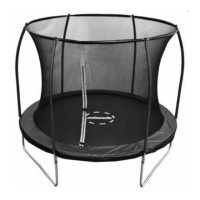
This document serves as a comprehensive manual for a Rusta trampoline, providing instructions for assembly, usage, safety, and maintenance in multiple languages (English, Swedish, Norwegian, German, and Finnish).
Function Description
The Rusta trampoline is designed for outdoor recreational use, allowing users to jump and perform various movements. It is a spring-loaded device that enables users to achieve unusual heights and positions. The trampoline is intended for domestic use and is not suitable for children under 3 years old. It is crucial to use the safety net and edge protector at all times with Rusta trampolines to ensure user safety.
Important Technical Specifications
- Product Dimensions: Ø366 cm x H90 cm
- Maximum Load: 100 kg
- User Capacity: Only one user at a time to prevent collision risk.
- Safety Net: Made of UV-resistant material.
- Clearance: A minimum of 8 meters of clear air above the mat and at least 2 meters of clear space around the trampoline are recommended for safe use.
Usage Features
The manual emphasizes controlled jumping and proper technique to minimize injury risk.
Basic Trampoline Exercises:
The manual illustrates and describes four basic trampoline exercises:
-
Standing Jump:
- Start with feet shoulder-width apart, head forward, eyes on the mat.
- Bend arms forward, upward, and in a circular motion.
- Bring feet together in the air, toes pointing down.
- Land with feet shoulder-width apart.
-
Sitting Jump:
- Land in a flat sitting position.
- Place hands on the trampoline next to hips.
- Return to standing by pushing up with hands.
-
Tummy Jump:
- Stand straight with arms stretched overhead.
- Land on tummy with hands and arms stretched forward.
- Push up from the trampoline with arms to return to standing.
-
180 Degree Twist:
- Start in the tummy jump position.
- Push up from the mat with the left or right hand (depending on desired twist direction).
- Turn head and shoulders in the same direction, keeping the back parallel to the mat and head up.
- Land on tummy again, push up with both hands and arms to return to standing.
Operating Instructions:
- Familiarize yourself with basic body positions and practice basic jumps until they can be performed in a controlled manner.
- To stop a jump, bend at the knees upon landing. This technique should always be used if balance or control is lost.
- Master basic jumps before attempting more advanced ones. A controlled jump involves starting and landing at the same point on the mat.
- Avoid jumping for too long to prevent fatigue and increased injury risk. Only one person should jump at a time.
- Climb on and off the trampoline carefully by holding the frame. Do not jump down from the trampoline.
- Maintain control by keeping eyes on the mat.
- Do not use the trampoline if tired, after eating, or under the influence of alcohol or drugs.
- Ensure the area around the trampoline is clear of objects.
- Children must always be supervised by an adult.
Maintenance Features
Regular care and maintenance are crucial for extending the trampoline's lifespan and reducing injury risk.
General Maintenance:
- Pre-use Check: Before each use, inspect the trampoline for wear, loose, or missing parts. Pay special attention to tears, cracks, holes in the mat or safety net, slackness in the net, loose seams, bent or damaged frame parts (e.g., legs), broken or missing springs, and protruding sharp edges.
- Fasteners: Check all nuts and bolts for tightness and re-tighten as needed. Ensure all spring-loaded (pit pin) joints are intact and cannot dislodge.
- Coverings: Inspect all coverings and sharp edges and replace them if necessary.
- Storage: Store the trampoline in a sheltered place or disassemble it if strong winds are expected. It can also be secured to the ground with ropes and stakes in at least three places (not just the legs). In winter, remove snow and store the mat and enclosure indoors in countries with heavy snow loads and low temperatures.
- Mat Condition: Ensure the mat is dry before use. Do not jump on a wet mat.
- Wind Conditions: Do not jump if it is windy.
Enclosure Net Maintenance:
- The safety net is a consumable item and should be replaced every two years (maximum 3 years).
- Inspection Schedule:
- 1 to 3 Months: Check the safety net (net, suspension, and straps) before each use.
- 3 to 6 Months: Carefully check the net, net suspension, and straps for UV damage before each use.
- 6 to 12 Months: Carefully check the net, suspension, straps, zippers, ties, and cords before each use. Replace after 12 months or earlier if necessary.
- UV Damage: Always check the safety net for UV damage, degradation, brittleness, cracks, and tears before each use.
- Tear Test: To check for wear, grasp a section of the netting with two fingers and pull downwards. If it tears or makes a cracking sound, the net is unsafe and must be removed immediately.
Trampoline Pad Maintenance:
- Visually inspect the entire perimeter of the trampoline pad for material deterioration, tears, looseness, loss of elasticity, or other damage.
Important Note: If any of the above issues are discovered, or anything else that could pose a risk of personal injury, the trampoline must be dismantled or put away and not used until the problem(s) have been resolved.
Assembly:
- Assembly requires at least two adults and the included spring loading tool.
- Before assembly, check all parts against the provided list and contact Rusta if any parts are missing.
- Use protective gloves during assembly to prevent crush injuries.
Warranty:
- Complaints must be submitted at the place of purchase with the original receipt. The user is responsible for damages resulting from improper use or failure to follow the manual. The right to complain will not apply in such cases.
Disposal:
- Used products should be handled separately from household waste and taken for recycling according to local waste management rules.

 Need help?
 General

 To Next Page