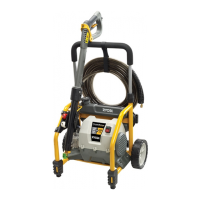
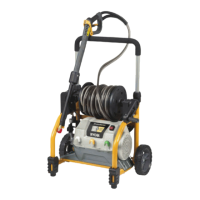
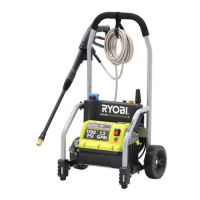
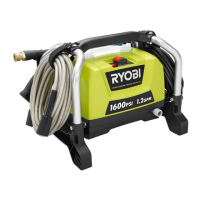
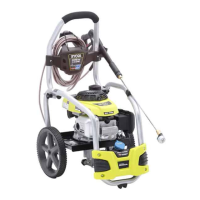
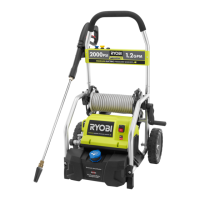
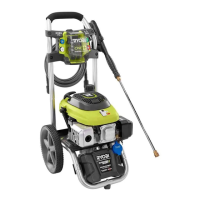
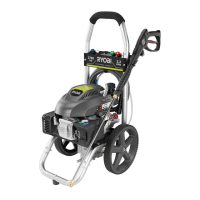
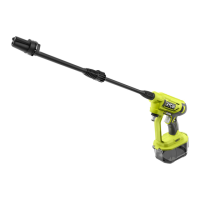
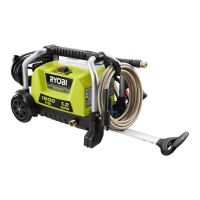
This document serves as the operator's manual for the RYOBI RPW150HS HydroSurge™ Electric Pressure Washer, providing essential information for its safe and effective use, maintenance, and troubleshooting.
The RYOBI RPW150HS is an electric pressure washer designed for domestic use, specifically for cleaning vehicles, boats, and buildings by removing stubborn dirt with clean water and chemical detergents. It is intended for operation at temperatures above 0°C. The appliance is not suitable for professional use.
Usage Features:
The pressure washer is equipped with several features to enhance its usability and performance. It includes an On/Off switch for easy control of the unit. The telescopic handle allows for convenient storage and can be extended for operation or retracted when not in use. To extend the handle, the handle release button must be depressed and held while pulling up on the handle. To retract, depress the handle release button and apply light pressure to push the handle down. Locking collars on the handle secure it in place when extended.
The gun/lance assembly is a key component, featuring two outlets: one for high-pressure spray and another for low-pressure (high flow) spray. The high-pressure trigger, when depressed, dispenses water at high pressure. A high-pressure trigger lock-out mechanism is integrated to prevent accidental use of the high-pressure trigger, enhancing safety. The HydroSurge™/detergent lever allows the user to switch between rinsing with water alone or applying a combination of water and detergent at low pressure.
For detergent application, the unit has a dedicated detergent tank. Users can remove the cap, add pressure washer-specific detergents, and then replace the cap. A detergent dial controls the dispensing of soap. The manual emphasizes using only detergents designed for pressure washers, as household detergents, acids, alkalines, bleaches, solvents, flammable materials, or industrial-grade solutions can damage the pump.
The pressure washer utilizes a Quick Connect collar for easy nozzle changes. Nozzles should only be changed when the gun's lock-out is engaged and the lance is not pointed at anyone. The manual describes connecting and disconnecting nozzles by pushing them into the collar until they click into place or by pulling back the Quick Connect collar to release them.
To operate the pressure washer, the garden hose must first be connected to the water intake coupler. It is crucial to run water through the garden hose for 30 seconds to clear debris and inspect the filter screen in the pressure washer intake for damage or dirt. The water supply must come from a water main, and hot water or water from ponds/lakes should never be used. A minimum of 3 meters of unrestricted garden hose is required between the pressure washer intake and the garden tap.
Starting the unit involves connecting the garden hose, turning on the water supply, squeezing the high-pressure trigger to release air pressure until a steady stream of water appears, and then connecting the pressure washer to the power supply and pressing the ON (1) switch. To stop, release the trigger and press the OFF (O) switch. The Total Stop System (TSS) automatically shuts off the unit when the spray gun trigger is released.
The manual outlines various cleaning methods:
- High Pressure Cleaning: Squeeze the high-pressure trigger. Detergent is not dispensed in this mode.
- Low Pressure (High Flow) Rinsing: Move the low-pressure lever forward. To dispense soap, turn the detergent dial to the ON position. To revert to water-only rinsing, turn the dial to OFF.
- Combination Cleaning/Rinsing: Move the low-pressure lever forward and depress the high-pressure trigger. To dispense detergent, turn the dial to ON; for no detergent, turn to OFF.
When cleaning, the spray nozzle should be 20-60 cm from the surface. The manual advises testing a small area first to avoid surface damage. For heavily soiled areas, a combination of high and low pressure (high flow) is recommended for constant flushing. When rinsing, the detergent dial should be turned to OFF, and the surface sprayed for approximately 10 seconds to flush any remaining detergent.
Maintenance Features:
Proper maintenance is crucial for the longevity and safe operation of the pressure washer. Before any inspection, cleaning, or servicing, the motor must be shut off, all moving parts stopped, and the plug disconnected from the power source to prevent serious personal injury or property damage.
General cleaning involves using clean cloths to remove dirt, dust, oil, and grease from plastic parts. Solvents, brake fluids, petrol, petroleum-based products, and penetrating oils should never come into contact with plastic parts, as they can cause damage and weaken the material, potentially leading to serious personal injury. Only original replacement parts from the manufacturer or approved by them should be used for servicing to avoid creating hazards or product damage.
Nozzle maintenance is addressed as excessive pump pressure or a pulsing sensation while squeezing the trigger can indicate a clogged or dirty nozzle. To clean the nozzle, the pressure washer must be unplugged, turned off, and the water supply shut off. The trigger should be pulled to release water pressure, and the nozzle removed from the lance. A straightened paper clip or nozzle cleaning tool can be used to free foreign materials, followed by flushing debris out with a garden hose. After cleaning, the nozzle is reconnected to the lance, and the water supply turned on.
For storage, the pressure washer should be kept in a dry, covered, frost-free area to prevent weather damage. It is important to empty all water from the gun, hose, and pump before storage. The use of a pump protector is recommended to prevent cold weather damage during winter storage.
The manual also provides instructions for drawing water from alternative sources like a water tank, bucket, or pond. This requires a suction hose kit, which includes a compatible hose and water filter. The suction hose connects to the water inlet, with the other end dropped into the water source. The water container must be full, and the unit turned on with the high-pressure nozzle disconnected. The trigger is pressed until a constant water stream appears, indicating the unit is ready for use.
Troubleshooting:
A troubleshooting section helps users diagnose and resolve common issues. For example, if the pressure washer doesn't start, solutions include checking the power cord connection, ensuring the switch is ON, or resetting the house circuit breaker. If the pump doesn't produce pressure, possible causes include inadequate water supply, spray lance leaks, a clogged nozzle, a faulty pump, air in the line, or a clogged water inlet filter. Solutions range from providing adequate water flow and cleaning the nozzle to contacting an authorized service center. Issues with the machine not reaching high pressure or no detergent being dispensed are also covered, with solutions like replacing the garden hose, checking for kinks/leaks, opening the water source fully, or adding detergent.
The manual emphasizes that if the power supply cord needs replacement, it must be done by an authorized service center to avoid safety hazards.



 To Next Page
 General