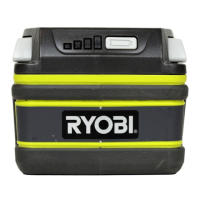
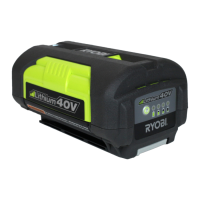
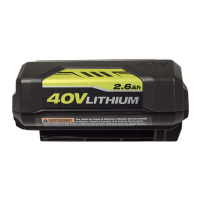
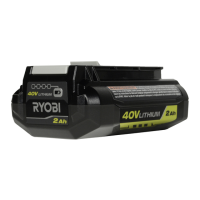
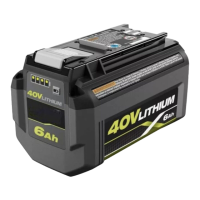
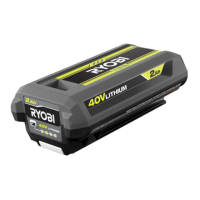
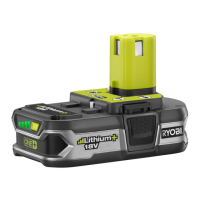
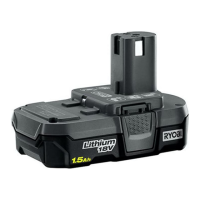
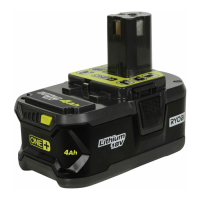
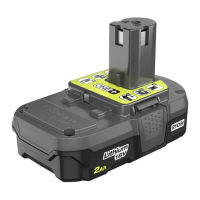
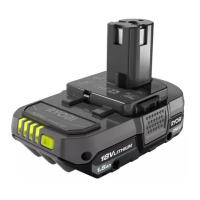
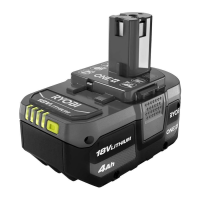
This document provides original instructions for the RYOBI 18V Lithium-Ion Battery Pack, covering models RB18L30A, RB18L60A, and RB18L90A. It emphasizes safety, proper usage, and maintenance to ensure optimal performance and longevity of the battery packs.
Function Description
The RYOBI 18V Lithium-Ion Battery Packs are designed to power Ryobi One+ 18V cordless products. They utilize lithium-ion cell technology and incorporate advanced features to monitor and protect the cells, maximizing battery life and ensuring safe operation. These battery packs are an integral part of the Ryobi One+ system, providing portable power for a wide range of tools.
Important Technical Specifications
The manual details the following specifications for the different battery pack models:
- RB18L30A:
- Output: 18 V
- Battery type: Lithium-Ion
- Battery capacity: 3 Ah
- Number of cells for battery: 5
- Weight: 0.67 kg
- RB18L60A:
- Output: 18 V
- Battery type: Lithium-Ion
- Battery capacity: 6 Ah
- Number of cells for battery: 10
- Weight: 0.92 kg
- RB18L90A:
- Output: 18 V
- Battery type: Lithium-Ion
- Battery capacity: 9 Ah
- Number of cells for battery: 15
- Weight: 1.18 kg
All models are designed for use with Ryobi One+ 18V cordless products only. Compatible chargers are listed, including BCL14181H, BCL14183H, BCL14184H, RC18120, RC18115, RC18627U, and RC18120. It's important to note that only compatible 18V chargers should be used.
Usage Features
The battery packs are equipped with several features to enhance usability and protect the battery:
- Battery Protection Features: These packs incorporate active, standby, shut-off, and sleep modes to monitor and protect the lithium-ion cells.
- Active Mode: If the tool stops during use due to overheating or overloading, releasing the trigger will reset and resume operation.
- Stand-by or Sleep Mode: If the tool does not reactivate, the battery is completely discharged and requires charging. The battery can be recharged in either stand-by or sleep mode without needing to be completely discharged first.
- Reactivation from Sleep Mode: A completely discharged battery (sleep mode) needs reactivation. To reactivate, place the battery in the charger for 90 seconds. If charging doesn't begin, remove the battery for 30 seconds and try again. If charging still doesn't start after 3 attempts, the battery may be faulty and should be serviced by a qualified repair person using identical replacement parts.
- LED Charge Indicator: The LED charge indicator light may not work if the battery protection feature has caused the battery pack to stop powering the tool (sleep mode). It will function again once the charger resets the battery pack.
- SHUT-OFF Mode: An additional SHUT-OFF mode minimizes self-discharge when the battery is not in use. It reactivates automatically when used with a tool or by pressing the LED gauge. In SHUT-OFF mode, a volt-meter will show low voltage; the actual voltage can be read by using the battery in a tool or pressing the LED gauge.
- Charge Level Indicator: The battery packs feature a charge level indicator with a button. Pressing the button illuminates LEDs to show the approximate remaining charge:
- 4 LEDs: 75-100%
- 3 LEDs: 50-75%
- 2 LEDs: 25-50%
- 1 LED: 10-25%
- No LEDs: 0-10%
- Cold Weather Operation: The lithium-ion battery pack can be used in temperatures down to -10°C. For optimal performance in cold weather, place the battery pack on a tool and use it in a light-duty application to allow the battery pack to warm up and begin operating normally.
- Charging:
- Battery packs are shipped in a low charge condition and should be charged prior to first use.
- Always charge the battery pack in a location where the temperature is more than 10°C but less than 37°C.
- Press down on the battery pack to ensure contacts on the battery pack engage properly with the contacts in the charger.
- Connect the charger to the power supply.
- Make sure the latches on each side of the battery pack snap into place and the battery pack is secured in the charger before beginning operation.
- Place the battery pack in the charger, aligning the raised rib on the battery pack with the groove in the charger.
- The battery pack will become slightly warm to the touch while charging; this is normal and does not indicate a problem.
- Do not place the charger and battery pack in an area of extreme heat or cold.
- When charging multiple batteries, allow 1 hour cooling time as required to fully recharge the battery pack.
- Hot Battery Pack Charging: If a battery pack is hot when removed from a tool, allow it to cool down for at least 15 minutes before placing it in the charger. This will reduce the risk of serious personal injury.
Maintenance Features
Proper maintenance is crucial for the safety and longevity of the battery packs:
- General Care:
- Keep the battery pack away from other metal objects (paper clips, coins, keys, nails, screws) to prevent shorting the terminals, which can cause sparks, burns, or fire.
- Do not place battery tools or batteries near fire or heat, as this can lead to explosion and injury.
- Do not crush, drop, or damage the battery pack. A damaged battery is subject to explosion and should be disposed of immediately.
- Never use any cordless product in the presence of open flame, as batteries can explode.
- Do not charge the battery tool in a damp or wet location to prevent electric shock.
- Do not store the battery pack outside or in vehicles.
- Leakage: In extreme usage or temperature conditions, battery leakage may occur.
- If liquid comes into contact with skin, wash immediately with soap and water, then neutralize with lemon juice or vinegar.
- If liquid gets into eyes, flush with clean water for at least 10 minutes and seek immediate medical attention.
- Storage:
- For battery storage longer than 30 days, store the battery pack where the temperature is below 27°C.
- Store battery packs in a "charged" condition (minimum 25-50% charged).
- To charge the battery pack after a six months storage period, it is recommended to discharge the battery about 10% - 20% by using it in a tool and charge afterwards to maximize the battery lifetime.
- Disposal and Recycling:
- Do not dispose of used battery packs in household refuse or by burning them. Hand them over to applicable collection points.
- Waste electrical products should not be disposed of with household waste. Recycle where facilities exist. Check with your local authority or retailer for recycling advice.
- Upon removal, cover the battery pack's terminals with heavy-duty adhesive tape.
- Do not attempt to destroy or disassemble the battery pack or remove any of its components.
- Never touch both terminals with metal objects and/or body parts as short circuit may result.
- Keep away from children. Failure to comply with these warnings could result in fire and/or serious injury.
- Residual Risks: Even when used as prescribed, certain residual risk factors remain. Users should always use the product only for its intended purpose, avoid altering or modifying the product, and be aware that misuse and improper handling can cause injury.

 Need help?
 General

 To Next Page