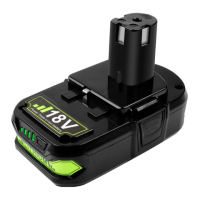
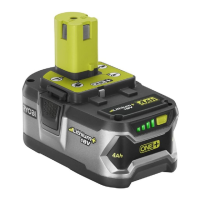
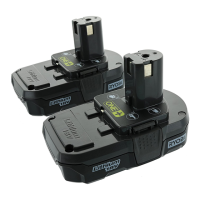
1 - English
SAFETY RULES
When battery pack is not in use, keep it away from
other metal objects like: paper clips, coins, keys, nails,
screws, or other small metal objects that can make
a connection from one terminal to another. Shorting
the battery terminals together may cause sparks, burns,
or a fire.
Always remove battery pack from your tool when you
are assembling parts, making adjustments, cleaning,
or when not in use. Removing battery pack will prevent
accidental starting that could cause serious personal
injury.
Always remove battery pack before storing the device.
When battery becomes fully charged, unplug the
charger from the power supply and remove the battery
pack from the charger.
Always wear eye protection with side shields marked
to comply with ANSI Z87.1. Failure to do so could result
in objects being thrown into your eyes and other possible
serious injuries.
Keep battery pack dry, clean, and free from oil and
grease. Always use a clean cloth when cleaning. Never
use brake fluids, gasoline, petroleum-based products, or
any solvents to clean battery pack.
Do not use a battery pack that is damaged or modified.
Damaged or modified batteries may exhibit unpredictable
behavior resulting in fire, explosion or risk of injury.
Do not modify or attempt to repair a battery pack that
has been damaged.
Do not expose a battery pack or appliance to fire or
excessive temperature. Exposure to fire or temperature
above 265°F (130°C) may cause explosion.
Have servicing performed by a qualified repair person
using only identical replacement parts. This will ensure
that the safety of the product is maintained.
Save these instructions. Refer to them frequently and
use them to instruct others who may use this tool. If you
loan someone this tool, loan them these instructions also.
WARNING!
READ AND UNDERSTAND ALL INSTRUCTIONS. Fail-
ure to follow all instructions listed below, may result in
electric shock, fire and/or serious personal injury.
Battery tools do not have to be plugged into an elec-
trical outlet; therefore, they are always in operating
condition. Be aware of possible hazards when not
using your battery tool or when changing accessories.
Following this rule will reduce the risk of electric shock,
fire, or serious personal injury.
Do not place battery tools or their batteries near fire
or heat. This will reduce the risk of explosion and possibly
injury.
Do not crush, drop or damage battery pack. Do not
use a battery pack or charger that has been dropped
or received a sharp blow. A damaged battery is subject
to explosion. Properly dispose of a dropped or damaged
battery immediately.
Batteries can explode in the presence of a source
of ignition, such as a pilot light. To reduce the risk of
serious personal injury, never use any cordless product
in the presence of open flame. An exploded battery can
propel debris and chemicals. If exposed, flush with water
immediately.
Do not charge battery tool in a damp or wet location.
Following this rule will reduce the risk of electric shock.
Charge only with RYOBI
™
18V dual chemistry battery
chargers. Use of other chargers may result in personal
injury, fire, or damage.
Do not charge in an area of extreme heat or cold. It
will work best at normal room temperature. To reduce
the risk of serious personal injury, do not store outside or
in vehicles.
Under extreme usage or temperature conditions, bat-
tery leakage may occur. If liquid comes in contact with
your skin, wash immediately with soap and water. If
liquid gets into your eyes, flush them with clean water
for at least 10 minutes, then seek immediate medical
attention. Following this rule will reduce the risk of serious
personal injury.
To register your RYOBI
™
product,
please visit: http://register.
ryobitools.com
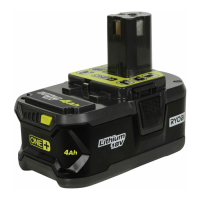
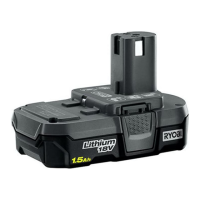
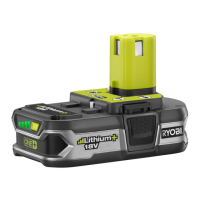
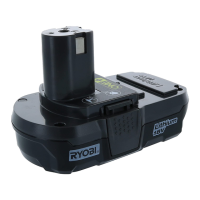
Use this battery pack for
RYOBI
™
ONE+
™
18 V cordless
products only. Refer to the
Operator’s Manual provided with
product. Always mention the model number above when
communicating with us regarding this battery pack.
LITHIUM-ION BATTERY PACKS
Lithium-ion batteries deliver fade free power for their entire
run time. Lithium-ion tools will not gradually lose power due
to decreasing battery charge. Instead, power from the battery
pack will drop from full to zero once the full charge has been
drained from the battery. Once this happens, recharging of
the battery is required. It is not necessary to drain the battery
pack completely before recharging.
BATTERY PROTECTION FEATURES
Lithium-ion battery packs are designed with features that
protect the lithium-ion cells and maximize battery life.
If the tool stops during use, release the trigger to reset and
resume operation. If the tool still does not work, the battery
needs to be recharged.
OPERATION
18 V LITHIUM-ION
BATTERY PACK
P190

 Need help?
 General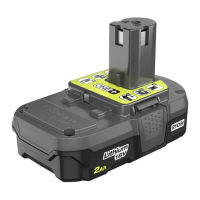

 To Next Page