Need help?
Do you have a question about the Ryobi R18JS and is the answer not in the manual?
Describes the intended application and limitations of the jigsaw.
General safety guidelines applicable to all power tools.
Safety measures related to the operating environment.
Safety precautions concerning electrical connections and grounding.
Personal protective measures and safe operating practices.
Guidelines for proper operation, maintenance, and storage of the tool.
Specific instructions for handling and maintaining battery packs.
Recommendations for professional servicing and repairs.
Specific safety precautions for using a jigsaw.
Extra safety advice regarding tool operation and environment.
Further warnings related to battery safety, including short circuits.
Guidelines for safely transporting lithium-ion batteries.
Potential hazards and how to mitigate them (vibration, dust, shock, blade, noise).
Methods to reduce exposure to vibrations and related health conditions.
Explains various safety and operational symbols used in the manual.
Guidance on recycling and responsible disposal of the product.
Instructions for inserting the cutting blade and preparing the tool for use.
Steps for inserting the battery pack and securing the workpiece for operation.
Adjusting speed control and orbital action for different cutting tasks.
Setting up bevel cuts and procedures for safely removing the blade.
Adjusting cutting depth, speed, and controlling the cutting action.
Adjusting the bevel angle and blade clamp for secure fit.
Connecting dust extraction and detailed steps for changing the blade.
Fine-tuning speed settings and performing plunge cuts.
Attaching and using the parallel guide for precise straight cuts.
Positioning workpiece for cuts and initiating cuts safely.
Creating pilot holes and adjusting speed during operation.
Steps for removing used blades and inserting new ones.
Lists compatible battery packs and chargers for the tool.
Details on measured vibration emission levels and safety precautions.
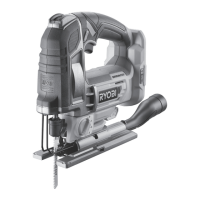
The RYOBI R18JS is an 18V cordless jigsaw designed for cutting various materials such as wood, plastic, drywall, and metal. It is intended for handheld use by adults who have read and understood the safety instructions and warnings provided in the manual. The product is not designed to be mounted onto a workbench unless specific instructions from the manufacturer are given.
The jigsaw operates by moving a blade rapidly up and down to cut through materials. It is powered by an 18V battery pack, making it a cordless tool that offers portability and flexibility during use. The tool features a trigger switch for activation and a lock-on button for continuous operation, reducing user fatigue during extended tasks. A speed control dial allows the user to adjust the blade's stroke rate, providing versatility for different materials and cutting requirements. The orbital adjustment knob enables the user to select different orbital settings, which can influence the aggressiveness of the cut and the speed of material removal. The base assembly provides stability and guidance during cutting, and it can be adjusted for bevel cuts. The blade clamp sleeve secures the blade in place, and the blade guard offers protection during operation.
Before operating the jigsaw, it is crucial to ensure that the battery pack is properly inserted into the battery port. The manual emphasizes the importance of selecting the correct blade for the material being cut and ensuring it is securely installed. The blade clamp sleeve allows for quick and tool-free blade changes. The speed control dial, often labeled with a "SPEED MATCH" indicator, helps users select the appropriate speed for various applications, from slower speeds for delicate cuts to faster speeds for rapid material removal. The orbital adjustment knob provides different pendulum action settings, which can be beneficial for faster cutting in softer materials or for more precise cuts in harder materials.
For straight cuts, the base assembly should be set to 0 degrees. The jigsaw also supports bevel cuts, allowing the base to be angled up to 45 degrees in either direction. This adjustment typically involves loosening a screw with a hex key, setting the desired angle, and then re-tightening the screw to secure the base. When making cuts, the workpiece should always be secured with clamps or other practical means to a stable platform to prevent movement and ensure control. The tool should be held firmly by its insulated gripping surfaces, especially when there is a risk of contacting hidden wiring. Starting the cut with the blade resting on the workpiece and then engaging the trigger switch is recommended. For plunge cuts, a pilot hole may need to be drilled first, or the tool can be carefully tilted and lowered into the material.
The jigsaw is designed for both straight and curved cutting on wood, metal, and plastic. Users are advised to avoid running the saw at low speeds for extended periods, as this can cause overheating. If overheating occurs, the saw should be cooled by running it without a load at full speed. Personal protective equipment, including eye protection and a dust mask, should always be worn during operation to protect against flying debris and dust inhalation.
Proper maintenance is essential for the safety, performance, and dependability of the jigsaw. Before performing any adjustments, changing accessories, or cleaning, the battery pack must always be removed from the tool to prevent accidental starting. The manual advises against using solvents to clean plastic parts, as they can damage the material. Instead, a clean cloth should be used to remove dirt and carbon dust. Brake fluids, gasoline, petroleum-based products, and penetrating oils should never come into contact with plastic parts, as these chemicals can weaken or destroy the plastic.
The product's bearings are lubricated for the life span of the tool under normal operating conditions, so no further lubrication is required. Keeping cutting tools sharp and clean is important, as properly maintained blades are less likely to bind and are easier to control. The product should be cleaned using a brush or a dust collection system. All repairs should be performed by an authorized service center to ensure safety and reliability, and only original manufacturer's replacement parts, accessories, and attachments should be used. Regular checks for misalignment or binding of moving parts, breakage of parts, or any other condition that may affect the tool's operation are recommended. If any damage is found, the tool should be repaired before further use. The manual also provides guidance on transporting lithium batteries safely, emphasizing the need to protect exposed connectors and to check with the forwarding company for advice if batteries are cracked or leaking.
 General
| Type | Jigsaw |
|---|---|
| Power Source | Battery |
| Voltage | 18V |
| Stroke Length | 25mm |
| No Load Speed | 1100 - 3000 spm |
| Weight | 1.6 kg |
| Bevel Capacity | 45° |
| Cutting Capacity (Steel) | 6mm |
| LED Light | Yes |
| Stroke Rate | 3000 strokes per minute |
| Orbital Action | 4 settings |


 To Next Page