PRODUCT SPECIFICATIONS
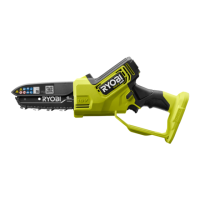
Cordless pruning saw
Model R18XPCS10
Rated voltage 18 V d.c.
No-load speed 6 m/s
Guide bar length 152.4 mm (6 in.)
Usable cutting length 145 mm (5.7 in.)
Chain stopping time < 2 s
Chain length 152.4 mm (6 in.)
Chain pitch 8.255 mm (0.325 in.)
Chain gauge 1.09 mm (0.043 in.)
Drive links quantity 30
Weight (without battery pack, guide
bar, chain, and oil)
0.98 kg
Vibration level (in accordance with IEC 62841-1 and
IEC 62841-4-1)
Front handle 3.9 m/s
2
Rear handle 3.4 m/s
2
Uncertainty of measurement 1.5 m/s
2
Noise emission level (in accordance with IEC 62841-1 and
IEC 62841-4-1)
A-weighted sound pressure level at
the operator’s position
79.0 dB(A)
Uncertainty of measurement 3.0 dB
A-weighted sound power level 87.0 dB(A)
Uncertainty of measurement 3.0 dB
Sound power level (in accordance with ISO 3744, 2000/14/EC
amended by 2005/88/EC)
Measured sound power level 94.1 dB(A)
Guaranteed sound power level 96.0 dB(A)
BATTERY AND CHARGER
Model R18XPCS12 R18XPCS10
Battery pack RB1820C -
Charger RC18115 -
Compatible
battery packs
RB18L15B, RB1820C, RB18L20A, RB1825C,
RB18L25A, RB18L40A, RB1840C, RB18L50A,
RB18L60A, RB1860X
REPLACEMENT PARTS
Manufacturer OREGON RYOBI
Chain 80BX030XTR RCHC6
Bar 637969 319739005
The chain must be tted with the bar from the same
manufacturer according to above combinations.
MAINTENANCE TOOL
Saw le 4.0 mm (5/32 in.)
WARNING! The declared vibration total values and the
declared noise emission values given in this instruction
manual have been measured in accordance with a
standardised test and may be used to compare one tool with
another. They may be used for a preliminary assessment
of exposure.
The declared vibration and noise emission values represent
the main applications of the tool. However, if the tool is used
for dierent applications, used with dierent accessories,
or poorly maintained, the vibration and noise emission
may dier. These conditions may signicantly increase the
exposure levels over the total working period.
An estimation of the level of exposure to vibration and noise
should take into account the times when the tool is turned o
or when it is running idle. These conditions may signicantly
reduce the exposure level over the total working period.
Identify additional safety measures to protect the operator
from the eects of vibration and noise, such as maintaining
the tool and the accessories, keeping the hands warm (in
case of vibration), and organising work patterns.


 To Next Page