Need help?
Do you have a question about the Ryobi RBL365J and is the answer not in the manual?
This document serves as an instruction manual for the RYOBI Cordless Blower, specifically covering models RBL365J, RBL3601J, and RBL3651J. It provides essential information for the safe assembly, operation, and maintenance of the product.
The RYOBI Cordless Blower is designed for outdoor use in dry and well-illuminated conditions. Its primary function is to blow light debris such as leaves, grass, and other garden refuse. The product is not intended for any other purpose and should not be used by children or individuals with reduced physical, mental, or sensory capabilities. Local regulations may also restrict the age of the operator.
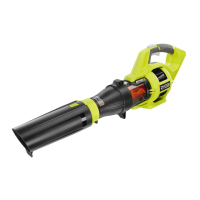
The blower operates using a battery pack, making it a cordless tool. It features a turbo boost button for increased power, a switch trigger for activation, and a blower tube to direct the air stream. The design prioritizes safety, performance, and dependability.
Preparation and Safety: Before using the blower, it is crucial to read and understand all safety warnings and instructions to prevent electric shock, fire, or serious injury. The manual emphasizes the importance of wearing hearing protection at all times due to the product's noise, which can cause permanent hearing injury if precautions are not strictly adhered to. Full eye protection, such as a full face mask or enclosed goggles, is also mandatory, as objects can be thrown at high speed by the powerful air jet.
Operators must wear substantial footwear and long trousers, avoiding bare feet or open sandals. Loose clothing, jewelry, or long hair should be secured to prevent entanglement in moving parts or being drawn into the air inlet. Before each use, all controls and safety devices must be checked for correct function, and the product should not be used if the off switch fails to stop it.
The blower should be operated in a recommended position on a firm and level surface, avoiding paved or gravel surfaces where ejected material could cause injury. The housing, guards, and handles must be inspected for damage and properly secured. Worn or damaged components should be replaced in sets to maintain balance, and unreadable labels should be replaced.
The work area must be cleared before each use, removing objects like rocks, broken glass, nails, wire, or string that could be blown by high-velocity air. Rakes and brooms can be used to loosen debris prior to blowing. Bystanders, children, and pets must be kept at least 15 meters away from the operating area, and the product should be stopped if anyone enters this zone.
Operation: The cordless blower should only be operated at reasonable hours, avoiding early morning or late night to prevent disturbing others. It must not be used in an explosive atmosphere or in bad weather conditions, especially if there is a risk of lightning. Good lighting is essential for the operator to have a clear view of the work area and identify potential hazards.
When operating, the full blower nozzle extension should be used to allow the air stream to work close to the ground for effective performance. The blower nozzle should never be pointed in the direction of people or pets. Objects should never be placed inside the blower tubes, and the product should not be placed on top of or near loose debris, as this can be sucked into the intake vent and cause damage.
If the blower is supplied with a harness, it should be carefully adjusted for comfortable support of the product's weight. The quick release mechanism should be identified and practiced before use to prevent serious injury in emergencies. No additional clothing should be worn over the harness or restrict access to the quick release mechanism.
Battery Use and Care: Only chargers specified by the manufacturer should be used for recharging battery packs. Using an unsuitable charger or battery pack can create a risk of fire. Power tools should only be used with specifically designated battery packs to avoid injury and fire.
When not in use, battery packs should be kept away from other metal objects like paper clips, coins, keys, nails, screws, or other small metal objects that could short the terminals, causing burns or fire. In case of liquid ejection from the battery pack due to abusive conditions, contact should be avoided. If contact occurs, the affected area should be flushed with water, and medical help sought if liquid contacts the eyes, as it can cause irritation or burns.
Damaged or modified battery packs or tools should not be used, as they may exhibit unpredictable behavior resulting in fire, explosion, or injury. Battery packs or tools should not be exposed to fire or excessive temperatures above 130°C, which can cause an explosion. All charging instructions must be followed, and the battery pack or tool should not be charged outside the specified temperature range, as this can damage the battery and increase the risk of fire.
Transportation and Storage: Before storing or transporting, the product should be stopped, the battery pack removed, and allowed to cool down. All foreign materials should be cleaned from the product. It should be stored in a cool, dry, well-ventilated place, inaccessible to children, and away from corrosive agents like garden chemicals and de-icing salts. Outdoor storage is not recommended. For vehicle transportation, the product must be secured against movement or falling to prevent injury or damage.
Lithium batteries must be transported in accordance with local and national provisions and regulations. Special packaging and labeling requirements apply when transporting batteries by a third party. Connectors should be protected with insulating caps or tape to prevent contact with other batteries or conductive materials. Cracked or leaking battery packs should not be transported. Further advice should be sought from the forwarding company.
Maintenance of the RYOBI Cordless Blower requires extreme care and knowledge and should only be performed by a qualified service technician. For service, the product should be brought to an authorized service center, where only original replacement parts should be used.
Only original manufacturer's replacement parts, accessories, and attachments should be used. Failure to do so can cause possible injury, poor performance, and may void the warranty.
Adjustments and repairs not described in this manual should not be attempted; for other repairs, an authorized service center should be contacted. After each use, the product should be cleaned with a soft, dry cloth.
All nuts, bolts, and screws should be checked at frequent intervals for proper tightness to ensure the product is in safe working condition. Any damaged part should be properly repaired or replaced by an authorized service center.
If the product is dropped, suffers heavy impact, or begins to vibrate abnormally, it should be immediately stopped and inspected for damage, or the cause of vibration identified. Any damage should be properly repaired or replaced by an authorized service center.
To reduce the risk of injury from rotating parts, the product should always be stopped and the battery pack removed, ensuring all moving parts have come to a complete stop before leaving it unattended, clearing blockages, checking, cleaning, or working on the product, or inspecting it after striking a foreign object.
In the event of an accident or breakdown, the battery pack should be immediately switched off and removed. The product should not be operated again until it has been fully checked by an authorized service center.
Clearing a Blockage: To reduce the risk of injury associated with contacting rotating parts, always stop the product, remove the battery pack, and ensure all moving parts have come to a complete stop before clearing blockages. The blower tubes should be removed to inspect for blockages, and the tubes cleared if required. The blower tubes should then be re-installed before starting the product.
 General
| Voltage | 36V |
|---|---|
| Battery Type | Lithium-Ion |
| Power Source | Battery |
| Battery Compatibility | Ryobi 36V Battery |
| Blowing Speed | 160 MPH |

 To Next Page