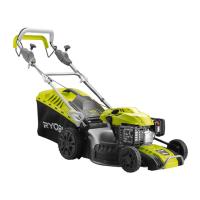
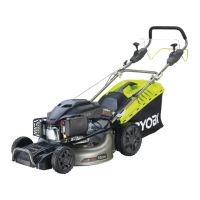
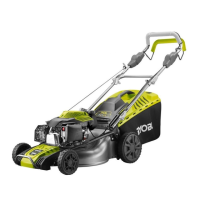
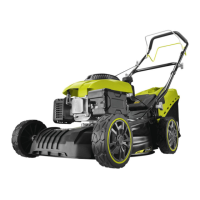
This document provides comprehensive instructions for the RYOBI RLM5319SMEB Petrol Lawn Mower, covering its function, usage, and maintenance.
Function Description
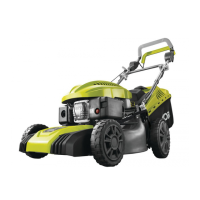
The RYOBI RLM5319SMEB is a pedestrian-controlled walk-behind petrol lawn mower designed for domestic lawn mowing. Its primary function is to cut grass using a rotating blade that operates approximately parallel to the ground. The mower is equipped with four wheels that should always touch the ground during operation. It is specifically intended for cutting domestic grass lawns and should not be used for any other purpose or with the wheels off the ground, nor should it be pulled or ridden on.
The mower offers multiple cutting modes:
- Rear Bagging Operation: This mode involves collecting grass clippings in a grass catcher, which is installed at the rear discharge door.
- Mulching Operation: In this mode, the mower finely chops grass clippings and returns them to the lawn as natural fertilizer. This requires installing a mulching plug and not using the grass catcher.
- Side Discharge Operation: This mode allows grass clippings to be discharged from the side of the mower. This requires installing a side discharge deflector, and the mulching plug should remain installed while the grass catcher is not used.
The engine is a Subaru 190cc OHC, providing the power for the cutting blade and the rear-wheel self-propelled drive system. A variable throttle lever allows for adjusting the engine speed, though it should be set to the fastest speed for starting and cutting grass. The mower is stopped by releasing the power lever.
Usage Features
The mower is designed for ease of use with several features to enhance the mowing experience:
- Handle Installation: The handles are placed in an operating position and secured with knobs. A rope guide on the handle helps manage the starter rope.
- Height Adjustment: The cutting height can be adjusted to seven different positions, ranging from 19 mm to 76 mm, to suit various lawn conditions and desired grass lengths. To raise the blade height, the height adjustment lever is moved toward the back of the mower; to lower it, the lever is moved toward the front.
- Starting the Engine: To start, the variable throttle lever is set to the fastest speed, the primer bulb is pressed three times (less often if the engine is already warm), the power lever bar is held down against the handle, and the starter grip is pulled until the engine runs. The starter cord should be released slowly to prevent snapping.
- Stopping the Engine: The engine stops when the power lever is released.
- Fueling: The mower uses unleaded petrol with an octane rating of 87 or higher. Fueling should always be done outdoors, away from sparks and flames, with the engine off and cool. The fuel cap should be loosened slowly to release pressure.
- Engine Oil: SAE 10W-30 API-SJ weight oil is recommended for general, all-temperature use. The oil level can be checked and refilled via the oil cap/dipstick.
- Mowing Tips:
- The lawn should be cleared of stones, sticks, wires, and other objects before mowing to prevent damage and injury.
- For best performance, only one-third or less of the total grass height should be cut.
- A slower walking speed is recommended for long grass to ensure effective cutting and discharge.
- Avoid cutting wet grass, as it can stick to the deck and impede bagging or mulching.
- New or thick grass may require a higher cutting height.
- The underside of the mower deck should be cleaned after each use.
- Slope Operation: Mowing across the face of slopes is recommended, never up and down. Extreme caution is advised when changing direction on slopes. Slopes greater than 15 degrees should be avoided. Users should maintain firm footing and release the power lever immediately if balance is lost. Avoid mowing near drop-offs, ditches, or embankments.
- Grass Catcher: The grass catcher is easily installed by lifting the rear discharge door and seating the hooks of the catcher frame into the handle bracket slots. It is emptied by lifting it from the mower and disposing of the clippings.
- Side Discharge Deflector: This deflector is installed by lifting the side discharge door and aligning its hooks with the hinge rod on the underside of the door.
Maintenance Features
Regular maintenance is crucial for the mower's performance and longevity. All maintenance should be performed with the engine off, the blade stopped, and the spark plug wire disconnected to prevent accidental starting.
- General Cleaning:
- Avoid using solvents on plastic parts; clean with dry or clean cloths.
- Remove grass and leaves buildup from around the engine and engine cover.
- The underside of the mower deck can be cleaned by connecting a water hose to the male connector, turning on the water, and running the mower at full revolutions (without engaging self-propel).
- Blade Maintenance:
- The cutting blade should be kept sharp and replaced if bent or damaged. Only manufacturer-approved replacement blades should be used.
- To replace the blade, the engine is stopped, the spark plug wire disconnected, and the mower is tilted on its side (carburetor facing up). A block of wood is wedged between the blade and deck to prevent turning. The blade bolt, lock washer, flat washer, and blade are removed, and the new blade is installed with curved ends pointing up. The bolt is then finger-tightened clockwise and torqued to 48-55 Nm (35-40 ft.lb.).
- Air Filter Cleaning: The air filter should be kept clean for proper performance and long life. It can be removed by pushing down a latch, washed in warm soapy water, rinsed, and dried. A light coat of engine oil should be applied and squeezed out before reinstalling. The filter should be replaced annually.
- Engine Oil Change: Engine oil should be changed every 25 hours of use, preferably when warm. The mower is tipped on its side to drain the oil from the fill hole into an approved container, then refilled with new oil. Used oil must be disposed of at an approved site.
- Spark Plug Maintenance: The spark plug should be properly gapped (0.028-0.031 in.) and free of deposits. It can be removed with a 13/16-in. socket, cleaned with a wire brush, and replaced if cracked or chipped. Recommended plugs are Torch E7RTC or NGK BPR6HS.
- Wheel Maintenance: The wheels should be checked for proper tightness of nuts and bolts. To replace a wheel, the hub cap and nut are removed, and the new wheel is installed.
- Drive Gear Maintenance: For smooth operation, the wheel assembly and drive shaft should be cleaned before storage. This involves removing the nut, wheel, dust cover, e-ring, washer, pins, and wheel gear, then wiping them clean with a dry cloth or rubbing alcohol. Lubrication of wheel components is not recommended.
- Storage: For storage longer than 30 days, fuel stabilizer can be added to the petrol tank, and the engine run for 10 minutes. Alternatively, the engine can be run until it is completely out of petrol. The fuel valve should be closed, and the mower cleaned. It should be stored in a well-ventilated, dry, locked-up area, out of reach of children and away from corrosive materials or open flames/sparks. The handle can be folded down for compact storage by loosening the handle knobs and lock nuts.


 To Next Page
 General
 Weight and Dimensions