Need help?
Do you have a question about the Ryobi RVC-1420C-G and is the answer not in the manual?
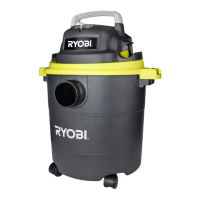
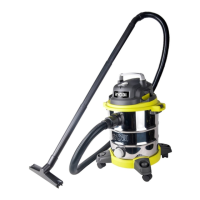
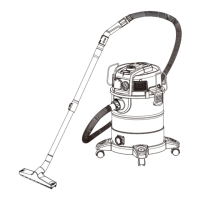
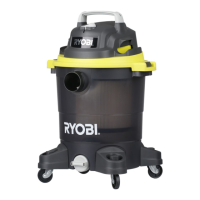
The RYOBI RVC-1420C-G is a versatile wet and dry vacuum cleaner designed for household use, offering a range of functionalities for various cleaning tasks. This owner's operating manual provides essential instructions for safe and effective operation, assembly, maintenance, and troubleshooting.
This appliance is primarily designed for vacuuming up non-hazardous and non-flammable materials in both wet and dry conditions. Its dual functionality allows it to tackle spills and liquids, as well as dry debris and dust, making it a comprehensive cleaning solution for private homes. The vacuum cleaner is equipped with a powerful motor to provide strong suction for efficient cleaning. In addition to its vacuuming capabilities, the RVC-1420C-G also features a blower function, which can be used to clear obstructions from the hose or to blow away debris from work areas.
The RYOBI RVC-1420C-G is designed for ease of use and adaptability to different cleaning scenarios. For dry vacuuming, the appliance utilizes a HEPA cartridge filter and a dust bag. Users must ensure that the correct dust bag is securely inserted and the HEPA cartridge filter is properly mounted for optimal performance and to prevent damage to the motor. The manual emphasizes that the HEPA filter is not suitable for wet or sharp materials. When transitioning to wet vacuuming, the HEPA cartridge filter and dust bag must be removed, and a foam filter should be installed over the filter basket. This prevents damage to the HEPA filter and ensures proper operation for liquid pickup. The machine is fitted with a float valve that automatically stops suction when the tank reaches its maximum liquid capacity, indicated by an increase in motor speed. This safety feature prevents overfilling and potential damage.
Assembly of the vacuum cleaner involves attaching the casters to the tank for mobility and securing the handle to the power head with screws. The hose set, stainless steel telescopic wand, floor tool, and crevice tool are provided as accessories to facilitate various cleaning tasks. The large end of the hose connects to either the front inlet of the tank for vacuuming or the blower connection in the top of the motor housing for the blower function. Accessories like the floor tool or crevice tool can then be fitted onto the suction tube or the free end of the hose/extension. The ON/OFF switch allows for simple control of the motor.
For the blower operation, the hose is connected to the blower port on the motor housing. This feature can be used to clear blockages within the hose or to blow dust and debris from surfaces. Safety precautions for blower use include wearing safety goggles and a dust mask, and keeping bystanders clear of blowing debris.
Regular maintenance is crucial for the longevity and optimal performance of the RYOBI RVC-1420C-G. The manual provides detailed instructions for cleaning and replacing filters, as well as general upkeep of the appliance. Before any maintenance, the power cord must be disconnected from the power outlet to ensure safety.
For dry vacuuming, the HEPA cartridge filter should be cleaned periodically by gently tapping or brushing off dirt. This filter is not washable and should be replaced regularly, typically every 3-6 months depending on usage, to maintain vacuum performance. The dust bag also needs to be checked and replaced when full or damaged. The manual warns that using the machine without a dust bag (except for wet vacuuming or with the HEPA cartridge filter) or with an incorrect/damaged dust bag can lead to motor burnout and void the warranty.
For wet vacuuming, the foam filter is used. After wet vacuuming, the foam filter must be removed, washed with a mild soap and water solution, rinsed with clean water, and allowed to air dry completely before reinstallation or storage. It is essential to remove the foam filter after wet vacuuming and install a HEPA cartridge filter for subsequent dry vacuuming.
The tank itself should be emptied, cleaned, and dried thoroughly after each use, especially after wet vacuuming, to prevent odors and maintain hygiene. The hose and other accessories should also be cleared of any dirt or debris. The manual advises checking the power cord regularly for any damage and having it replaced by an authorized service center if necessary. Only original spare parts and accessories should be used to avoid potential dangers and to keep the warranty valid. The float valve should also be checked often to ensure it functions correctly.
The manual emphasizes that improper filter assembly can cause motor failure, highlighting the importance of following instructions carefully. It also provides a troubleshooting guide for common issues such as no power, dust escaping, or low suction, offering solutions like checking the power supply, replacing filters, or clearing blockages.
 General
| Model | RVC-1420C-G |
|---|---|
| Power Source | Battery |
| Voltage | 18 V |
| Battery Voltage | 18 V |
| Run Time | 20 minutes |
| Charging Time | 3 hours |
| Type | Handheld |
| Dust Capacity | 0.6 liters |
| Filter Type | Foam |

 To Next Page