Need help?
Do you have a question about the Ryobi TUFF SUCKER P710 and is the answer not in the manual?
Details on motor, charger input, and charge rate.
Instructions for removing the tool and accessories from the box and checking for damage.
List of items included with the Tuff Sucker™ Wet/Dry Vacuum.
Steps for charging a battery pack within normal temperature range.
Explanation of the LED indicators on the charger and their meanings.
Procedure for charging the battery pack, including LED status and timing.
Instructions for charging a battery pack that has become hot from continuous use.
Guide on how to properly insert the battery pack into the vacuum.
Instructions for safely detaching the battery pack from the vacuum.
How to turn the vacuum on and off using the switch.
Guidance on vacuuming liquids and using the squeegee attachment.
Instructions for attaching the brush, crevice, and squeegee tools to the vacuum.
Tips on cleaning plastic parts and avoiding damage from solvents.
Procedures for checking, emptying, and cleaning the dust bowl.
Steps for removing, cleaning, and reinstalling the vacuum's filter.
Information on how to purchase and install a new filter.
Guide on how to correctly reassemble the dust bowl onto the vacuum unit.
Information on battery care, storage, and proper recycling of nickel-cadmium batteries.
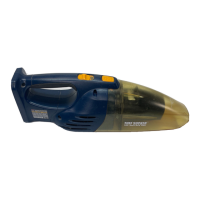
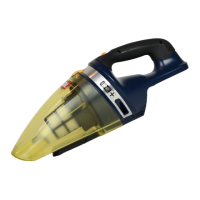
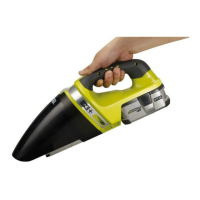
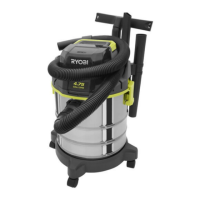
The Ryobi TUFF SUCKER™ 18 Volt Cordless Wet/Dry Vacuum, model P710, is a versatile and portable cleaning tool designed for both wet and dry vacuuming tasks around the household. Engineered to Ryobi's high standards for dependability, ease of operation, and operator safety, this hand vac aims to provide years of rugged, trouble-free performance when properly cared for. It is intended for light-duty vacuuming of dry surfaces and damp or wet surfaces, making it suitable for a variety of cleaning needs.
The Ryobi TUFF SUCKER™ P710 operates as a cordless hand vacuum, offering freedom of movement without the constraint of power cords. It is powered by an 18-volt battery pack (sold separately), which provides the necessary power for its suction capabilities. The vacuum is equipped with a conveniently located ON/OFF switch on top of the handle, allowing for easy control during operation. To start the vacuum, the user slides the switch toward the front of the vacuum, and to stop it, the switch is slid toward the back.
For dry vacuuming, the device efficiently picks up dust, dirt, and small debris. For wet vacuuming, it is capable of picking up liquid spills. The dust bowl features a "full line indicator" to show the maximum level for liquids, ensuring that the hand vac is never overfilled. It is crucial to empty the dust bowl often when vacuuming liquids to prevent overfilling and to avoid lifting the hand vac with liquids in the dust bowl. The vacuum should never be used to pick up flammable or combustible liquids such as gasoline, as this could cause the motor to ignite.
The P710 comes with several attachments to enhance its functionality:
These attachments can be easily snapped into place on the front end of the vacuum's dust bowl, ensuring a firm and secure connection before operation.
The Ryobi TUFF SUCKER™ P710 emphasizes user safety and convenience. Users are strongly advised to read and understand the operator's manual completely before using the product to reduce the risk of injury. Always wearing safety goggles or glasses with side shields is recommended during operation, especially when dealing with dusty conditions, to protect against foreign objects being thrown into the eyes.
The cordless nature of the vacuum means it is always in operating condition once a charged battery pack is installed. Therefore, the switch should always be locked when not in use or when carrying the device. The battery pack, which is sold separately, is installed by aligning a raised rib on the battery pack with a groove in the hand vac's battery port and pressing it into place until the latches snap securely. To remove the battery pack, the latches on both sides of the battery pack are depressed.
The battery packs for this tool are nickel-cadmium rechargeable batteries and are shipped in a low charge condition. It is recommended to charge the battery pack until the green LED on the charger comes on, indicating a full charge. The charger (also sold separately) is designed for 120 volts, 60 Hz, AC only. The charging process involves connecting the charger to a power supply and placing the battery pack into the charger, ensuring proper alignment. The charger features LED indicators to show the charging status: a red LED for fast charging, a green LED for a fully charged battery and maintenance charge mode, and specific combinations of yellow and green LEDs for deeply discharged or defective battery packs. If the battery pack becomes hot from continuous use, it should be allowed to cool down before recharging.
Proper maintenance is key to ensuring the longevity and optimal performance of the Ryobi TUFF SUCKER™ P710. Regular cleaning of the hand vac and its components is essential for maximum dust collection and efficient operation.
The dust bowl should be checked, emptied, and cleaned periodically. To remove the dust bowl, the battery pack must first be removed from the vacuum. Then, the release button located on top of the hand vac is depressed, and the dust bowl is pulled down and out from the motor housing. It is important not to tilt or tip the hand vac back with liquids in the dust bowl during this process.
The filters also require regular cleaning. After removing the dust bowl, the assembled filter rack and filter are pulled out. The filter is locked in place in the filter rack and can be removed by twisting it to unlock from the tabs. Dust and dirt can be shaken or lightly brushed off the filter. For thorough cleaning, the filter, filter rack, and dust bowl can be washed, but it is crucial to ensure all pieces are completely dry before reattaching them to the hand vac. When replacing the filter, users should request part number 3023109. The filter is placed in the filter rack, aligning the slots with the tabs, and then twisted to lock it in place, with an arrow on the filter pointing up. The assembled filter rack and filter are then placed back into the dust bowl.
Reattaching the dust bowl involves positioning the two sections, aligning the slots on the bottom of the dust bowl with the tabs on the bottom of the motor housing, and then snapping the two sections together.
For general maintenance, it is advised to avoid using solvents when cleaning plastic parts, as many commercial solvents can damage or weaken plastics. Clean cloths should be used to remove dirt, dust, oil, and grease. Users are warned against allowing brake fluids, gasoline, petroleum-based products, or penetrating oils to come into contact with plastic parts, as these chemicals can cause serious personal injury.
When servicing the tool, only identical Ryobi replacement parts should be used to prevent hazards or product damage. Any parts not listed for customer replacement should be serviced by a Ryobi Authorized Service Center.
Battery maintenance is also important. To obtain the longest possible battery life, the battery pack should be removed from the charger once fully charged. For storage longer than 30 days, battery packs should be stored in a "discharged" condition where the temperature is below 80°F.
The manual also emphasizes the importance of proper battery pack removal and preparation for recycling. Nickel-cadmium batteries must be recycled or disposed of properly, as local, state, or federal laws may prohibit their disposal in ordinary trash. Upon removal, the battery pack's terminals should be covered with heavy-duty adhesive tape to prevent short circuits, and users are warned not to destroy or disassemble the battery pack.
 General
| Type | Wet/Dry Vacuum |
|---|---|
| Model | P710 |
| Voltage | 18V |
| Power Source | Battery |
| Cordless | Yes |
| Cord Length | Cordless |


 To Next Page