
 Need help?
Do you have a question about the SA F1 Series and is the answer not in the manual?
Open valve slowly after attaching air. Connect to main air supply.
Factory set regulators for main air (80 PSI), squeegee (30 PSI), and carriage. Includes gauges.
Filter separates water; lubricator keeps components oiled. Use specific air tool oil.
Foot pedal initiates print cycle. Locking pin allows screen drop for maintenance.
Adjust down distance for flood bar and squeegee using cylinder knobs and reference marks.
Adjust carriage lift, flood, and print speeds using flow control valves.
Set stroke length and adjust shock absorber stiffness via shock plate.
Adjust squeegee stop with back shock absorber for desired stroke length.
Use adjustable locks and press frame hand wheel for carriage height and front post alignment.
Carriage Up/Down switch lifts carriage. Flood Hold switch performs one flood stroke.
Keep Thompson shafts clean of ink and debris for optimal operation.
Loosen and tighten the four screen frame clamps to properly secure the screen.
Loosen front knobs and slide holder back for screen cleaning or replacement.
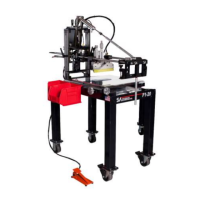
The F1 Series Precision Screen Printer is a robust and versatile machine designed for efficient and precise screen printing operations. Its primary function is to apply ink onto a substrate through a screen, executing a print cycle that involves flooding, printing, and lifting actions. The machine is engineered to provide consistent results, making it suitable for various printing applications where accuracy and repeatability are crucial.
The core function of the F1 Series printer revolves around its pneumatic system, which controls the movement of the print head, squeegee, and flood bar. Air is supplied to the machine and regulated to specific pressures for different components, ensuring optimal performance. The main air supply is crucial, and its valve should be opened slowly after attachment to prevent sudden pressure surges. A main air regulator sets the overall pressure, typically at 80 PSI, which is monitored by a dedicated gauge. Separate regulators are in place for the squeegee/print head and the carriage up-down mechanism, allowing for fine-tuned control over their respective operations. The squeegee/print head regulator is factory set at 30 PSI, while the carriage up-down regulator, used for the overhead cylinder on the printer carriage, is also factory set and should remain locked to maintain consistent carriage movement.
Before air reaches the pneumatic components, it passes through an air filter, which separates water from the air, preventing potential damage to the system. The bottom plug of the air filter can be unscrewed to drain accumulated water. Following the filter, an air lubricator ensures that all pneumatic components are adequately lubricated. It is critical to use specific air tool oil for this purpose, filling the plug located on top and loosening the smaller cap to do so. Maintaining the lubricator approximately ¼ full is recommended, as failure to use proper oil can lead to damage to valves, hoses, and cylinder seals.
The printing process itself is initiated by depressing a foot pedal, which triggers a single print cycle. This cycle typically involves the flood bar applying ink across the screen, followed by the squeegee pressing the ink through the screen onto the substrate, and finally, the print head lifting. The machine offers extensive control over these movements to achieve desired print quality.
The F1 Series printer provides numerous adjustable features to optimize its operation for different printing tasks and screen setups.
The flood bar and squeegee have independent up/down adjustments. For the flood bar, a knob located above its cylinder allows for precise control over its down distance, with a recommended distance of approximately 0.005 inches between the flood bar and the screen. It is important to turn off the main air source when making these adjustments to the print head for safety and accuracy. Similarly, a knob above the squeegee cylinder adjusts its down distance, aided by red, yellow, and black reference lines for consistent positioning.
The machine incorporates several flow controls to manage the speed of various movements:
A shock plate is used to set the desired stroke length. The stiffness of the shock absorber, which works in conjunction with the shock plate, can be adjusted with a flathead screwdriver. It is important that the print head does not crash into the plate at the end of the stroke. A specific component, Part #R0803001, is designed to compress at the same time as the shock absorber, ensuring smooth deceleration. The squeegee stop is also adjustable in conjunction with the back shock absorber to precisely fit the desired stroke length.
The carriage height can be adjusted using adjustable locks. Loosening these locks allows the press frame hand wheel to be turned, which raises or lowers the front carriage assembly. The front post rest helps maintain parallelism to the printing surface when the carriage is in the down position and is adjustable via its own hand wheel. A carriage up/down toggle switch provides convenient control for lifting and lowering the carriage.
For screen management, the machine features screen frame clamps that secure the screen in place. There are four such clamps that need to be loosened and tightened. The front screen frame holder allows for easy cleaning or screen replacement; its front knobs can be loosened, and the holder slid back to the grip finger.
A flood hold switch performs one flood stroke without initiating a full print cycle, which can be useful for pre-flooding the screen or for specific setup procedures.
Regular maintenance is essential to ensure the longevity and consistent performance of the F1 Series printer.
The air filter requires periodic draining of accumulated water by unscrewing its bottom plug. The air lubricator must be maintained approximately ¼ full with specific air tool oil to keep pneumatic components lubricated. Failure to do so can lead to significant damage to valves, hoses, and cylinder seals.
The Thompson shafts, which are critical for smooth and consistent operation, should be kept free of ink and debris. Regular cleaning of these shafts prevents friction and ensures precise movement of the carriage.
The locking pin is a key feature for maintenance. Pulling out the L-pin allows the screen to drop, providing easy access for cleaning and maintenance. This feature, along with the adjustable front screen frame holder, simplifies the process of cleaning the screen and replacing it when necessary.
In summary, the F1 Series Precision Screen Printer is a sophisticated machine designed for high-precision screen printing. Its comprehensive set of adjustable features, including precise control over flood bar and squeegee movements, speed settings, and stroke length management, allows operators to achieve optimal print quality for a wide range of applications. Coupled with its user-friendly design for setup and maintenance, it offers a reliable and efficient solution for demanding printing environments.
 General
| Operating Temperature | 41°F to 104°F (5°C to 40°C) |
|---|---|
| Storage Temperature | -4°F to 140°F (-20°C to 60°C) |
| Print Technology | Thermal Transfer |
| Resolution | 300 dpi (dots per inch) |
| Maximum Print Width | 4.09 inches (104 mm) |
| Connectivity | USB, Serial, Ethernet |
| Supported Media Types | Labels, Tags, Receipts |
| Memory | 128 MB RAM |
| Power Supply | 100-240 VAC, 50/60 Hz |
| Humidity | 20% to 85% (non-condensing) |

 To Next Page