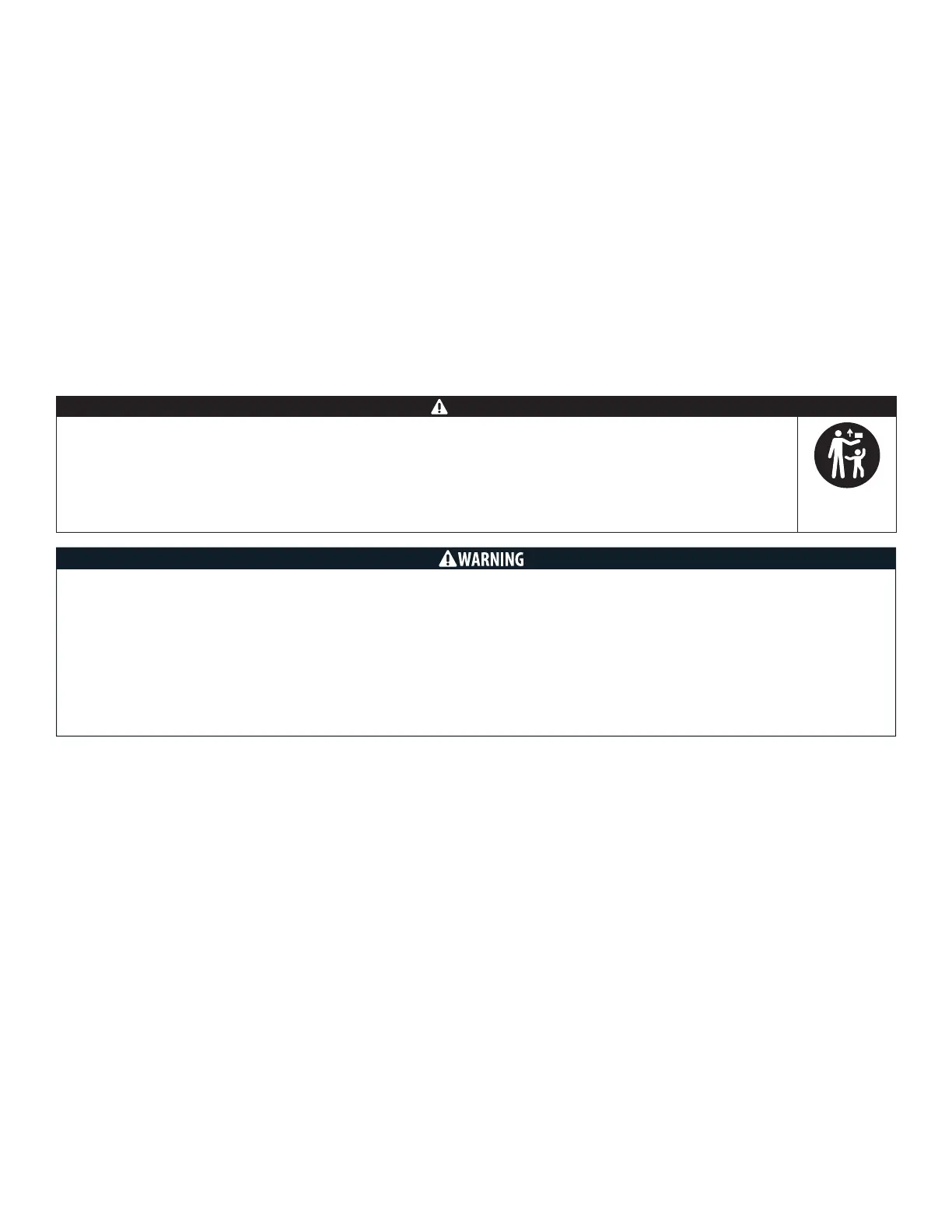
• INGESTION HAZARD: this product contains a button cell or coin battery.
• DEATH or serious injury can occur if ingested.
• A swallowed button cell or coin battery can cause Internal Chemical Burns in as little as 2 hours.
• KEEP new and used batteries OUT OF REACH OF CHILDREN.
• Seek immediate medical attention if a battery is suspected to be swallowed or inserted inside any
part of the body.
WARNING
• NOT suitable for children under 3 years, because small parts could be swallowed.
• Prolonged exposure to alarm siren may cause permanent hearing loss.
• Prior to use, you MUST read & watch the warnings & instructions at sabrered.com/safetytips.
• A properly installed and maintained security product may ONLY reduce the risk of events such as burglary,
robbery, break-ins. It is NOT insurance or a guarantee that such events will not occur, that adequate warning or
protection will be provided, or that there will be no personal injury, death, and/ or property damage as a result.
• BATTERY WARNING: Do not install backwards, charge, put in fire, or mix with other battery types as it may
explode or leak causing injury.
BATTERY WARNING:
• Immediately dispose of used batteries and keep away from children. Do NOT dispose of batteries in household trash.
• Even used batteries may cause severe injury or death.
• Call a local poison control center for treatment information.
• Do not mix old and new batteries, different brands or types of batteries, such as alkaline, carbon-zinc, or rechargeable
batteries.
• Ensure the batteries are installed correctly according to polarity (+ and -).
• Remove and immediately discard batteries from equipment not used for an extended period of time.
• Do not force discharge, recharge, disassemble, expose to high temperatures or incinerate. Doing so may result in injury
due to venting, leakage or explosion resulting in chemical burns.
FCC COMPLIANCE STATEMENT:
This device complies with part 15 of the FCC Rules. Operation is subject to the following two conditions: (1) This device may
not cause harmful interference, and (2) this device must accept any interference received, including interference that may
cause undesired operation.
WARNING: Changes or modifications not expressly approved by the party responsible for compliance could void the user’s
authority to operate the equipment.
NOTE: This equipment has been tested and found to comply with the limits for a Class B digital device, pursuant to part 15 of
the FCC Rules. These limits are designed to provide reasonable protection against harmful interference in a residential
installation. This equipment generates, uses and can radiate radio frequency energy and, if not installed and used in accor-
dance with the instructions, may cause harmful interference to radio communications. However, there is no guarantee that
TROUBLESHOOTING
The alarm (receiver) false alarms.
• Check if any animals are in the vicinity of the alarm. During warm weather, moving shadows may also activate the alarm.
• Make sure that the alarm is not positioned near a radiator or heat source.
• Check if any appliances within the property are emitting a strong electromagnetic field near the door/window magnetic
contact. Strong electromagnetic fields may cause the door/window magnetic contact to false alarm.
The alarm (receiver) cannot receive the signal sent from the transmitter (remote key fob or door/window magnetic contact).
• Check if the pairing between the transmitter and the receiver has been successful.
• If the pairing was successful, check the battery voltage for both the receiver and the transmitter. Low voltage will cause
the product to fail.
The alarm detects movement, however, no alarm sounds.
• Check if the low battery Indicator is flashing (please replace batteries immediately).
• If the unit is armed and set in the HOME mode and the alarm detects an intrusion, the alarm will not sound. The PIR
Sensor in the alarm is disabled in HOME mode.
• Check if the receiver is installed correctly.
interference will not occur in a particular installation. If this equipment does cause harmful interference to radio or television
reception, which can be determined by turning the equipment off and on, the user is encouraged to try to correct the interfer-
ence by one or more of the following measures:
• Reorient or relocate the receiving antenna.
• Increase the separation between the equipment and receiver.
• Connect the equipment into an outlet on a circuit different from that to which the receiver is connected.
• Consult the dealer or an experienced radio/TV technician for help.
SEE ADDITIONAL CAUTIONS AND WARNINGS ON THE FRONT AND BACK OF PACKAGING.
3/11/24 | REV. V07


 To Next Page
 Loading...