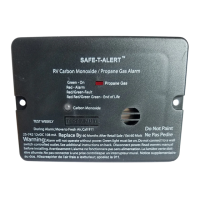
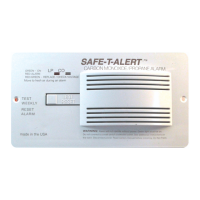
RECREATIONAL VEHICLE (RV)
Combination Carbon Monoxide and Gas Alarm
USER’S MANUAL Models 85-741
PATENT US 7,248,156 ALL RIGHTS RESERVED 85RV042021-1
ATTENTION: This user’s manual contains important Carbon
Monoxide (CO) and gas alarm installation, operation, troubleshooting
and warranty information. Read, follow, and keep this manual for
future reference.
NOTE: If you install or purchase this alarm for another person, give
this manual to that person.
IMPORTANT: It is recommended that this alarm is replaced after
five years of service. Record the installation / retail sale date in the
Owner’s Replacement Record section of this manual and also record
a replacement date. This unit has an End of Life (EOL) signal that
will sound after 5 years of use.
DUAL SENSOR TECHNOLOGY
The SAFE-T-ALERT™ 85 Series combination CO / Gas Alarm is an alarm that
combines into a single compact system, a powerful alarm that detects both
Carbon Monoxide (CO) and explosive Propane (LPG) gas. The 85 Series uses
the latest microprocessor technology combined with two electronic self-
cleaning sensors that operate independently of each other. The combined unit
can detect both CO and explosive gases simultaneously.
This detector is listed as a CO and Propane gas detector for RV use. Other
explosive gases detected, but not tested for, include Acetone, Alcohol,
Butane, and Gasoline all of which you may have in your RV.
To prevent false alarms from brief “puffs” of gas the detector has a recheck
cycle before alarming. If high levels of gas remain during the recheck cycle,
the detector will alarm.
The electronic CO sensor in your SAFE-T-ALERT
TM
CO alarm is very
sensitive to CO gas. It will not react to safe levels of most other gases.
WHY EVERY RV NEEDS AN 85 SERIES CO AND GAS ALARM
Everyone is at risk for carbon monoxide poisoning! Particularly sensitive are
children, pregnant women, the elderly and people with lung or heart disease or
anemia! Carbon monoxide (CO) is an odorless, colorless gas that prevents the
blood from carrying oxygen to vital organs. CO is 200 times more likely to
replace oxygen in the blood. The Consumer Product Safety Commission
(CPSC) recommends using at least one CO alarm located outside of
sleeping areas. For the best security, locate a CO alarm in each sleeping
area. Safe-T-Alert CO alarms are available for secondary installations.
Propane gas can cause explosions! Using propane requires taking safety
precautions to avoid injury. LP gas is usually identified by an unpleasant
odor. Certain conditions may make some people unable to detect this
unpleasant odor. These conditions include advanced age, colds, allergies,
and the use of tobacco, alcohol or drugs that may diminish the sense of
smell.
ABOUT THIS ALARM
Because CO is a colorless, odorless, tasteless and highly poisonous gas; it
can endanger lives even at low levels of concentration. The CO Alarm
will alert you to potentially dangerous situations. The following
symptoms may be related to CO POISONING. Discuss these
symptoms with ALL household members and RV guests:
Mild Exposure: Headaches, running nose, sore or watery eyes, often
described as “flu-like” symptoms.
Medium Exposure: Dizziness, drowsiness, vomiting.
Extreme Exposure: Unconsciousness, brain damage and death.
NOTE: Reported cases of CO gas poisoning indicate that while victims
are aware they are not well, they are disoriented. They are unable to save
themselves by exiting the RV or calling for assistance. Small children
and pets may be affected first.
Your SAFE-T-ALERT
TM
85 Series alarm helps protect your household
members and guests from CO produced while using your RV. CO gas is
produced when any type of fuel is incompletely burned. Potential sources
of CO in and around your RV can include gas or diesel engine exhaust,
portable space heaters, gas stoves and ovens, furnaces, defective engine
exhaust systems, portable grills, other nearby RVs, portable generators,
generator exhaust, and other propane-powered appliances. All are sources
of CO.
The following are also sources of CO that may affect your RV:
Extended operation of unvented fuel burning appliances can build up
high CO levels.
An idling vehicle in an open or closed garage.
Temperature inversions can trap exhaust near the ground.
CO build up can be caused by reverse/negative venting of fuel burning
appliances including; 1) Clogged, loose or faulty stacks or chimneys of
(clothes dryers, furnaces and water heaters, etc.), 2) wind direction
and/or velocity, 3) simultaneous operation of multiple fuel burning
appliances, and/or exhaust fans.
WARNING:
LIMITATIONS OF CO and GAS ALARMS
THIS ALARM WILL NOT WORK WITHOUT POWER. Some
reasons for no alarm power are; a blown or missing fuse, broken wire, a
faulty wire connection or circuit breaker, a discharged battery, cut lead
wires, or improper supply (+) or ground (-) connections.
THIS ALARM WILL ONLY INDICATE THE PRESENCE OF GAS
AT THE SENSOR. CO or explosive propane/ gas gases may be present in
other areas. MTI recommends installing CO alarms in all sleeping areas. Do
not block or cover the alarm with any object that can prevent a gas leak or
carbon monoxide from reaching the sensor.
THIS ALARM IS INTENDED FOR USE IN RV's. It is intended for
use in inside locations of a RV. It is not designed to measure compliance
with commercial and industrial standards.
THIS ALARM MAY NOT BE HEARD. The alarm’s loudness is
designed to meet or exceed regulatory standards; however, the alarm may
not be heard if alarms are located in remote locations or behind closed
doors. Persons who are hard-of-hearing, have consumed alcoholic

 Need help?
 General

 To Next Page