SP | Sheave Mountaing and Alignment | Tensioning
7
CHECK SHEAVE MOUNTING AND
ALIGNMENT
V-Belt drives do not require alignment to as close
tolerances as most other types of drives - but
unless the belts enter and leave the sheaves in a
relatively straight line, wear is accelerated.
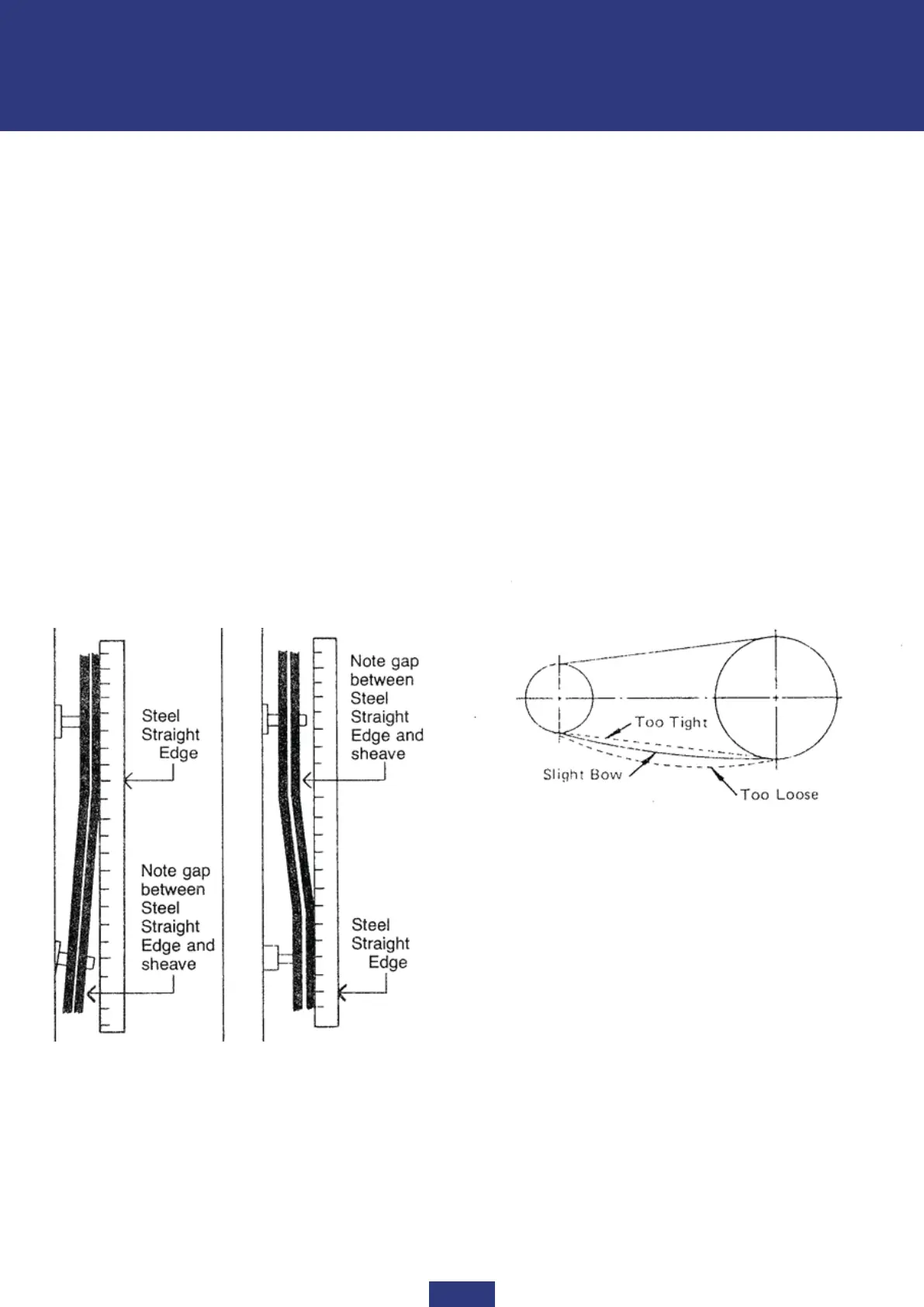
The two most common causes of misalignment are
shown: (a) the shafts of the driver and driven
machines are not parallel, and (b) the sheaves are
not located properly on the shafts. To check align-
ment, all you need is a straight edge or, for drives
with longer centres, a steel tape. If these aren't
available, you can, as a last resort, even use heavy
string. Just line the straight edge or tape along the
outside face of both sheaves as shown in the
illustration. Misalignment will show up as a gap in
between the sheave face and straight edge, or
perhaps as a "break" in the tape or string. Make
sure that the width of the outside land is equal on
both sheaves, when using this method.
V-BELT DRIVE TENSIONING METHOD
Before attempting to tension any drive it is
important that the sheaves be properly installed
and aligned. The V-belts should be placed over the
sheaves and in the grooves without forcing them
over the sides of the grooves.
Step 1: With all belts in their proper groove, adjust
the centres to take up all slack and until the belts
are fairly tight.
Step 2: Start the drive and continue to adjust until
the belts have only a slight bow on the slack side
of the drive while operating under load. See
sketch.
Step 3: After a few days of operation, the belts will
seat themselves in the sheave grooves and it may
become necessary to readjust so that the drive
again shows a slight "bow" in the slack side.
The drive is now properly tensioned and should
operate satisfactorily with only an occasional
readjustment to compensate for belt and groove
wear.



 To Next Page