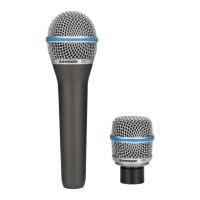
Operating the CL7
Using the Hi-Pass Filter
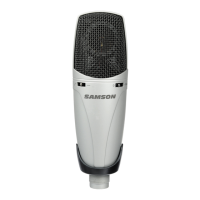
The CL7 offers a user selectable hi-
pass, (or low-cut filter), which you can
use to eliminate any unwanted low fre-
quency reproduction. When the Hi-
pass Filter is set to the “flat” (indicated
by the straight line) position, there is
no effect on the signal. When the Hi-
pass switch is set to the “roll-off” posi-
tion (indicated with the angled line), a
12dB per octave low-cut at 100Hz is
applied to the signal.
This can be extremely useful for
removing low frequency stage rumble,
wind noise during outdoor use, and fil-
tering out lows from drums when used
as overhead cymbal microphone on a
drum kit.
Polar Pattern
The most important characteristic of any microphone is its directionality or “pick-
up pattern”. There are three basic categories of pick up patterns; omni, bi and
uni-directional. Omni mics pick up sound from all directions, bi-directional (fig-
ure 8) mics pick up the sound directly in front and back of the microphone while
rejecting the sound on the left and right sides, and uni-directional (cardioid) mics
pick up the sound in front of the microphone.
While omni and bi-directional microphones are very useful for a variety of appli-
cations, the majority of “miking” situations in recording and live sound require
uni-directional or cardioid microphones. The uni-directional nature allows for
better separation of instruments in the studio and more control over feedback in
live sound reinforcement. When positioned correctly the hyper-cardioid pick-up
pattern allows you to pick up more of the sound you want and less of the sound
you don’t want.
5



 To Next Page