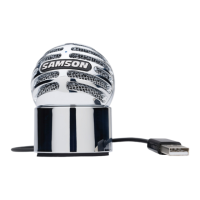
_M_e_t_e_o_r_M_i
c_._u_s_B_S_t_u_d_io_c_o_n_d_e_n_se_r
_M_i_c
_ro .... p_h_o_n_e
__
IIWflii
ll
!i!ilillll!iiii!'BR'
!!&l®ni\!W!i!WWM'IfMtl!li!IIIW!@i[;
,YgJMlt!iliE
/,,
,
,
1
,
,
,
,
,,_,~,
,,,,
,, ,
'
,
Recording Techniques
Acoustic Guitar
There are a variety
of
ways
that
the Meteor Mic can be used
to
mike
an
acoustic guitar.
Optimal
microphone placement will depend
on
the
type
of
instrument, and
what
kind
of
sound you're
looking
to
capture.
It
may be necessary
to
experiment
with
various positions
to
achieve full
and balanced
tone. When
miking a standard
steel
string acoustic,
it
is
suggested
that
you
begin
with
the
microphone at a distance
of
6-12
inches from
the sound hole,
positioned slightly off-axis, and pointing
to-
wards
the
edge
of
the
fingerboard. From this position, moving
the
microphone towards the sound
hole will
cause the mic
to
capture more
low
frequencies.
If,
instead, you wish
to
capture
more high-end,
or
to
remove any unwanted boominess, move
the microphone toward the fingerboard. Unlike a
steel
string acoustic guitar, the sound
of
a
nylon
string acoustic guitar
that
is
played
by
finger picking
is
usually naturally warmer.
To
record
an
even, full tone,
it
is
suggested
that
you begin by positioning
the
microphone
3-6
inches above
the center
of
the
bridge. This will help
emphasize
the
higher frequencies and pick
up
the
attack
sound
of
the
finger picking.
If
the microphone
is
picking
up
too
much
low
frequency from
the
sound
hole, move
the
microphone
so
that
it
is
slightly off-axis from the guitar.
If
you have a pair
of
13



 To Next Page