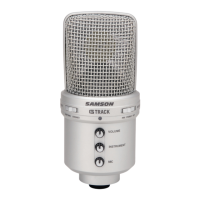
_M_e_te_o_r_M_ic_·_U_S_B_S_tu_d_i_o_C_o_n_d_e_n_s_e_r_M_ic_r_o
..
p_h_o
_n_e
__
~Zmw!MI!i\\Th~"'~'*WW~
l\l*Mffi'\'&
mm.,,·,,,.,,ws""'"'''·"
Recording Techniques
Guitar Amp
Placement
of
the
microphone when recording an electric guitar can impact
the
tone
as
much
as
the
choice
of
instrument and amplifier. Guitar amps are
usually
close-miked
but
consideration
must be made for
the
type
of
signal
the
amp
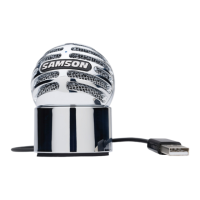
will produce. While condenser microphones like
the
Meteor Mic have fast transient response,
they
cannot handle extreme high
SPL's.
The Meteor Mic
should be placed approximately
4
inches from
the
grill
of
the
amp.
For
a brighter sound,
the
mi-
crophone should face
the
center
of
the
amplifier's speaker cone.
By
moving
the
microphone
off
of
the
center
of
the
speaker,
the
sound becomes mellow, rolling
off
some
of
the
high frequencies.
To
add more
of
the
room sound,
the
microphone can be angled away from
the
amplifier,
or
placed
further away from
the
speaker.
Overhead Drum Kit
Because
of
its extended high frequency response and fast transient response,
the
Meteor Mic
performs exceptionally
well when used
as
an overhead
drum
set microphone.
You
can position
the
microphone approximately centered
5
feet in
front
of
the
drum
kit
12-24
inches above
the
kit. For stereo miking, use
two
microphones
placed
over
the
drum
set at a distance
of
three
to
five
feet.
Even
though
overhead mics are mostly for
the
cymbals, you can
get
the
entire kit
to
sound
great
with
just
two
microphones.
You
should experiment
with
the
exact placement depending on
the
size
of
the
room and whether you're looking for
an
ambient
or
close-miked sound.
15



 To Next Page