
 Need help?
Do you have a question about the Samsung ML 2250 and is the answer not in the manual?
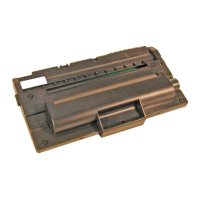
Provides an overview of the Samsung ML-2250 toner cartridge, its engine specs, and comparisons to other models.
Lists the essential tools required for disassembling and reassembling the toner cartridge.
Lists the necessary consumable supplies for performing the toner cartridge remanufacturing.
Details common print defects and their causes, such as streaks, light prints, or repeating marks.
Explains how to interpret the printer's LED lights for diagnosing machine errors and status.
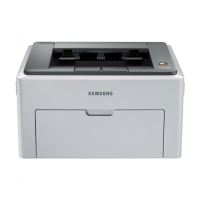
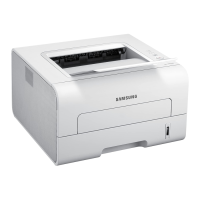
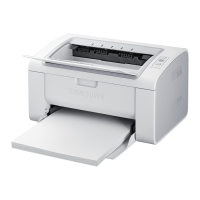
The provided manual details the remanufacturing process for the Samsung ML-2250 toner cartridge, which is compatible with a range of Samsung, Dell, and Xerox printers. This cartridge is a key component in laser printing, responsible for holding and distributing toner onto the drum for image formation. The remanufacturing process outlined in the manual allows for the reuse of these cartridges, offering an environmentally friendly and cost-effective alternative to purchasing new ones.
The Samsung ML-2250 toner cartridge is an integral part of a laser printer's imaging system. Its primary function is to store toner powder and deliver it to the photoconductor drum, which then transfers the image to paper. The cartridge contains several critical components that work in concert to achieve this. The toner hopper holds the toner supply. The developer roller, also known as the magnetic roller, picks up toner from the hopper and charges it, preparing it for transfer to the drum. The doctor blade regulates the amount of toner on the developer roller, ensuring an even layer for consistent print quality. The primary charge roller (PCR) applies a uniform electrical charge to the photoconductor drum, making it receptive to the laser's image. The photoconductor drum, often referred to simply as the drum, is a light-sensitive cylinder that receives the latent image from the laser and then transfers the toner to the paper. Finally, a wiper blade cleans any residual toner from the drum after each print cycle, preparing it for the next image. The cartridge also incorporates a series of gears that drive these components, ensuring their synchronized operation. In many variations of this cartridge, a chip is present to communicate with the printer, monitoring toner levels and page counts, and sometimes enforcing cartridge replacement.
The Samsung ML-2250 toner cartridge is designed for ease of installation and removal in compatible laser printers. While the manual focuses on remanufacturing, the underlying design facilitates straightforward user interaction for replacement. The cartridge is typically inserted into a designated slot within the printer until it clicks into place. The absence of a drum cover on these cartridges simplifies the overall design, though it necessitates careful handling during installation to avoid damaging the drum. The manual notes that new cartridges often come with a piece of heavy paper taped around them, which likely serves as a protective measure for the drum during shipping and initial handling. The various printer models that use this cartridge, such as the Samsung ML2250 series, Samsung SCX-4520, Dell 1600n, Xerox Phaser 3150, and Xerox WorkCentre PE120/PE120i, offer different page yields (3,000 or 5,000 pages at 5% coverage), indicating the flexibility of the cartridge design to accommodate different user needs and printer models. The presence or absence of a chip, and the specific type of chip, dictates the cartridge's compatibility and functionality with different printer models, influencing features like toner level reporting and cartridge authentication. The manual also provides instructions for printing test pages (Demo, Configuration, and Cleaning pages) from the ML-2250 printer, which are essential for diagnosing print quality issues and verifying cartridge functionality after remanufacturing.
The core of the manual is dedicated to the maintenance and remanufacturing of the cartridge, highlighting several key features that enable its refurbishment. The cartridge's design allows for the disassembly of its main components, including the top cover, end caps, PCR, PCR cleaner assembly, drum, developer roller, and associated gears. This modular design is crucial for remanufacturing, as it permits individual components to be cleaned, inspected, and replaced as needed.
Key maintenance steps include:
The manual also includes a section on common cartridge problems and their diagnoses, which serves as a maintenance guide for identifying issues such as light prints, dirty PCR, scratched or chipped drums, bad wiper blades, and bad developer rollers. This diagnostic information is invaluable for remanufacturers to ensure that refurbished cartridges meet quality standards. The machine error codes, indicated by LED patterns on the printer, further aid in diagnosing problems related to the cartridge or printer functionality. Overall, the maintenance features of the Samsung ML-2250 toner cartridge, as detailed in the remanufacturing instructions, highlight a design that supports extensive refurbishment, extending the lifespan of the cartridge and reducing waste.
 General
| Print Technology | Laser |
|---|---|
| Print Speed | 22 ppm |
| Resolution | 1200 x 1200 dpi |
| Connectivity | USB 2.0, Parallel |
| Input Capacity | 250 sheets |
| Output Capacity | 150 sheets |
| Memory | 8 MB |
| Duplex Printing | Manual |
| Media Weight | 60 - 163 g/m² |
| Media Sizes | Letter, Legal, Executive, A4, A5 |




 To Next Page
