
 Need help?
Do you have a question about the Samsung PM871a and is the answer not in the manual?
Legal notice regarding document usage, confidentiality, and restrictions on information disclosure.
Hold SSD by side areas without squeezing; wear anti-static gloves and wrist strap for ESD protection.
Grip opposite connectors if side grip is not possible; avoid touching the connector area.
Do not stack SSDs. Handle carefully on hard surfaces to prevent impact damage.
Avoid dropping, knocking over, or hitting the SSD on surfaces to prevent severe damage.
Do not lay the SSD on solid objects, as this can impact its physical dimensions and cause failure.
Do not touch connectors with metal objects; do not attempt to open the drive casing.
Ensure connectors are fully connected. Connect SATA cables by holding the drive by its sides.
This document outlines the proper handling procedures for a Samsung 2.5-inch Solid State Drive (SSD), emphasizing best practices to ensure its longevity and prevent damage. The guide is designed to help users understand how to interact with the SSD safely and effectively, covering various aspects from physical handling to connection protocols.
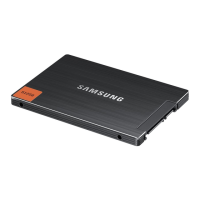
The Samsung 2.5-inch SSD is a storage device designed for high-speed data access and reliable performance. It serves as a modern alternative to traditional hard disk drives (HDDs), offering faster boot times, quicker application loading, and enhanced overall system responsiveness. Its compact 2.5-inch form factor makes it suitable for a wide range of devices, including laptops, desktops, and various embedded systems where space and performance are critical. Unlike HDDs, SSDs use flash memory to store data, which means they have no moving parts. This characteristic contributes to their durability, silent operation, and lower power consumption. The primary function of this SSD is to provide persistent data storage, allowing users to install operating systems, applications, and store files with confidence in its speed and reliability.
The handling guide focuses on the physical interaction with the SSD, which is crucial for its proper functioning and longevity. Key usage features highlighted in the document revolve around careful physical manipulation. When holding the SSD, users are instructed to always hold the side area without squeezing strongly. This prevents undue pressure on the internal components and the casing, which could lead to damage. If holding the side is not feasible, the guide advises holding the area opposite the connectors. This alternative grip ensures that sensitive parts like the connectors are not inadvertently touched or stressed.
A critical aspect of handling is the protection against electrostatic discharge (ESD). The document explicitly states the importance of wearing anti-static gloves and a wrist strap whenever holding or touching the drive. ESD can cause irreparable damage to electronic components, and these precautions are essential to mitigate that risk.
The guide also specifies areas to avoid when handling the SSD. Users are warned not to hold the connector area. The connectors are delicate and crucial for data and power transfer; gripping them can bend pins, loosen connections, or damage the internal circuitry.
Furthermore, the document addresses environmental and physical stress factors. It advises not to stack the SSDs. Stacking can create pressure points, especially if the drives are not perfectly aligned or if heavy objects are placed on top, potentially leading to casing deformation or internal component damage.
The guide strongly emphasizes being careful while handling the SSD on hard surfaces. The SSD is a robust device, but it is not impervious to physical shock. The document illustrates scenarios to avoid, such as dropping the SSD, knocking it over, or hitting it against other objects or surfaces. These actions can cause severe damage to the internal components, even if the external casing appears intact. The SSD could be severely damaged if it hits a hard surface, leading to data loss or complete drive failure.
Another important instruction is not to lay the SSD on solid objects in a way that could impact its physical dimensions. The guide shows an illustration where a solid object could impact the PCB (Printed Circuit Board) or the cover, potentially causing the SSD to fail. This implies that the SSD should be placed on flat, stable surfaces, and care should be taken to avoid placing it on uneven or protruding objects that could exert localized pressure.
Finally, the guide provides instructions on connecting the SSD. It warns not to insert or remove SSD products with partially or loosely connected connectors. This can lead to bent pins, damaged ports, or intermittent connections, which can corrupt data or prevent the drive from being recognized. When connecting a SATA cable, the user is instructed to hold the drive by its sides to ensure a stable and secure connection without stressing the connectors.
While the document is primarily a handling guide rather than a maintenance manual, it implicitly covers maintenance through preventative measures. The core of SSD maintenance, as suggested by this guide, is to prevent physical damage and electrostatic discharge.
The instruction to wear anti-static gloves and a wrist strap is a key maintenance feature, as it prevents ESD damage, which is a common cause of failure for electronic components. By following this, users are actively maintaining the integrity of the SSD's internal electronics.
Avoiding physical impacts such as dropping, knocking over, or hitting the SSD is also a form of preventative maintenance. These actions can lead to structural damage, circuit board fractures, or component dislodgement, all of which compromise the SSD's functionality. By preventing such incidents, users are ensuring the physical health of the drive.
The warning not to touch the connectors with metals and not to attempt to open the drive casing are crucial maintenance guidelines. Touching connectors with metal objects can short-circuit the drive or damage the pins, making it unusable. Attempting to open the casing not only voids the warranty but also exposes sensitive internal components to dust, moisture, and physical damage, which can lead to immediate failure. The casing is designed to protect the internal components, and breaching it compromises this protection.
Proper connection practices, such as ensuring SATA cables are fully and securely connected, are also a form of maintenance. Loose connections can lead to intermittent power or data transfer, causing read/write errors, data corruption, or system instability. By ensuring proper connections, users are maintaining the reliability of data flow to and from the SSD.
In essence, the "maintenance" aspect of this guide is entirely focused on proper handling and environmental control to prevent damage, rather than active repair or cleaning. The SSD, being a solid-state device, generally requires no moving parts maintenance. Its longevity is primarily dependent on preventing physical and electrical stress. Adhering to these handling guidelines is the most effective way to "maintain" the Samsung 2.5-inch SSD and ensure its long-term performance and reliability.
 General
| Form Factor | 2.5-inch |
|---|---|
| Sequential Read Speed | up to 540 MB/s |
| Sequential Write Speed | up to 520 MB/s |
| NAND Type | 3D V-NAND |
| Random Read Speed | up to 98, 000 IOPS |
| MTBF | 1.5 million hours |
| Power Consumption (Idle) | 50 mW |
| Operating Temperature | 0°C to 70°C |
| Storage Temperature | -40°C to 85°C |
| Shock Resistance | 1500 G |
| Interface | SATA 6Gb/s |
| Random Write Speed | up to 90, 000 IOPS |
| Power Consumption (Active) | 2.5W |
| Vibration Resistance | 20 G |
| Dimensions | 100 x 69.85 x 7 mm |
| Weight | 50g |
| Capacity | 128GB, 256GB, 512GB, 1TB |



 To Next Page