EasyManua.ls Logo

Santa Fe ADVANCE120 - User Manual

Default Icon
16 pages
Print Icon
To Next Page IconTo Next Page
Loading...
TS-1152 08/20 Rev B
Installation & Operation Instructions
Santa-Fe-Products.com | 800.533.7533
Serial Number
Install Date
Sold By
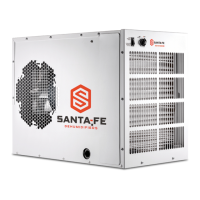
The Santa Fe Advance90 and Advance120
have a horizontal conguration and unique dual
airflow outlets that make them an ideal solution
for basements and crawl spaces. Installation
flexibility makes these units ideal for almost any
application. No conventional dehumidier
can perform as efciently and effectively
in basements and crawl spaces as the
Advance Series.
ADVANCE SERIES | ADVANCE 90
ADVANCE 120
Patent: thermastor.com/patents

Questions and Answers

Summary

Safety Instructions

Dehumidifier Setup

Important Precautions

Highlights critical safety and operational guidelines to prevent hazards and ensure proper function.

Drain Installation

Service and Troubleshooting

Troubleshooting Common Symptoms

Lists common operational issues and their potential causes and solutions.

Performance Troubleshooting

Provides a systematic approach to diagnose and resolve performance-related issues.

Refrigerant Charging

Guidelines for handling refrigerant charge if lost due to leaks or service.

Electrical Requirements

Warranty Information

Overview

The Santa Fe Advance Series dehumidifiers, specifically the Advance90 and Advance120 models, are designed for efficient and effective humidity control in residential settings, primarily basements and crawl spaces. Their horizontal configuration and unique dual airflow outlets offer installation flexibility, making them suitable for various applications where conventional dehumidifiers might not perform as efficiently.

Function Description:

The primary function of the Santa Fe Advance dehumidifier is to remove excess moisture from the air, thereby controlling humidity levels. This is achieved through a refrigeration system powered by a compressor. The unit draws in humid air, passes it over a cold coil where moisture condenses, and then discharges drier air. The condensed water is collected and drained away. The dehumidifier is equipped with a humidity control switch that turns the unit on and off based on the desired relative humidity (RH) set point. It also features a defrost thermostat to prevent internal damage from excessive frost formation, ensuring continuous operation even in cooler conditions.

Important Technical Specifications:

  • Models: Advance90 and Advance120.
  • Configuration: Horizontal.
  • Airflow Outlets: Dual.
  • Electrical Requirements: Plugs into a common grounded 115VAC outlet.
    • Advance90: Draws 5.7 Amps at 80°F and 60% RH.
    • Advance120: Draws 7.3 Amps at 80°F and 60% RH.
  • Circuit Capacity: Minimum 15 Amp circuit capacity recommended.
  • Operating Temperature Range: Designed to operate between 49°F and 95°F, most effectively between 56°F and 95°F.
  • Power Cord Length: 9 feet.
  • Drain Hose: 8 feet included, with a drain adapter.
  • Filter Type: Equipped with MERV-13 air filter (89-90% ASHRAE dust spot). Optional MERV-8 or MERV-11 filters are available.
  • Duct Collars (Optional): 10" diameter for return air inlet and supply air outlets.
  • Certifications: Conforms to unified standard UL 60335-2-40 and CSA standard C22.2.60335-2-40 (ETL Listed).
  • Warranty: 2-year limited warranty on the product, and 6-year limited warranty on components.

Usage Features:

  • Humidity Control Adjustment: An adjustable dial allows users to set the desired relative humidity.
    • "Drier" setting: 35% to 45% RH.
    • "Normal" setting: 45% to 55% RH (recommended for most applications).
    • "Humid" setting: 55% to 65% RH.
    • The unit turns on when RH rises to the set point and turns off when RH is within ±5% of the set point.
    • Setting the control to "dry" in rooms under 65°F is not recommended as it may lead to long periods of ineffective operation.
  • Fan Operation:
    • "FAN ON" mode: The internal blower runs continuously, providing air circulation or filtration even when the unit is not dehumidifying.
    • "FAN AUTO" mode (recommended): The internal blower runs only when the unit is actively dehumidifying.
  • Defrost Cycle: Automatically prevents frost buildup on internal components, allowing the fan to run until normal operating conditions are restored.
  • Drainage: Requires a drain trap for proper operation to prevent air backflow. Condensate is gravity-drained via the included hose. An optional condensate pump kit is available for situations requiring lift to dispose of condensate.
  • Installation Flexibility:
    • Can be placed on a level surface using the included leveling feet.
    • Can be suspended from floor joists using an optional hang kit (feet are installed as a securing measure after hanging).
    • Ducting (Optional): The unit can be ducted to finished areas for more comprehensive humidity control.
      • Return air inlet and supply air outlets can accommodate 10" diameter duct collars.
      • A duct plate is included to block off one of the exhaust outlets if only one is needed.
      • Recommended installations include a "Supply Kit Only" setup (supplying dry air to a finished area from an unfinished basement) and a "Supply and Return Duct Kit" setup (ducting both supply and return air to and from a finished area).
      • An optional remote dehumidistat can be used for external humidity control.
  • Location Considerations:
    • Should be placed near a suitable drain.
    • Requires at least one foot (12") clearance from walls or obstructions for intake/exhaust.
    • Must be installed indoors and in an upright position.
    • Avoid placing where curtains or debris can restrict airflow.
    • Ensure sufficient space for maintenance access, especially for removing the top "L" shaped panel for electrical service.
    • Avoid direct placement on structural building members without vibration absorbers.

Maintenance Features:

  • Filter Replacement: The MERV-13 air filter should be checked and replaced every three to six months to maintain dehumidifier capacity and efficiency. Operating without a filter or with a dirty filter voids the product warranty.
    • Filter replacement involves removing a magnetized filter door, pulling out the old filter, and inserting a new one with arrows facing into the dehumidifier.
    • The unit must be turned off before changing the filter.
  • Drain Line Maintenance: Regularly check the drain line for any buildup of algae or sludge, especially when changing the filter, to ensure proper drainage and prevent water leakage.
  • Troubleshooting: The manual provides a detailed troubleshooting guide for common issues such as fan not running, low dehumidification capacity, or compressor cycling. It emphasizes that troubleshooting should be performed by a qualified HVAC technician due to electrical shock hazards and the high-pressure refrigerant system.
  • Refrigerant Charging: If refrigerant is lost, a new charge must be accurately weighed in, with recovery of any old charge. Refer to the unit nameplate for correct charge weight and refrigerant type.
  • Compressor/Capacitor Replacement: The compressor is equipped with a two-terminal external overload and a run capacitor. This service should only be performed by qualified personnel.

Santa Fe ADVANCE120 Specifications

General IconGeneral
BrandSanta Fe
ModelADVANCE120
CategoryAir Conditioner
LanguageEnglish

Related product manuals