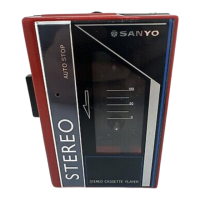
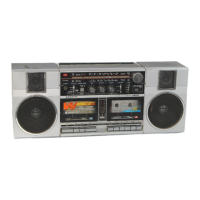
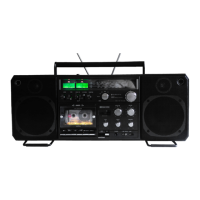
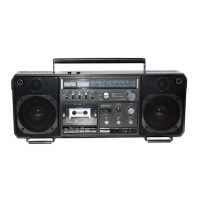
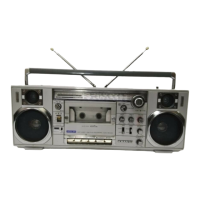
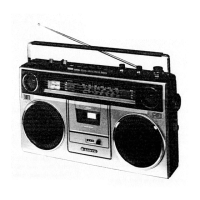
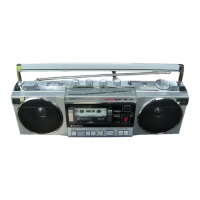
This document is a service manual for the Sanyo M W731L Cassette Recorder, manufactured in Spain. It provides detailed information for servicing and adjusting the device, including disassembly instructions, technical specifications, and circuit diagrams.
Function Description
The Sanyo M W731L is a stereo cassette recorder with an integrated tuner, allowing for both recording and playback of cassette tapes, as well as reception of radio broadcasts across multiple bands. It features a dual-deck system, indicated by "TAPE 'A'" and "TAPE 'B'" references in the azimuth adjustment and motor speed adjustment sections, suggesting capabilities for dubbing or continuous playback. The device includes a "DUBBING SWITCH" with a "NORMAL" setting, confirming its dubbing functionality. It also has a "SURROUND SWITCH" and "SURROUND SPEAKER" terminals, indicating a surround sound feature for an enhanced audio experience. The presence of "CD/LINE IN" terminals allows for external audio sources to be connected and recorded or played through the device. Headphone output is also available for private listening.
Important Technical Specifications
- Recording System: AC bias, 4-track stereo. This indicates a high-quality recording method that minimizes distortion and noise, and the stereo capability provides a rich, two-channel audio experience.
- Erasing System: Magnet erase, 2-track. This is a common and effective method for clearing previously recorded material from cassette tapes.
- Tape Speed: 4.75 cm/sec. (1-7/8 i.p.s.). This is the standard speed for compact cassette tapes, ensuring compatibility with most pre-recorded and user-recorded cassettes.
- Rewind and Fast Forward Time: 110 sec. (C-60). This specification indicates the time it takes to fully rewind or fast forward a C-60 cassette tape, providing an idea of the transport mechanism's efficiency.
- Frequency Range (Tuner):
- LW: 150 - 285 kHz
- MW: 525 - 1,605 kHz
- SW: 5.95 - 18.0 MHz
- FM: 87.5 - 108 MHz
These broad frequency ranges allow the user to tune into a wide variety of radio stations across different broadcasting bands.
- Frequency Response (Cassette): 80 ~ 12,000 Hz. This range indicates the audio frequencies the cassette deck can reproduce, covering most of the audible spectrum for music and speech.
- Output Power: 11W (P.M.P.O.) / 3.5 + 3.5W (MUSIC POWER). This specifies the audio output capability, with 11W Peak Music Power Output and 3.5W per channel for continuous music power, suitable for personal listening or small room environments.
- Power Source:
- DC: 9V, "D" type × 6 (battery operation)
- AC: 120/220V, 50/60Hz (mains operation)
The dual power source capability makes the device portable for outdoor use and suitable for indoor use with mains power. The "VOLTAGE SELECT SWITCH" mentioned in the product safety notice confirms its adaptability to different AC voltages.
- Dimensions (W × H × D): 575 × 136 × 131 mm. These dimensions provide an idea of the physical size of the unit.
- Weight: Approx. 3.4 kg (including batteries). This indicates the portability of the device.
- Terminal Impedance:
- HEADPHONES: 32 ohms
- CD/LINE IN: 47 kohms
These impedances ensure proper matching with standard headphones and external audio sources.
- Speaker Impedance (Tuner Adjustment): 2.7 ohm. This is a specific impedance for the internal speakers, relevant for tuner adjustments.
- Standard Output (Tuner Adjustment): 50mW (0.36V). This is the reference output level for tuner adjustments.
Usage Features
The manual highlights several user-oriented features, particularly in the context of service and adjustment:
- Function Selector: The "RADIO" setting for the function selector indicates easy switching to radio mode.
- Fine Tuning: The "CENTER" setting for fine tuning suggests a precise tuning mechanism for radio reception.
- Dubbing: The "DUBBING SWITCH" and "DUBBING SPEED SWITCH" (mentioned in the product safety notice) confirm the ability to copy tapes, potentially at different speeds.
- Beat Cancel: The "BEAT CANCEL SW" (mentioned in the product safety notice) suggests a feature to reduce interference or "beats" that can occur during recording or playback, especially when dubbing.
- Surround Sound: The "SURROUND SWITCH" and "SURROUND SPEAKER" terminals indicate an immersive audio experience.
- Headphone Jack: A standard headphone jack is provided for private listening.
- CD/Line In: Allows connection of external audio devices like CD players for playback or recording.
Maintenance Features
The service manual is primarily focused on maintenance and repair, providing detailed instructions for technicians:
- Disassembly: Step-by-step instructions with exploded views are provided for removing the cabinet and mechanism, and for removing the P.C. Board. This is crucial for accessing internal components for repair.
- Dial Cord Installation: Detailed diagram and instructions for correctly installing the dial cord, which is essential for proper tuner operation.
- Head Replacement and Azimuth Adjustment:
- Instructions for demagnetizing and cleaning heads after replacement.
- Detailed procedure for adjusting the azimuth of both Tape Deck A and Tape Deck B using a test tape (VTT-703, 10 kHz) and a cross-tip screwdriver to maximize left/right outputs. This ensures optimal sound quality and compatibility with other recordings.
- Motor Replacement and Speed Adjustment:
- Instructions for replacing the motor.
- Procedure for adjusting the motor speed using a test tape (MTT-111N, 3,000 Hz), a VTVM, and a digital counter to achieve a precise 3,000 Hz reading. This is vital for accurate playback and recording speed.
- Mechanism Adjustment:
- Emphasizes cleaning the head, capstan, and pinch roller before measurement.
- Instructions for checking tape-up torque, back tension, and tape tension using specific test cassettes (TW-2111, TW2231, TW-2412). These adjustments are critical for reliable tape transport and to prevent tape damage.
- Tuner Adjustment:
- General advice to use a plastic screwdriver for adjustments.
- Detailed procedures for adjusting the intermediate frequency of MW and FM, including specific input and output connections, SG frequencies, tuning dial positions, and expected VTVM oscilloscope readings.
- Separate adjustment tables for LW, MW, SW, and FM bands, covering tuning, coverage, and tracking.
- FM VCO adjustment procedure, including input signal specifications, pilot signal connection, and SVR501 adjustment to achieve a 76 kHz ± 200 Hz frequency counter reading. This ensures accurate and stable radio reception.
- Circuit Diagrams: Comprehensive schematic diagrams for the amplifier (AMP.) and tuner (TUNER) sections, along with a wiring diagram, are provided. These are indispensable for troubleshooting and component-level repair.
- Product Safety Notice: Highlights the importance of using specified replacement parts for safety-critical components (marked with the IEC symbol) and performing leakage-current or resistance measurements after repairs. This underscores a commitment to user safety and proper repair practices.
- Exploded Views: Detailed exploded diagrams for the cabinet, chassis, and mechanism are included, showing the arrangement of all parts and aiding in correct reassembly.
- Product Code Numbers: Provides specific product codes for different color variants (Gray and Red), useful for ordering correct parts.

 Need help?
 General

 To Next Page