EasyManua.ls Logo

Sanyo PLUS T35 - Display Unit Description; Display Unit Functionality; Dial and Frequency Display Logic

Sanyo PLUS T35
32 pages
Print Icon
To Next Page IconTo Next Page
To Previous Page IconTo Previous Page
Loading...
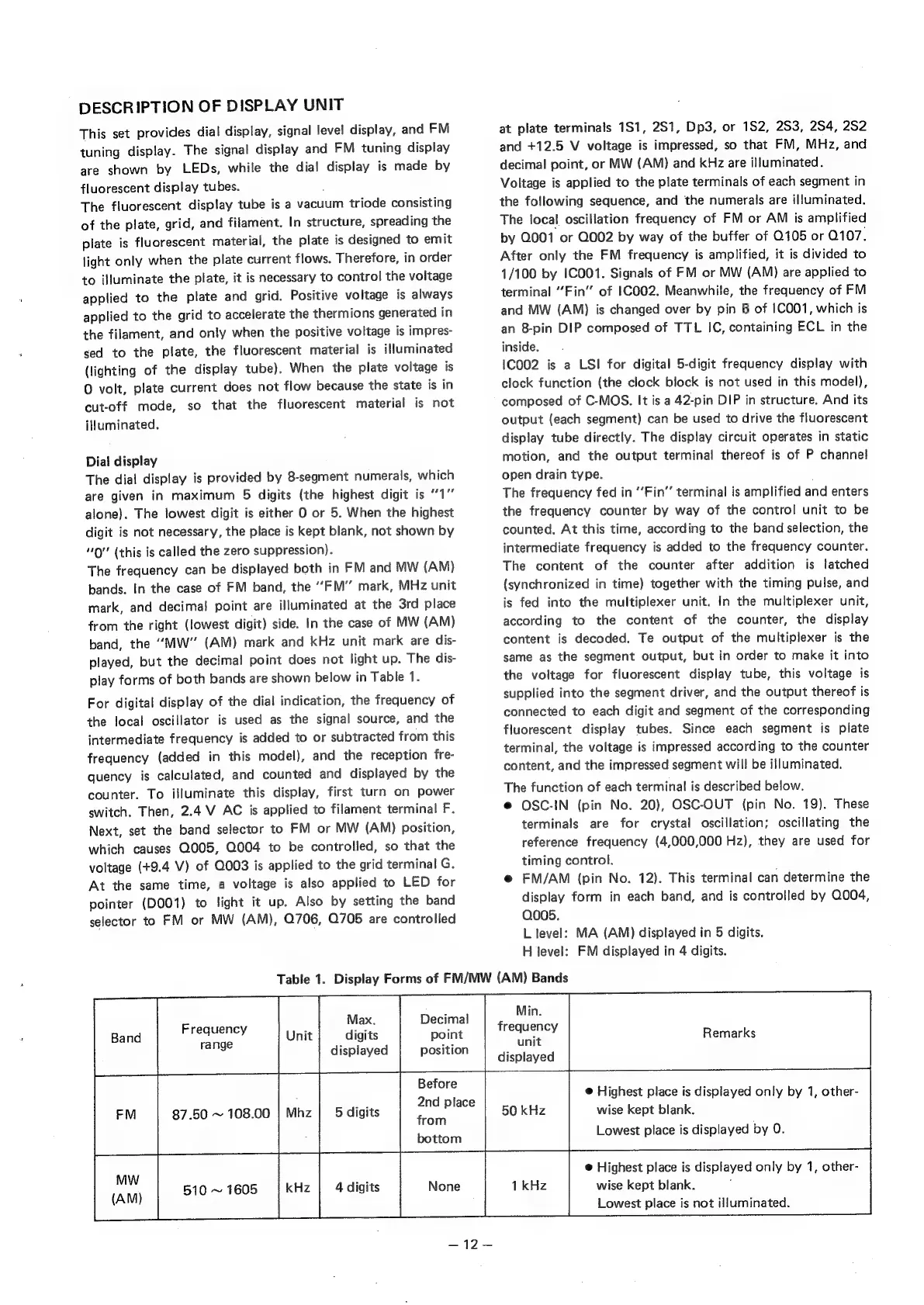
DESCRIPTION
OF
DISPLAY
UNIT
This
set
provides
dial
display,
signal
level
display,
and
FM
tuning
display.
The
signal
display
and
FM
tuning
display
are
shown
by
LEDs,
while
the
dia!
display
is
made
by
fluorescent
display
tubes.
;
The
fluorescent
display
tube
is
a
vacuum
triode
consisting
of
the
plate,
grid,
and
filament.
In
structure,
spreading
the
plate
is
fluorescent
material,
the
plate
is
designed
to
emit
light
only
when
the
plate
current
flows.
Therefore,
in
order
to
illuminate
the
plate,
it
is
necessary
to
control
the
voltage
applied
to
the
plate
and
grid.
Positive
voltage
is
always
applied
to
the
grid
to
accelerate
the
thermions
generated
in
the
filament,
and
only
when
the
positive
voltage
is
impres-
sed
to
the
plate,
the
fluorescent
material
is
illuminated
(lighting
of
the
display
tube).
When
the
plate
voltage
is
0
volt,
plate
current
does
not
flow
because
the
state
is
in
cut-off
mode,
so
that
the
fluorescent
material
is
not
illuminated.
Dial
display
The
dial
display
is
provided
by
8-segment
numerals,
which
are
given
in
maximum
5
digits
(the
highest
digit
is
“1”
alone).
The
lowest
digit
is
either
O
or
5.
When
the
highest
digit
is
not
necessary,
the
place
is
kept
blank,
not
shown
by
“Q''
(this
is
called
the
zero
suppression).
The
frequency
can
be
displayed
both
in
FM
and
MW
(AM)
bands.
In
the
case
of
FM
band,
the
“FM”
mark,
MHz
unit
mark,
and
decimal!
point
are
illuminated
at
the
3rd
place
from
the
right
(lowest
digit)
side.
In
the
case
of
MW
(AM)
band,
the
“MW”
(AM)
mark
and
kHz
unit
mark
are
dis-
played,
but
the
decimal
point
does
not
light
up.
The
dis-
play
forms
of
both
bands
are
shown
below
in
Table
1.
For
digital
display
of
the
dial
indication,
the
frequency
of
the
local
oscillator
is
used
as
the
signal
source,
and
the
intermediate
frequency
is
added
to
or
subtracted
from
this
frequency
(added
in
this
model),
and
the
reception
fre-
quency
is
calculated,
and
counted
and
displayed
by
the
counter.
To
illuminate
this
display,
first
turn
on
power
switch.
Then,
2.4
V
AC
is
applied
to
filament
terminal
F.
Next,
set
the
band
selector
to
FM
or
MW
(AM)
position,
which
causes
Q005,
Q004
to
be
controlled,
so
that
the
voltage
(+9.4
V)
of
Q003
is
applied
to
the
grid
terminal
G.
At
the
same
time,
a
voltage
is
also
applied
to
LED
for
pointer
(D001)
to
light
it
up.
Also
by
setting
the
band
selector
to
FM
or
MW
(AM),
Q706,
Q705
are
controlled
at
plate
terminals
11,
251,
Dp3,
or
182,
283,
254,
282
and
+12.5
V
voltage
is
impressed,
so
that
FM,
MHz,
and
decimal
point,
or
MW
(AM)
and
kHz
are
illuminated.
Voltage
is
applied
to
the
plate
terminals
of
each
segment
in
the
following
sequence,
and
the
numerals
are
illuminated.
The
local
oscillation
frequency
of
FM
or
AM
is
amplified
by
001
or
Q002
by
way
of
the
buffer
of
Q105
or
Q107.
After
only
the
FM
frequency
is
amplified,
it
is
divided
to
1/100
by
ICO001.
Signals
of
FM
or
MW
(AM)
are
applied
to
terminal
‘‘Fin”
of
1CQ02.
Meanwhile,
the
frequency
of
FM
and
MW
(AM)
is
changed
over
by
pin
6
of
1C001,
which
is
an
8-pin
DIP
composed
of
TTL
IC,
containing
ECL
in
the
inside.
1CO002
is
a
LSI
for
digital
5-digit
frequency
display
with
clock
function
(the
clock
block
is
not
used
in
this
model),
composed
of
C-MOS.
It
is
a
42-pin
DIP
in
structure.
And
its
output
(each
segment)
can
be
used
to
drive
the
fluorescent
display
tube
directly.
The
display
circuit
operates
in
static
motion,
and
the
output
terminal
thereof
is
of
P
channel
open
drain
type.
;
The
frequency
fed
in
‘Fin’
terminal
is
amplified
and
enters
the
frequency
counter
by
way
of
the
control
unit
to
be
counted.
At
this
time,
according
to
the
band
selection,
the
intermediate
frequency
is
added
to
the
frequency
counter.
The
content
of
the
counter
after
addition
is
latched
(synchronized
in
time)
together
with
the
timing
pulse,
and
is
fed
into
the
multiplexer
unit.
In
the
multiplexer
unit,
according
to
the
content
of
the
counter,
the
display
content
is
decoded.
Te
output
of
the
multiplexer
is
the
same
as
the
segment
output,
but
in
order
to
make
it
into
the
voltage
for
fluorescent
display
tube,
this
voltage
is
supplied
into
the
segment
driver,
and
the
output
thereof
is
connected
to
each
digit
and
segment
of
the
corresponding
fluorescent
display
tubes.
Since
each
segment
is
plate
terminal,
the
voltage
is
impressed
according
to
the
counter
content,
and
the
impressed
segment
will
be
illuminated.
The
function
of
each
terminal
is
described
below.
@
OSC-IN
(pin
No.
20),
OSC-OUT
(pin
No.
19).
These
terminals
are
for
crystal
oscillation;
oscillating
the
reference
frequency
(4,000,000
Hz),
they
are
used
for
timing
control.
©
FM/AM
(pin
No.
12).
This
terminal
can
determine
the
display
form
in
each
band,
and
is
controlled
by
Q004,
Q005.
L
level:
MA
(AM)
displayed
in
5
digits.
H
level:
FM
displayed
in
4
digits.
Table
1.
Display
Forms
of
FIM/MW
(AM)
Bands
Decimal
point
Position
Frequency
range
Max.
Unit
digits
displayed
MW
24
=o
frequency
displayed
Before
;
iat
2nd
place
FM
87.50
~
108.00
|
Mhz
|
5
digits
fase.
:
bottom
Min.
unit
Remarks
@
Highest
place
is
displayed
only
by
1,
other-
wise
kept
blank.
Lowest
place
is
displayed
by
0.
©
Highest
place
is
displayed
only
by
1,
other-
wise
kept
blank.
Lowest
place
is
not
illuminated.
1
kHz