Need help?
Do you have a question about the Saris Bones 2 and is the answer not in the manual?
Instructions for attaching the initial arms of the bike carrier to the vehicle.
Details on how to securely fasten the carrier to the vehicle using straps.
Guidance on how to place bicycles onto the mounted carrier.
Performing final adjustments and safety checks after initial mounting.
Completing bike loading and performing essential final verification steps.
Details on carrier weight, load capacity, and maximum bike weight.
Critical safety precautions and usage guidelines for the bike carrier.
Liability information, installation warnings, and proper usage responsibilities.
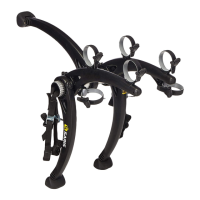
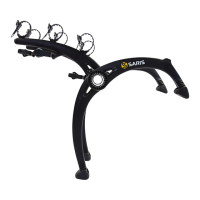
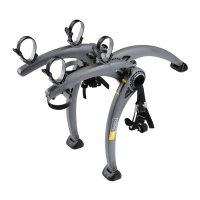
The Saris Bones 2 is a rear-mounted bicycle carrier designed to transport up to two bikes on the back of a vehicle. It is part of the Bones series of cycle racks, known for their distinctive design and functionality. The carrier is designed for ease of assembly and use, providing a secure way to transport bicycles without the need for a roof rack or hitch receiver on all compatible vehicles.
The primary function of the Saris Bones 2 is to securely hold and transport bicycles on the rear of a car. It achieves this by utilizing a system of adjustable legs and straps that attach to the vehicle's trunk or hatch. The carrier's design incorporates a series of adjustable arms and cradles that accommodate various bike frame sizes and styles, holding them firmly in place during transit. The carrier is designed to distribute the weight of the bicycles evenly, minimizing stress on the vehicle and ensuring stability.
The carrier's structure is built around a central spine with three articulated legs that can be adjusted to fit the contours of different vehicle types. These legs are equipped with soft, non-marring feet that rest against the vehicle's paintwork, protecting it from scratches and damage. The upper legs typically rest on the top edge of the trunk or hatch, the middle legs on the bumper or lower part of the trunk, and the lower legs on the lower edge of the trunk or bumper.
Bicycles are mounted onto the carrier's arms, which extend outwards from the central spine. Each arm features two cradles, designed to support the bike's top tube, and a separate anti-sway strap that prevents the bike from swinging during transport. The cradles are often made of a soft, protective material to prevent damage to the bike frame. The bikes are secured to these cradles using straps, typically made of rubber or a similar flexible material, which wrap around the bike frame and hook into the cradles.
The carrier's attachment to the vehicle involves a system of six straps: two upper straps, two side straps, and two lower straps. These straps hook onto the edges of the trunk, hatch, or bumper, and are then tightened to pull the carrier firmly against the vehicle. The tightening mechanism usually involves buckles or cam-lock systems that allow for quick and secure adjustment. Once all straps are tightened, the carrier forms a stable platform for the bicycles.
The Saris Bones 2 offers several features designed to enhance its usability and convenience:
Maintaining the Saris Bones 2 is relatively straightforward and focuses on ensuring its longevity and safe operation:
By following these usage and maintenance guidelines, users can ensure the Saris Bones 2 remains a reliable and safe solution for transporting their bicycles.
 General
| Capacity | 2 bikes |
|---|---|
| Weight | 9 lbs |
| Adjustable Arms | Yes |
| Weight Capacity (per bike) | 35 lbs |
| Assembly Required | No |
| Foldable | Yes |
| Warranty | Limited lifetime |
| Mounting Type | Trunk-mounted |
| Compatibility | Most vehicles |
| Frame Compatibility | Fits most bike frames |
| Straps | 6 straps |
| Strap Type | Ratchet straps |

 To Next Page