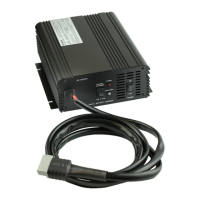
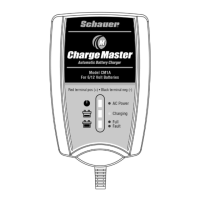
Caution! This charger is intended for use with rechargeable Lead Acid type battery only: Flooded, Gel, AGM, SLA, VRLA
and SLI (starting / automobile). Use with any other type of battery may cause damage or explosion.
Charger Safety Features:
o Reverse Polarity protection
o Short Circuit Protection
o Cooling Fan
o Low voltage turn-on (load sensing)
- Charger requires a minimum battery voltage to begin charging cycle. This protects against trying to
charge a dead or shorted battery. Lower LED would remain off when connected. Minimum voltage is
1/3 charger rated voltage (example: 24 volt charger, minimum battery voltage requirement is 8 volts)
Charger is equipped with a final stage maintenance float mode. You may leave charger attached to the
battery for prolong periods of time and it will not overcharge the battery. Lead acid battery prefer to be in a
charged state. It is recommended to charge your battery after each use. Leaving the charger attached in float
mode will aid against sulfation build-up on the battery’s lead plates and maintain battery in a ready state.
When charger is turned off the LED lights may flash for several seconds as power dissipates from charger. If
AC power is interrupted by a power outage or other, the charger will resume its charge/maintenance cycle
when AC power is restored.
Proper charge rate (charger amperage rating) must be used to prevent damage to battery. Contact battery
manufacturer for recommended charge rate. For a single battery or batteries connected in series (negative to
positive), the battery amp hour (Ah) capacity is that of a single battery. For batteries connected in parallel
(positive to positive and negative to negative), the battery Ah capacity is cumulative of all battery’s Ah.
Only batteries of same Ah rating, size and condition/age should be connected in series or parallel. Combining
batteries of different capacity, age or condition will result in an unbalanced charging of individual batteries in
the pack resulting in possible battery damage.
Caution! Charger operation, connections and proper electrolyte level should be checked routinely.
Proper electrolyte levels for Flooded (Wet), non-maintenance free sealed batteries:
Note: Use distilled/purified water only, unfiltered tap water contains minerals and may cause build up on the
lead plates of the battery.
Confirm correct electrolyte level per your battery’s manufacturer instructions. Check electrolyte level
routinely to avoid exposing lead plates to air; this may cause irreparable damage due to oxidation to the lead
plates reducing the battery’s capacity. Do not fill to correct level prior to charging; this may cause overflow
during charging. It is best to fill battery several hours after charge cycle when the battery has cooled down. If
top of plates are exposed before charging, only add enough water to cover the top of the plates; top off level
after charge cycle and batteries have cooled down. Electrolyte gassing (bubbling) towards the end of charge
cycle is beneficial for the health of the battery. It keeps the electrolyte from stratifying and condensing in the
lower portion of the battery causing uneven charging of the plates. Prolonged gassing will lower electrolyte
level.


 To Next Page
 Loading...