8.2
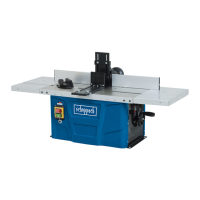
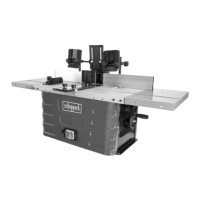
Operating deviations Shaper
Machine vibrates:
- Clamping levers for height and diagonal adjustment are not tightly screwed.
- Sawing tool is not tightly screwed.
Cuts are not clean/wood is burned:
- Sawing tool is dull
- Sawing tool is incorrectly mounted.
Rapid sawing tool wear:
- Sawing tool is incorrectly sharpened.
- Contaminated wood (cement, sand, nails).
Motor becomes too warm:
(It is too hot to touch with bare hands, it continuously shuts itself off.)
- By all means have a qualied electrician inspect the motor.
Machine comes to a stop:
- Overloading (feeding too rapid, sawing tool is dull).
Wood is raised by the rear side of the saw blade:
- Longitudinal limit stops are not parallel
- Splitting wedge is not aligned or crossing is too weak.
The spindle height is difcult to adjust:
- Thoroughly clean and lubricate the threaded rod, gears and slide tracks.
- Check the operation of the clamping lever.
Miscellaneous:
- Bearings make unusual noises: Inspect the bearings and replace if necessary.
- Check the tension of the V-belt (V-belts are accessible when the exhaust cover is removed).
8.1
Operating deviations Saw
Machine vibrates:
- Clamping levers for height and diagonal adjustment are not tightly screwed.
- Sawing tool is not tightly screwed.
Cuts are not clean/wood is burned:
- Sawing tool is dull
- Sawing tool is incorrectly mounted.
Rapid sawing tool wear:
- Sawing tool is incorrectly sharpened.
- Contaminated wood (cement, sand, nails).
Motor becomes too warm:
(It is too hot to touch with bare hands, it continuously shuts itself off.)
- By all means have a qualied electrician inspect the motor.
Machine comes to a stop:
- Overloading (feeding too rapid, sawing tool is dull).
Wood is raised by the rear side of the saw blade:
- Longitudinal limit stops are not parallel
- Splitting wedge is not aligned or crossing is too weak.
The spindle height is difcult to adjust:
- Thoroughly clean and lubricate the threaded rod, gears and slide tracks.
- Check the operation of the clamping lever.
Miscellaneous:
- Bearings make unusual noises: Inspect the bearings and replace if necessary.
- Check the tension of the V-belt (V-belts are accessible when the exhaust cover is removed).
8.0 Malfunctions
GB
8.3 Planer-thicknesser
Operating deviations
If your machine is maintained properly, it is unlikely that any problems will arise.
If the motor will not run:
- check the electrical system is switched on
- check that the machine is connected to the power supply
- drop in voltage (should be checked by a qualified electrician)
- Check the position of the vacuum exhaust sensor
When the machine tables are hard to adjust:
- grease the threaded rods, sliding surfaces, etc.
If the machine runs at an abnormally slow speed:
- the cutters are blunt
- depth of cut too great (adjust according to the hardness and width of the timber, and the condition of the cutters)
- drive rollers are dirty (clean them)
- table not clean or surface in a state of deterioration
- the drive belt is slipping
The machine vibrates:
- cutters are blunt or badly adjusted
- the cutters used are of different sizes (matching set only must be used)
- uneven floor mounting (adjust floor stand accurately)
The machine locks during planing:
- uncouple the drive
- switch off the motor
- remove cutter by lowering the planing table a little way
- reduce depth of cut and begin again, gradually reapproaching the planed depth
If a heel forms or the face is uneven after surfacing:
- the cutter is set higher than the exit table
- the workpiece is running incorrectly on the work tables
- see also “machine vibrates”
35


 To Next Page
 Loading...