Need help?
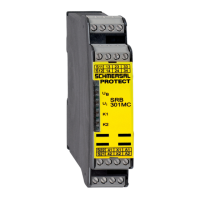
Do you have a question about the schmersal SRB 301MC and is the answer not in the manual?
Provides information for mounting, set-up, and commissioning of the safety-monitoring module.
Operations must be carried out by trained specialist personnel authorized by the plant operator.
Explains symbols used in the operating instructions, including information and warning notes.
Describes the intended use of the products for safety-related functions in plants and machines.
User must observe safety instructions, country-specific standards, and accident prevention rules.
Inadequate or improper use can lead to personal hazards or damage to machinery.
Manufacturer accepts no liability for damages from defective mounting or unauthorized parts.
Lists the available options and their descriptions for ordering the safety relay module.
Details specifications for special versions not covered in the standard order code.
Explains the function of safety-monitoring modules for safety circuits in control cabinets.
Provides detailed technical specifications, including general, mechanical, and electrical data.
Outlines safety classifications according to ISO 13849-1, IEC 61508, and IEC 60947-5-1.
Instructions for mounting the module onto standard DIN rails (EN 60715).
Provides the physical dimensions (H/W/D) for different models of the safety relay module.
Covers electrical connection safety and principles for the module.
Explains the status indications provided by the LEDs (K1, K2, UB, U).
Details the function of each terminal for voltages, inputs, outputs, and start functions.
Important notes regarding signalling outputs, automatic reset, and handling components.
Steps for testing the safety function of the module, including checks for fixing, cables, and enclosure.
Recommendations for regular visual inspection and functional tests, including fault detection intervals.
Instructions for safely disassembling the safety-monitoring module.
Guidelines for disposing of the safety-monitoring module according to regulations.
Provides various wiring diagrams for different control configurations and applications.
Explains how to configure the module for external reset or automatic start modes.
Details sensor configurations for emergency stop and guard door monitoring circuits.
Describes actuator configurations for single-channel and dual-channel control with feedback circuits.

 To Next Page
 General