Defining Your Goals
Your body will do what you train it to do. That’s why it’s important to define and focus on your goals.
Here are some fitness components that will help you define your goals and choose your fitness program.
MUSCLE STRENGTH is the maximum force you can exert
against resistance at one time. Your muscle strength comes
into play when you pick up a heavy bag of groceries or lift
a small child. It is developed when a localized muscle is
worked both positively (concentric) and negatively
(eccentric) at a resistance great enough to perform only
five to eight repetitions of the exercise before the muscle
fails. Each set of repetitions is followed by a rest interval
that typically runs three times longer than the set. Later,
between exercise sessions, the muscle overcompensates for
the stress and usually increases in both strength and size.
MUSCLE ENDURANCE is the ability to perform repeated
contractions. It comes into play when you cross-country
ski or work on your feet all day. Endurance training
addresses the slow twitch, endurance muscle fibers, which
depend on oxygen for energy. To develop muscle
endurance, use low resistance and high repetitions —
about 15-20 repetitions in each set, three sets to each exer-
cise, working the muscle only to fatigue.
MUSCLE POWER is the combination of strength and
speed of the muscular contraction. This is often misinter-
preted as:
a) Being directly associated with certain skill or sport
and/or
b) Meaning that you must move fast.
Load is actually a more important factor than speed when
attempting to improve power. When training to achieve
muscular power, pick a resistance that fatigues you in the
3-5 repetition range. When performing these reps, it is
more important to think of contracting the muscles faster
rather than attempting to move faster. Performing sport
simulation exercises usually results in a deterioration of the
motor pattern or skill. The biomechanically sound method
of improving power in your sport is to train for power
using the correct joint movements, as described in this
manual. Then practice the skill associated with your sport,
learning to apply this newly achieved power.
BODY COMPOSITION is the ratio of fat weight (fat) to
lean weight (muscles, bones and tissue). As you age, the
ratio shifts. The fat weight increases and the lean weight
decreases. Training for muscle strength will generally
increase muscle size and aerobic conditioning will help
burn extra calories. Performing these two forms of exercise,
either at different times or together, will create the greatest
changes in body fat weight.
BALANCED STRENGTH and alignment is the result of
equal strength developed in all parts of the body. It comes
into play in your standing and sitting posture, and in your
ability to perform just about any activity safely and effec-
tively. An over-development of the back will round the
shoulders; weak or stretched abdominal can cause lower
back pain. You want a balance of muscle strength in front
and back. In addition, you need a balance of strength
between your middle, lower, and upper body.
FLEXIBILITY is the ability of a muscle or group of mus-
cles to move the joint through a full range of motion.
Flexibility comes into play when you execute an overhand
serve or stretch for the top shelf in the kitchen. It is a
cooperative movement of opposite muscle groups. When a
muscle contracts, its opposite muscle group must relax for
the action to occur. Increased flexibility means an
increased range of motion, made possible by this simulta-
neous contracting and relaxing. Good flexibility is impor-
tant in protecting the body from injury and can be
achieved through the balanced strength training programs
included in this manual.
CARDIOVASCULAR ENDURANCE is the ability of the
heart and lungs to supply oxygen and nutrients to exercis-
ing muscles over an extended period of time. It comes into
play when you jog a mile or ride a bike. It is a critical
component of overall fitness and health. Any exercise pro-
gram must be supplemented with cardiovascular training,
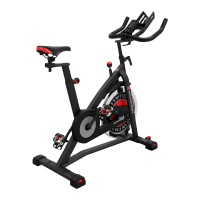
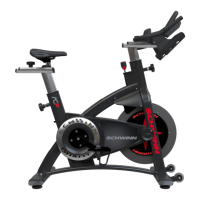
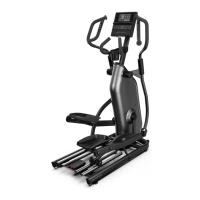
such as rowing on the Schwinn Comp. Please check with
your local Schwinn Fitness dealer or visit www.schwinnfit-
ness.com for more cardio fitness equipment such as tread-
mills, ellipticals and exercise bicycles.
7


 To Next Page