50
Once the engine is running, use the mixture knob to get a smooth idle. Let the engine warm up to normal
operating temperature. Once warmed up, attempt to set the knob near the center position (12 o’clock).
To do this will most likely require adjustments to the RPM FUEL values. If the knob is on the rich side of
12 o’clock, the RPM FUEL values are too low and vice versa.
On F systems, you must set the MAGNET POSITION parameter as soon as the engine is idling
smoothly before performing any other adjustments. Refer to that section of the manual. For
Lycoming using SDS factory hall bracket Magnet Position values are preset already.
Fine tuning RPM FUEL values
We normally want to aim for around 12 to 1 AFRs and this is best determined using a wideband AFR
meter. You can read the AFRs in gauge 3 or 4 screens. AFR is displayed as O2 in Gauge 4 as shown
below.
Correcting the Mixture Using a Wideband AFR Meter
Example #1: At 2500 RPM say, we have an RPM FUEL value of 108. The A/F ratio is 14.7, but we
would like to make the A/F ratio 13.5.
Correction=14.7/13.5
Correction= 1.09.
Now we multiply the RPM FUEL value by 1.09.
108 x 1.09=117.7. Round off to 118.
Example #2: At 2000 RPM say, we have an RPM FUEL value of 108. The A/F ratio is 12.5, but we would
like to make the A/F ratio 13.5.
Correction=12.5/13.5
Correction= 0.93
Now we multiply the RPM FUEL value by 0.93.
108 x 0.93=100.44. Round off to 100.
With a wideband sensor, best power will usually occur with an A/F ratio of around 12.5:1, however
automotive type engines may not tolerate running this lean due to piston thermal considerations and air
cooled aircraft engines may not cool sufficiently. We recommend most engines be set up to run around
11 to 11.5 AFR during high power conditions- WOT, takeoff and climb. See the appropriate supplemental
manual for your engine type for more detailed specific information.
Manifold Pressure, MAP or MP
There are 64 programmable ranges in the manifold pressure chart for adjusting fuel. Data in the manifold
pressure chart determines the relationship intake manifold pressure and the amount of fuel injected.
Aviation EM-6 systems are calibrated in inches of mercury absolute. There are 3 different MAP sensors
used with the system which cover a different range of pressures. All units are pre-programmed with a
standard MAP value chart depending on the MAP sensor used. These values should be close, so most
initial programming is usually done on the RPM FUEL values. MAP values generally increase in a near
linear fashion as manifold pressure increases. Your MAP values should never go up and down like
a saw tooth.
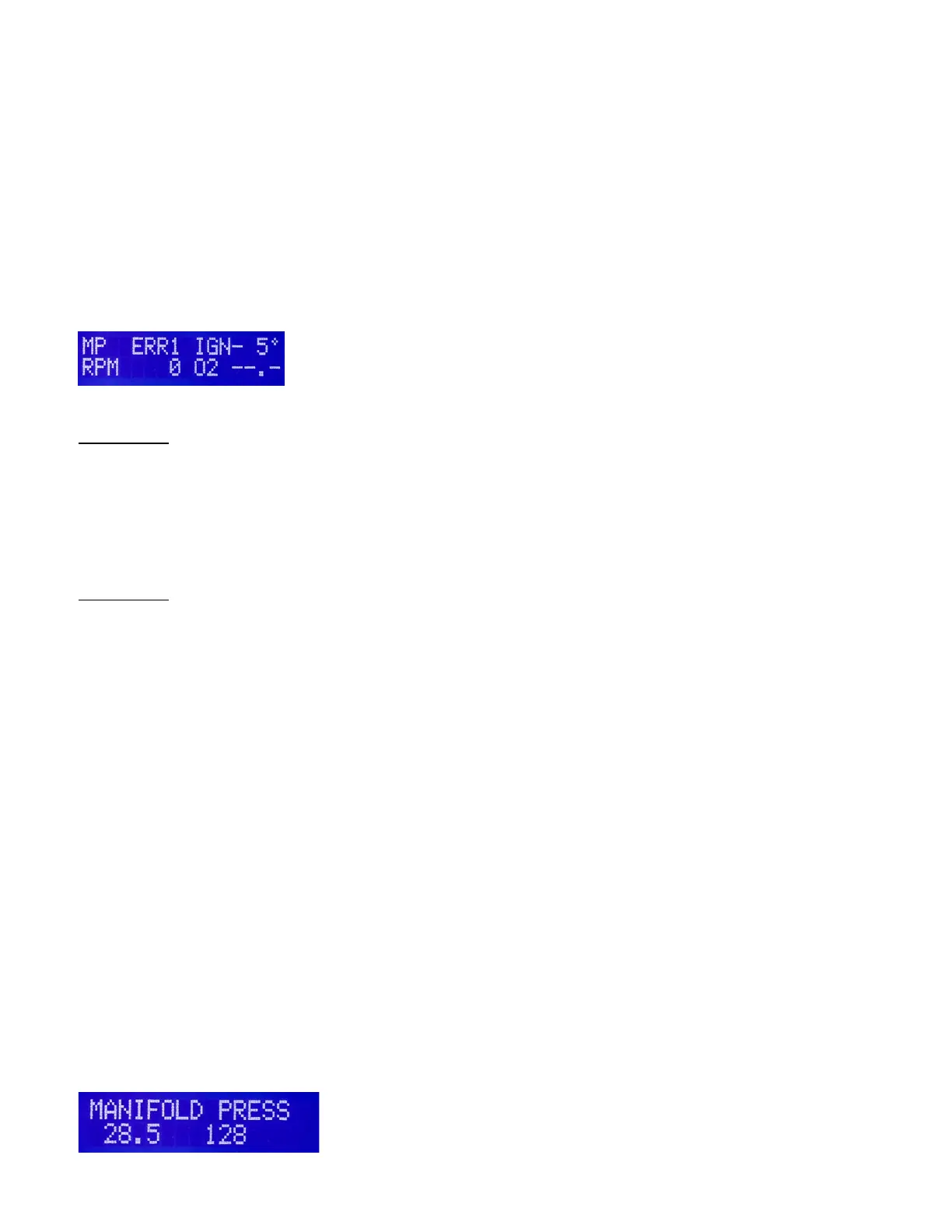
Example Manifold Pressure window, manifold pressure is 28.5 in AB, and the fuel number is 128.


 To Next Page
 Loading...