54
Generally in aviation applications if using leaded fuel, do not use the closed loop function due to reduced
O2 sensor life with these fuels, O2 life can be shortened to a few hours sometimes with leaded fuel. For
engines using unleaded avgas or Mogas, closed loop may be used.
When Closed Loop is set to Off, then the ECU makes the fuel injection pulse based solely on RPM Fuel
and Manifold Pressure fuel values and other fuel values in the system. This is often referred to as open
loop control.
When Closed Loop is turned On, then what happens is the fuel values are still used to get a base fuel
injection amount just like open loop, but then a correction amount is added or subtracted based on the
Wideband O2 signal feedback. If the AFR is leaner than target the ECU will begin adding to a correction
amount which gets added onto the base injection amount. Conversely, if the AFR is richer than Target
AFR then the ecu will begin subtracting the correction amount with ability to go negative thus making the
correction subtract some fuel from the base fuel amount. Note that this action does not reprogram any
values in the system, so none of your fuel values get changed, so in other words this is not a self tuning
type of system but a temporary, at the moment, type of correction. This method had been used in
automotive fuel injection for decades to target 14.7:1 AFR to keep exhaust emissions low. Difference
here with SDS is you can adjust the Target AFR to whatever is required, be it power, economy, or
cooling.
In the event that the wideband feedback does not function correctly, there are fixed limits for correction of
+/-25% as well as error detection if too much trim occurs but the ecu is not seeing enough change in
AFR. If ERR2 is seen in Gauge5 screen then this indicates software did not see enough change in AFR
during correction. There can be some reasons for this, not that the O2 wideband has a failure but this
could come from a large change in AFR target from one RPM Range to the next, or from changing
throttle very slowly but not enough to restart the O2 checking. Generally the O2 error checking only
occurs in steady state running, steady rpm steady throttle conditions. ERR2 can be cleared by pressing +
key in Gauge5 or other gauge screens 1-4. If ERR2 is present Closed loop does not operate. O2 sensors
do have a finite lifespan and in aircraft this can be a shorter life than in automotive applications due
mainly to high power operation most of the time, whereas automotive is mostly part throttle. One
symptom of O2 failure is the AFR reading is frozen and does not change at all if you suspect this turn the
mixture knob richer or leaner the AFR reading should change immediately, if not there is a problem with
the wideband, most likely the sensor or broken wiring connection.
By watching Gauge5 screen you can observe the amount of correction required to achieve the Target
AFR, and this is very good data to observe and utilize to make changes to RPM Fuel values. If you are
seeing a correction amount of 15% or more, then it is recommended to observe what RPM range the
engine is in, and make an adjustment to that RPM Fuel value, then less correction will be required and
the AFR will be much closer to Target the moment the engine enters that particular RPM range.
Closed Loop RPM and MP limits
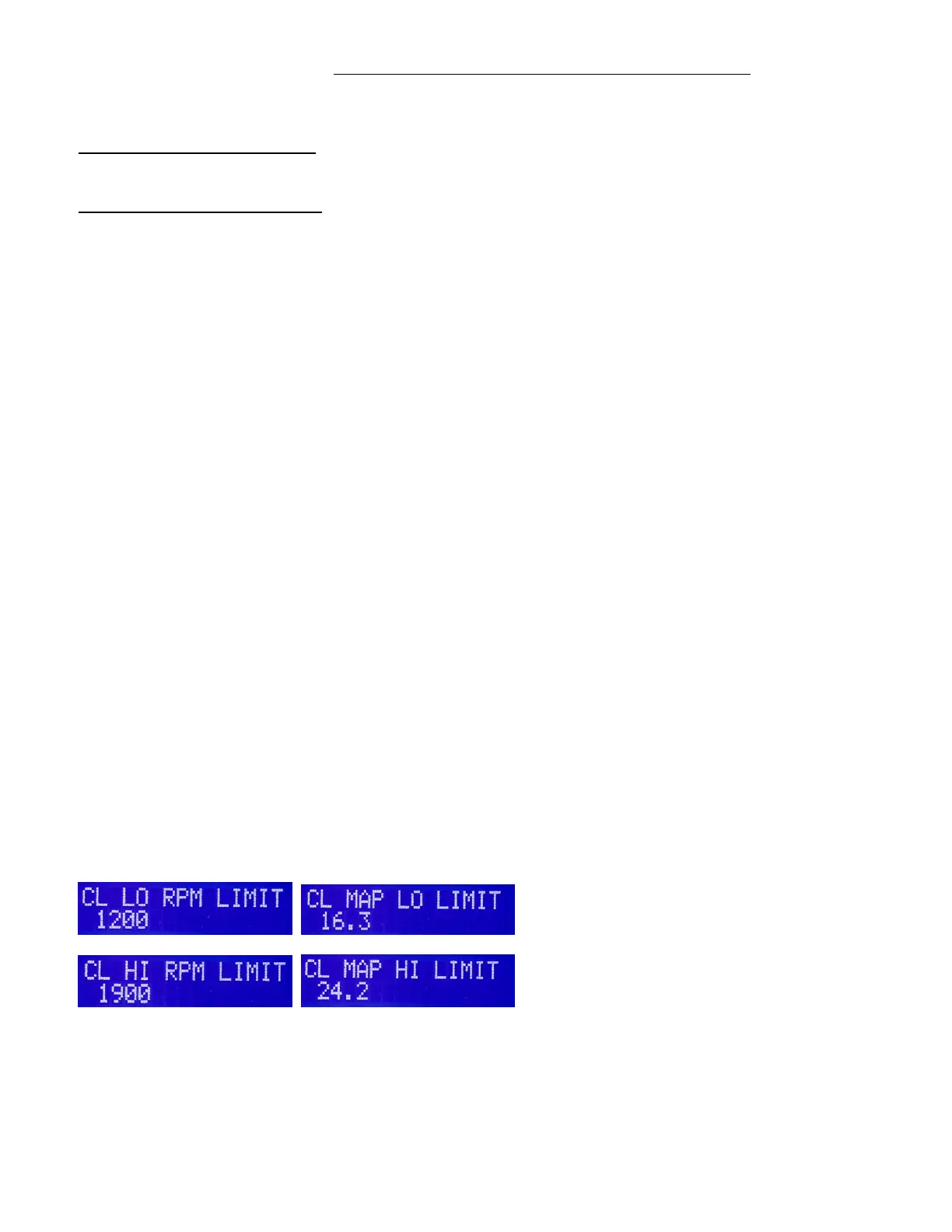
We define automatic closed loop operation with 4 main boundaries, LO and HI RPM and LO and HI MAP
as shown below:
When RPM or MAP is outside of any one of these boundaries, the ECU will jump out of closed loop, back
into open loop, running off your programmed values.
To enable closed loop, select this window below, using the + button to scroll through the closed loop
enable/ disable options.


 To Next Page
 Loading...