1. SAFETY
1.1. ELECTRICAL SAFETY
WARNING! It is the user’s responsibility to check the following:
Check all electrical equipment and appliances to ensure that they are safe before using. Inspect power supply leads, plugs and
all electrical connections for wear and damage. Sealey recommend that an RCD (Residual Current Device) is used with all electrical
products. You may obtain an RCD by contacting your local Sealey dealer.
If the product is used in the course of business duties, it must be maintained in a safe condition and routinely PAT (Portable
Appliance Test) tested.
Electrical safety information, it is important that the following information is read and understood.
1.1.1. Ensure that the insulation on all cables and on the appliance is safe before connecting it to the power supply.
1.1.2. Regularly inspect power supply cables and plugs for wear or damage and check all connections to ensure that they are secure.
1.1.3. Important
correct fuse - see fuse rating in these instructions.
8 DO NOT pull or carry the appliance by the power cable.
8 DO NOT pull the plug from the socket by the cable.
8 DO NOT use worn or damaged cables, plugs or connectors. Ensure that any faulty item is repaired or is
1.1.4.
If the cable or plug is damaged during use, switch off the electricity supply and remove from use.
Ensure that the cable outer sheath extends inside the cable restraint and that the restraint is tight.
1.1.5. If an extension reel is used it should be fully unwound before connection. A reel with an RCD fitted is
preferred since any appliance plugged into it will be protected. The cable core section is important and should be at least 1.5mm², but
to be absolutely sure that the capacity of the reel is suitable for this product and for others which may be used in the other output sockets,
we recommend the use of 2.5mm² section cable.
1.2. GENERAL SAFETY
DANGER! BE AWARE, LEAD-ACID BATTERIES GENERATE EXPLOSIVE GASES DURING NORMAL BATTERY OPERATION.
FOR THIS REASON, IT VERY IMPORTANT TO READ AND FOLLOW THESE INSTRUCTIONS CAREFULLY, EACH TIME YOU USE
THE CHARGING EQUIPMENT.
1.2.1. Follow these instructions and those published by the battery and vehicle manufacturers, and the maker of any equipment you intend to
use in the vicinity of the battery. Remember to review warning marks on all products and on engines.
WARNING! Modern vehicles contain extensive electronic systems.
YouarerequiredtocheckwiththevehicleManufacturer,foranyspecicinstructionsregardingtheuseofthistypeof
equipment on each vehicle.
1.2.2.
1.3. PERSONAL PRECAUTIONS
1.3.1. Ensure there is another person within hearing range and close enough to come to your aid, should a problem arise when working near a
lead-acid battery.
9
9 Have fresh water and soap nearby in case battery acid contacts skin, clothing or eyes.
9
running water for at least 15 minutes and seek immediate medical attention.
9 Remove personal metallic items such as rings, bracelets, necklaces and watches. A lead-acid battery can produce a short-circuit current
which is high enough to weld a ring or the like to metal, which would cause severe burns.
9 Ensure hands, clothing (especially belts) are clear of fan blades and other moving or hot parts of engine, remove ties and contain long hair.
8 DO NOT smoke or allow a spark or flame in the vicinity of battery or engine.
C
Original Language Version
ear
Protective
Gloves
arning:
Electricity
Protect
From
Rain
se in
ell
entilated
Areas
Keep away
from sources
of ignition:
attery could
explode
Refer to
Instruction
Manual
arning:
Explosive
Material
ear eye
Protection
arning:
Corrosive
substance
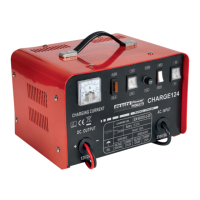
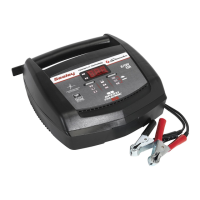
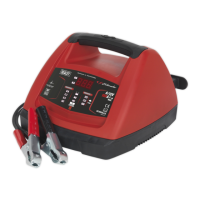
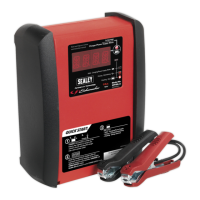
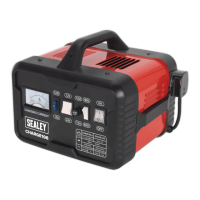
BATTERY CHARGERS 8/11/14/16/19/28AMP 230V
CHARGE 106.V3/107.V3/110.V3/112.V3/115.V3/124.V3
Recommended fuse rating
13 Amp


 To Next Page
 Need help?
 General