Need help?
Do you have a question about the Sealey PW1712 and is the answer not in the manual?
Safety precautions for electrical connections and supply.
Comprehensive safety advice for operating the pressure washer.
Instructions for detaching, filling, and re-attaching the water tank.
Guidance on selecting and using power sources (12V battery or vehicle socket).
How to connect the hose, gun, and operate the pressure washing function.
Instructions for using the detergent dispensing system with the nozzle.
Steps for attaching and using the brush accessory with the nozzle.
Guidelines for charging and maintaining the pressure washer's battery.
Procedures for maintaining the pump unit, fuse, and nozzle.
Advice on recycling and disposing of waste materials responsibly.
Compliance with Waste Electrical and Electronic Equipment regulations.
Steps for safely removing and disposing of the battery.
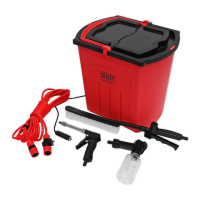
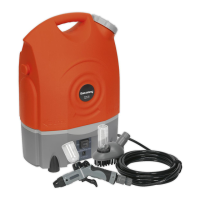
The Sealey PW1712 is a lightweight, portable, cordless pressure washer designed for a variety of domestic cleaning tasks, including vehicles, motorcycles, and bicycles. Its cordless nature makes it ideal for situations where a mains electric supply is unavailable, such as classic car shows or track days.
The device operates using a 12V power source, either directly from a vehicle's accessory socket or from its internal rechargeable lead-acid battery. The battery provides up to 40 minutes of continuous use, offering flexibility for cleaning tasks away from power outlets. It features a 17-liter water tank that can be easily detached from the base for convenient refilling. The unit comes equipped with a 6-meter hose, a variable nozzle, and a fixed brush, both of which include built-in detergent bottles for integrated cleaning. For enhanced portability and storage, the PW1712 includes an accessory storage pouch, durable wheels, and a shoulder strap.
Before initial use, the battery should be fully charged. It is recommended to keep the battery fully charged and to recharge it after each use. If the machine is not used regularly, the battery should be charged at least every three months. To charge the battery, insert the pin jack into the socket located below the selector switch and connect the charger to a 230V mains supply.
To prepare the washer for use, the water tank must first be detached from the base by turning it 1½ turns anti-clockwise and lifting it off. The tank cap can then be unscrewed to fill it with clean water. It is crucial to use only clean water; non-filtered water or corrosive chemicals will damage the cleaner and invalidate the warranty. Detergents should not be added directly to the main water tank; instead, use the dedicated detergent bottles supplied with the machine. After filling, re-attach the tank to the base by pushing down and turning clockwise to lock.
The washer offers two power source options: directly from a vehicle's 12V accessory socket or from its internal 12V battery. A rocker switch allows selection of the desired power source, with the center "O" setting serving as the "OFF" position. If using the 12V accessory socket, plug the adaptor into the vehicle. It is advisable to keep the vehicle engine running while using the washer in this mode. Remember to switch off and disconnect from the vehicle when not in use.
For pressure washing, connect the hose and gun to the machine by pulling back the connector on the hose and pushing the hose onto the gun. Once connected, the pump will build up initial pressure and stop until the trigger on the gun is pulled to release the pressurized water. The trigger can be locked on by pushing it fully forward. The spray pattern can be adjusted by rotating the collar on the nozzle. The unit incorporates an automatic stop switch that turns off the pump when the trigger is released. Always discharge any residual pressure in the hose before removing tools or attachments.
The detergent dispenser is integrated into the nozzle. The detergent bottle can be removed by unscrewing it from the nozzle body. After filling with appropriate detergent, invert the body and screw the bottle back into place. Detergent flow is controlled by moving a control lever, which, when fully clockwise, starts the flow. The detergent is dispensed by water displacement from the nozzle, meaning the detergent level does not visibly decrease, but its strength is diluted by the incoming water. Once the detergent is exhausted, remove the bottle, empty it, and refill with neat detergent.
For the brush attachment, unscrew the collar on the nozzle as far as possible and pull to remove the variable nozzle. Replace it with the brush attachment, locking it in by aligning the lugs on the brush with the holes in the nozzle body. When using the detergent system with the brush, keep the empty bottle on the nozzle and turn the control lever to the 'off' position. To use detergent with the brush, fill the brush bottle and fit it, then turn the control wheel to release the detergent.
The pump unit itself does not require regular maintenance. The 12V connector lead is protected by an 8A fast-blow cartridge fuse in the accessory socket. If this fuse blows, it must be replaced with an identical fuse. Should the nozzle become blocked, gently run the nozzle cleaning tool through it to remove any deposits. Alternatively, when disconnected from the hose, the nozzle can be back-flushed with either water or air to dislodge blockages. When not in use, the machine should be drained, hoses removed, and stored in a cool, frost-proof location, out of reach of children.
It is crucial to adhere to safety guidelines. Never use the washer if any part of the unit, gun, nozzle, detergent bottle, hose, or cables are damaged. Only replace or repair using genuine parts; unauthorized parts can be dangerous and will invalidate the warranty. Always ensure connections are securely fastened and undamaged before use. Be aware of potential hazards during use and understand the washer's applications and limitations. Maintain the washer in good condition and have it serviced by an authorized agent. Wear appropriate protective clothing, goggles, and anti-slip rubber-soled footwear. Ensure adequate air circulation around the washer to prevent overheating. Keep all persons and animals at a minimum distance of 15 meters from the washer during operation. The high-pressure jet can propel loose particles at high speed, potentially causing serious injury. Never use the washer on materials containing asbestos, as this could release hazardous asbestos particles into the atmosphere. Do not touch the charger with wet hands, direct the jet against yourself, other persons, animals, electrical equipment, or the machine itself. Avoid using the washer if tired or under the influence of alcohol, drugs, or intoxicating medication. Do not use flammable or toxic liquids or any other product with the washer; only use recommended detergents. Non-recommended detergents may corrode the machine cover and accessories. Do not connect other appliances to the machine's inlet or outlet, and do not move the unit by pulling hoses or electrical cables; always use the handle. Store the unit in a frost-proof, dry, childproof location when not in use.
For environmental protection, unwanted materials should be recycled rather than disposed of as waste. All tools, accessories, and packaging should be sorted and taken to a recycling center. When the product becomes completely unserviceable, drain any fluids into approved containers and dispose of the product and fluids according to local regulations. At the end of its working life, the product must be disposed of in compliance with the EU Directive on Waste Electrical and Electronic Equipment (WEEE) in an environmentally protective way. The battery should be removed by unscrewing four screws on the bottom of the base, removing the cover, sliding out the battery, and disconnecting it. Dispose of the battery in an environmentally protective way, adhering to the Waste Batteries and Accumulators Regulations 2009.
 General
| Power | 1700 W |
|---|---|
| Max Pressure | 120 bar |
| Flow Rate | 468L/hr |
| Weight | 10.5 kg |
| Hose Length | 8 m |
| Cable Length | 5 m |
| Voltage | 230 V |
| Model | PW1712 |
| Motor Power | 1700 W |

 To Next Page