WARNING! Before performing any maintenance operation,
switch off the compressor, disconnect from electricity
supply and release all air from the tank (except for 5.3.a)
5.1. Operations to be carried out after the first 50 working hours:
a) Check that all bolts/nuts are tight, particularly those
retaining the crankcase and cylinder head.
b) Replace the lubricating oil - see para 5.5.
5.2. Operations to be carried out weekly:
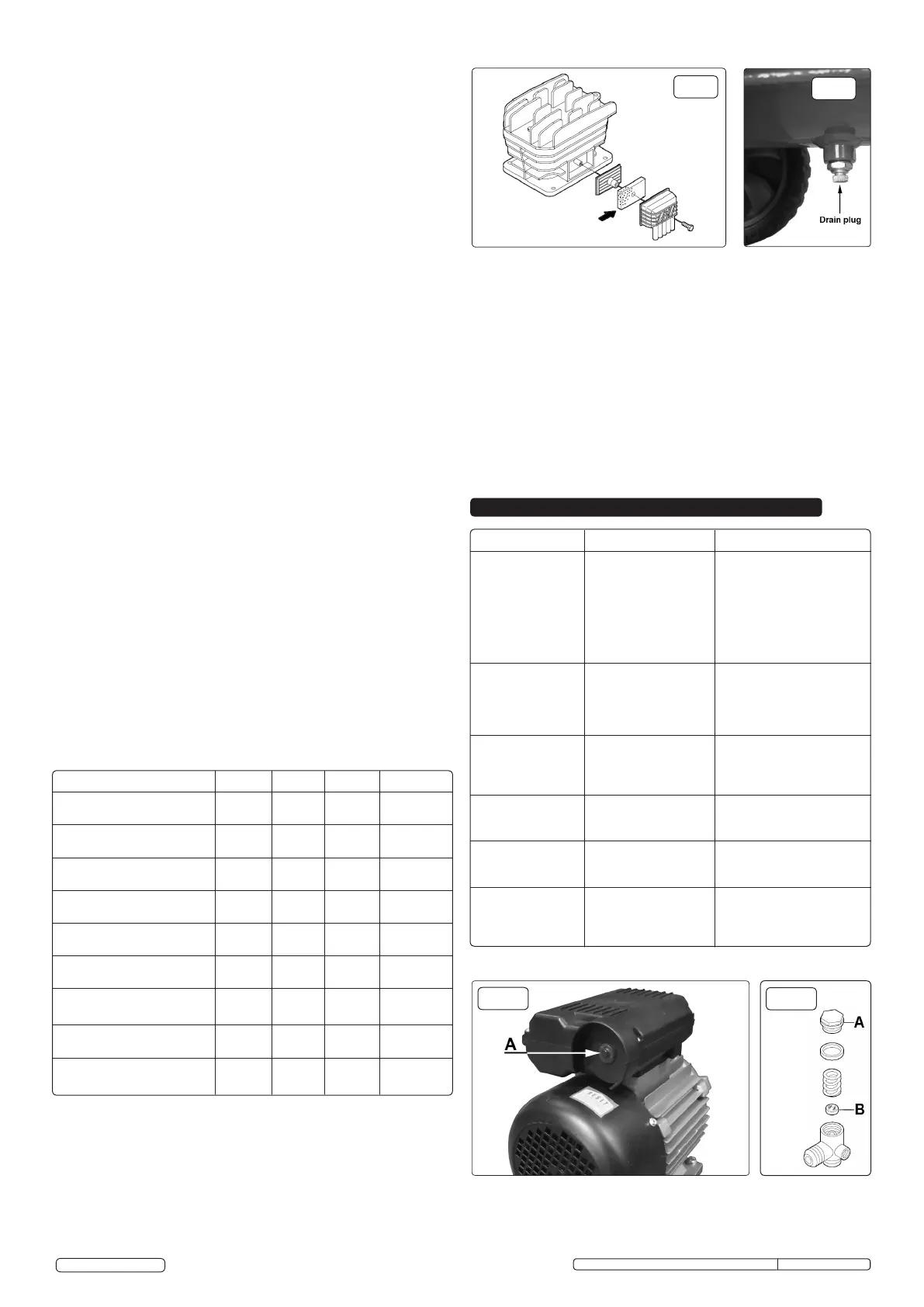
a) Drain condensation by opening the valve located under the
tank (fig.9). Place a container under the valve and open the
valve by turning anti-clockwise.
WARNING! Take care if there is still pressure inside the cylinder
as water could flow out with considerable force.
Recommended pressure 1 - 2bar max.
b) Check oil level and, if necessary, top up.
5.3. Operations to be carried out every 50 hours
(or more frequently, if the compressor operates in a very
dusty atmosphere):
a) Remove the air filter element (fig.8). Using stored air from
the compressor's tank, clean the filter with compressed air.
(Wear eye protection and DO NOT direct air towards the
body or hands). DO NOT operate the compressor without
the filter as foreign bodies or dust could seriously damage
the pump. Replace the filter element and air filter housing.
b) Check for oil leaks.
5.4. Operations to be carried out every 100 hours:
a) Check the automatic cut-out at max. pressure and the
automatic cut-in at 2bar below.
5.5. Operations to be carried out every 400 hours:
a) Replace the lubricating oil. For oil specifications see 5.7.
Remove the filler/breather plug (see fig.4) then remove oil
drain plug, draining the oil into a container. Drain when the
compressor is hot so that the oil drains rapidly and
completely. Incline compressor to ensure complete
drainage. Replace oil drain plug and refill through the filler/
breather aperture. Do not overfill. Replace plug.
WARNING! Never mix different oils and do not use non-
detergent/low quality oils as the compressor may be
damaged.
WARNING! Dispose of waste oil only in accordance with
local authority requirements.
b) Replace air filter. (See fig.8)
c) Check all tube fittings and electrical connections.
d) Inspect pressure tank inside and out for damage or corrosion.
5.6. Maintenance Schedule
fig.9
Maintenance Operations Weekly 50hrs 100hrs 400hrs
Drain condensation
•
Check oil level
•
Clean intake filter
•
Check for oil leaks
•
Replace oil
•
Check cut-out
•
General cleaning of
compressor
•
Replace air filter
•
Check tube fittings and
electrical connections
•
5.7. Recommended oils
Synthetic oil suitable for temperatures ranging from -5°C to 45°C:
viscosity 5W50. We do not recommend using mineral oil in these
compressors.
Part No. Qty Description
FSO1 1ltr x 12 Compressor oil fully synthetic
FSO1S 1ltr x 1 Compressor oil fully synthetic
FSO5 5ltr x 1 Compressor oil fully synthetic
5.8. IMPORTANT WARNING - Air contaminants taken into the
compressor will affect optimum performance. Example: Body
filler dust or paint overspray will clog the pump intake filter and
may cause internal damage to pump/motor components. Please
note that any parts damaged by any type of contamination will
not be covered by warranty.
6. TROUBLE SHOOTING
Fault Cause Remedy
Pressure drop in the
tank.
Air leaks at
connections.
Run compressor to max.
pressure, switch off.
Brush soap solution over
connections and look for
bubbles. Tighten connections
showing leaks. If problem
persists contact Authorised
Service Agent.
Pressure switch
valve leaks when
compressor is idle.
Non-return valve seal
defective.
Discharge all tank pressure.
Referring to fig.11, unscrew
valve cap 'A'. Clean rubber
disc 'B' and its seat. Refit all
parts accurately.
Compressor stops
and does not restart.
Power failure.
Motor failure.
Check electricity supply and
fuse.
Contact Authorised Service
Agent.
Compressor does
not stop at max
pressure.
Pressure switch fault. Contact Authorised Service
Agent.
Compressor does
not reach max
pressure.
Filter clogged.
Head gasket or valve
fault.
Replace filter element.
Contact Authorised Service
Agent.
Compressor noisy
with metallic knock.
Low oil level.
Bearing or piston
damage.
Turn off and top up oil
immediately.
Contact Authorised Service
Agent.
fig.8
fig.10
fig.11
Inspection of pressure tank both inside and out.
Under the PRESSURE SYSTEMS SAFETY REGULATIONS 2000 it is
the responsibility of the owner of the compressor to initiate a system of
inspection that both denes the frequency of the inspection and appoints
a person who has specic responsibility for carrying out the inspection.
Original Language Version
SAC2103B.V2, SAC2153B.V2, SAC2203B.V2 Issue: 1 - 30/10/13
© Jack Sealey Limited


 To Next Page
 Loading...