Need help?
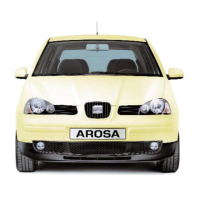
Do you have a question about the Seat Arosa 2003 and is the answer not in the manual?
Provides important information, tips, and notes on passive safety in the AROSA.
Explains the importance and function of seat belts for accident protection.
Details how properly worn seat belts reduce kinetic energy and injury risk.
Guides on correctly fastening a 3-point seat belt for maximum protection.
Explains the function of belt tensioners to supplement Air Bag protection.
Provides warnings and instructions for safely securing child seats.
Details the Air Bag system as a passive safety feature supplementing seat belts.
Explains specific reasons and procedures for deactivating Air Bags, especially for child seats.
Identifies and explains the various controls and indicators on the instrument panel.
Details the meaning and function of various warning lamps on the instrument panel.
Covers procedures for opening and closing the vehicle, including keys and central locking.
Explains the operation, features, and safety precautions for electric windows.
Provides instructions for operating the sliding/tilting roof and emergency procedures.
Details the operation of exterior and interior lighting, including switches and controls.
Covers front seat adjustment, heated seats, head restraints, and luggage space.
Explains the operation of the heating, ventilation, and air conditioning systems.
Provides guidance on manual and automatic gearboxes, driving programmes, and selector lever positions.
Explains how to apply and release the handbrake and associated warnings.
Details the ignition lock positions for petrol and diesel engines and vehicle operation.
Provides general notes and procedures for starting the engine safely.
Instructions for filling the fuel tank, including notes on fuel types and safety.
Information on petrol types, octane ratings, and additives for optimal engine performance.
Details diesel fuel specifications, RME fuel properties, and winter driving considerations.
Covers general brake notes, effects of road conditions, and overheating issues.
Explains systems like Servobrake, ABS, and EDL for enhanced vehicle safety.
Provides guidance on running-in, economical driving, and vehicle care for environmental impact.
Covers technical requirements, operations, and driving tips for towing a trailer.
Details vehicle care, washing procedures, and paint protection methods.
Provides instructions for checking and refilling essential fluids and components.
Covers procedures for replacing spark plugs, dust/pollen filters, and accessories.
Covers emergency procedures, tools, spare wheel, changing wheels, and tyre maintenance.
Explains fuse locations, replacement procedures, color codes, and automatic fuses.
Provides general information on technical data, engine specifics, performance, and fuel consumption.
Details vehicle weight specifications, including maximum authorized and axle loads.
Illustrates and describes the fixing points for retrofitting a tow hook.
Explains how to locate and interpret vehicle identification data, type plates, and stickers.
Provides detailed engine specifications for various petrol engine variants.
Lists key vehicle dimensions, including length, height, wheelbase, and wheel gauge.
Specifies tyre pressure recommendations for summer and winter tyres.
 General
| Brand | Seat |
|---|---|
| Model | Arosa 2003 |
| Category | Automobile |
| Language | English |

 To Next Page