Need help?
Do you have a question about the Segway Ninebot KickScooter and is the answer not in the manual?
Adherence to general safety rules and best practices for riding.
Guidelines for who can ride, rider age, and environmental conditions.
Precautions for charging, using accessories, and modifications.
List of items included in the package and optional accessories.
Visual overview of KickScooter parts and explanation of dashboard functions.
Step-by-step instructions for assembling the KickScooter.
Detailed guide for installing an optional second battery pack.
Steps for app installation, connection, and KickScooter activation.
Instructions and precautions for charging the KickScooter's battery.
Guidance on basic riding techniques, balance, and acceleration.
Warnings about riding in rain, over obstacles, and managing speed.
Precautions for throttle use, obstacles, road types, and handle control.
Guidelines on carrying objects, riding posture, and passenger limits.
Advice on riding in water and avoiding specific environmental conditions.
Instructions for folding the KickScooter and carrying it.
Guidance on cleaning, proper storage, and maintaining the battery pack.
Detailed technical data for different KickScooter models.
Information regarding product certifications and regulatory compliance.
Details on intellectual property and legal disclaimers.
Contact details for customer service and technical support.
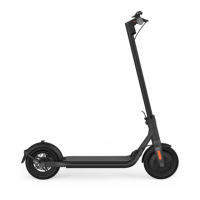
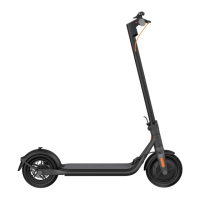
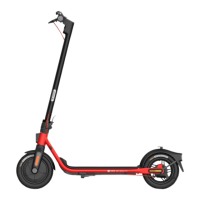
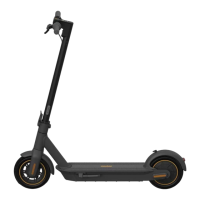
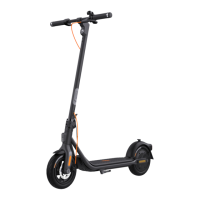
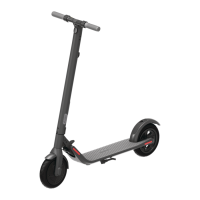
The Ninebot KickScooter ES series is a fashionable recreational transporter designed for personal mobility, offering a blend of convenience, safety, and connectivity. It is an electric scooter that allows riders to travel efficiently and interact with a global community through its mobile application.
The KickScooter's primary function is to provide personal transportation. It is equipped with an electric motor that propels the scooter, controlled by an electronic throttle on the handlebar. For stopping, it features both an electric brake and a foot brake, which should be used together for maximum braking capability, especially in emergencies. The scooter's dashboard displays essential information such as current speed, power mode, and battery level, ensuring riders are always informed about their ride status. It also includes a headlight for visibility and safety during low-light conditions.
A key feature of the KickScooter is its connectivity. Through the Ninebot by Segway App, riders can connect their mobile devices via Bluetooth to activate the scooter, access tutorials, monitor its status, and receive firmware updates. This app-integration enhances the user experience by providing real-time data and fostering a connected riding community. The scooter supports different power modes—Sport mode for maximum power and speed, Standard mode for moderate performance, and Speed limit mode for minimum power and increased range—allowing riders to adjust their experience based on their needs and environment.
The ES series KickScooter is designed for a single rider and is not intended for carrying passengers or heavy objects. It is suitable for riders between 14 and 60 years old, with a recommended height range. The device is also designed with a folding mechanism, making it easy to carry and store when not in use.
Before the first ride, users must install the Ninebot by Segway App, register, and log in. The scooter requires activation through the app, which includes a New Rider Tutorial to ensure users understand basic operation and safety instructions. Until activated, the KickScooter operates at a very low speed and beeps occasionally as a safety reminder. The app also allows for ongoing firmware updates, ensuring the scooter operates with the latest features and safety protocols.
To start riding, the user stands on the footrest with one foot and pushes off with the other to initiate gliding. Once balanced, the throttle on the right hand can be pressed to accelerate. For safety, the motor will not engage until the scooter reaches a minimum speed of 1.8 mph (3 km/h). Turning is achieved by shifting body weight and slightly turning the handle.
Braking involves releasing the throttle, quickly stirring the brake handle thumb shifter, and simultaneously stamping the rear fender with the foot to engage mechanical braking. It is crucial to use both electric and foot brakes together for effective stopping, especially in emergency situations, to prevent falls or collisions.
The KickScooter is designed for use on asphalt and flat pavements, avoiding obstacles greater than 0.4 inches (1 cm) and gaps greater than 1.2 inches (3 cm). It is not recommended for use in snow, rain, or on wet, muddy, icy, or slippery roads, as this can lead to loss of balance and falls. Riders should also avoid riding over loose sand, gravel, or sticks.
For enhanced safety, riders are advised to wear an approved helmet and other protective gear. They should always be alert, scanning both far ahead and in front of the scooter for obstacles and low-traction surfaces. Respecting pedestrians by yielding the right of way, passing on the left, and slowing down when approaching from behind are essential practices. The KickScooter should not be ridden on public roads, motorways, or highways where prohibited by local laws.
The device is designed for easy folding and carrying. To fold, the rider steps on the folding pedal while pushing the handlebar forward slightly, then folds the handlebar down until it locks into the rear fender. Once folded, the scooter can be lifted by the stem for convenient transport.
Regular maintenance is crucial for the longevity and safe operation of the KickScooter. Cleaning the mainframe can be done with a soft, wet cloth. For stubborn dirt, a toothbrush and toothpaste can be used, followed by cleaning with a soft, wet cloth. Scratches on plastic parts can be polished with fine-grit abrasive paper. It is important to avoid using alcohol, gasoline, acetone, or other corrosive/volatile solvents, as these can damage the scooter's appearance and internal structure. The KickScooter should never be washed with a power washer or hose. Before cleaning, ensure the scooter is powered off, the charging cable is unplugged, and the rubber cap on the charge port is tightly sealed to prevent damage to electronic components.
Battery pack maintenance is vital. The battery should be stored and charged within specified temperature limits. Puncturing the battery is strictly prohibited. To maintain optimal performance, the battery should be charged after each ride, and complete draining should be avoided. A well-maintained battery can perform effectively even after many miles. Battery range and performance are best at room temperature (70°F [22°C]) and decrease in colder temperatures. The battery range typically recovers as the temperature rises.
A fully charged battery can retain its charge for 120-180 days in Standby Mode, while a low-power battery retains charge for 30-60 days. Charging the battery after each use is recommended, as completely draining it can cause permanent damage, which may not be covered by the Limited Warranty. Disassembling the battery is not permitted due to the risk of fire and the absence of user-serviceable parts.
Before each ride, riders should check for loose fasteners and damaged components. If the KickScooter makes abnormal sounds or signals an alarm, riding should be stopped immediately, and the device should be diagnosed via the Ninebot by Segway App, with service sought from a dealer or distributor if necessary. Using only Ninebot or Segway approved parts and accessories is recommended, as modifications can interfere with operation, cause serious injury or damage, and void the Limited Warranty.
 General
| Max Load | 220 lbs (100 kg) |
|---|---|
| Battery | Lithium-Ion |
| Connectivity | Bluetooth |
| Foldable | Yes |
| Lights | rear brake light |





 To Next Page