1.3. Main Technical Specications
Range of radiated frequencies 2–3GHz
Max. peak radiated power < 2W
Antenna polarisation elliptic
Operation modes SEARCH
AUDIO
ADAPT
Sensitivity range in manual mode 40dB (5 values with 8dB increment)
Response indication
– visual three 16-segment LED gauge bars
– aural internal speaker or headphones
Power supply two 3.7V rechargeable Li-ion batteries
(type 18650)
Time of operation on one battery charge 3-4 hours, depending on the operation mode
Battery charging time < 3 hours
Operating conditions
– working temperature range +5...+40°С
– relative air humidity up to 85 percent (at 25°С)
Weight (with batteries) 1,75kg
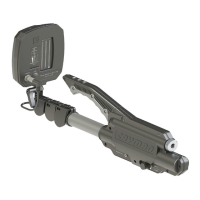
Dimensions (length×width×height)
– when folded
510х145х130mm
– with telescopic arm pulled out completely
1500х250х130mm
Weight of full set in case 5,8kg
1.4. Principles of Operation
ST 40
2 Cayman is a nonlinear junction detector, or NLJD. Instruments of this type employ
active detection, i.e. they emit probing signals and analyse the return. Their primary search targets
are electronic devices, and those typically consist of circuit plates with conductive elements and
various semiconductor parts connected to them, such as diodes, transistors, and microchips.
The probing electromagnetic radiation induces variable electromotive forces in these loops, and
electronic components with a non-linear current-voltage curve transform the initial signal into its
higher frequency harmonics, which come back to the NLJD’s receiver.
Higher harmonics can also be re-radiated by corroded metal or the so-called MOM-diodes,
metal-oxide-metal structures brought about by contacting metal surfaces. However, these
formations return somewhat different spectra than semiconductors.
With ST 40
2 Cayman one can distinguish with high probability between responses given by
real semiconductors, and those ‘faked’ by MOM-structures or corrosion. Another important
advantage is a condent detection of search targets behind partially shielding obstacles, which is
achieved by simultaneously radiating several frequencies within the 2-3GHz band and analysing
the composite picture of the reection spectrum.
OPERATING MANUAL
24


 To Next Page