EasyManua.ls Logo

Sencore TF151 - Zero Bias Drain Current (IDSS) Testing; IDSS Impact and Example

Default Icon
24 pages
Print Icon
To Next Page IconTo Next Page
To Previous Page IconTo Previous Page
Loading...
Leakage
in
an
FET
is
extremely
low,
and any
indication
of
leakage
on the
TFISI
can
be
considered
bad,
indicating,
a
defective
FET
.
The
actual
maximum
leakage
rating
can
be
found
in
the
Sencore
FET
and
Transistor
Reference
Book
supplied
with the
TFlSl.
If
the
Field
Effect
transistor
is
a
dual
gate
type, the
leakage
of the
second
gate
can
be
easily
checked
by
simply
setting
the
Function
switch
to
the
LEAKAGE (lG2SS)
position
and
reading
the
meter
on
the
leakage
scale
fOT
leakage
of
the
second
gate.
The
gate
leakage
of an
FET
is
extremely
small
and
may
not
appear
to
move
the
point-
er
of
the
me
ter
at
all.
If
the
meter
moves
any
amount
on
an
FET,
the
FET
can
be
considered
defective
and
should
be
replaced.
To
check
to
see
if
the
meter
has
moved
you
may
disconnect
the
gate
lead
from
the
FETwhile
watching
the
meter
needle
when
checking
for
leakage.
Any
movement
of
the
meter
when
connecting
or
disconnecting
the
gate
lead
indicates
a
leakage
and
a
defective
FET.
ZERO
BIAS
DRAIN
CURRENT
(lOSS)
Zero
bias
drain
current
or
lOSS
is
a
very
important
paramet
er to
the
FET.
This
test
is
used
to
match
and
"CUL
L"
FETs
for
various
circuits
and on the
production
line.
An
FET
may
have
a
very
wide
range
of
lOSS
and
will
have
to be
selected
to
work
in
the
various
circuits
designed
by
the
different
manufacturers
.
In
a
balanced
bridge
circuit
or
differential
amplifier,
the
two
FETs
must
be
matched
for
Gm
and
lOSS
for
the
circuit
to
be
balanced
and
work
properly.
In
a
cascode
amplifier
circuit,
the
upper
FET
should
have a
zero
bias
drain
current
of
two to
four
times
that
of the
lower
FET
for
best
gain
and
stability
of the
circuit.
Thus,
the
manufacturers
will
select
the
FETs
to
match
the
circuit
and
will
generally
color
code
them.
When
or-
dering
replacement
FETs
from
the
manufacturers.
be
sure
to
specify
the
color
code
of
the
FET
for
best
operation
of
the
circuit.
With
the
TFlS1,
the
lOSS
check
will
give
you the
actual
zero
bias
drain
current
for
depl
e
tion
type
FET's.
Enhancement
type
FET's
are
forward
biased
and lOSS
is
not
measured.
However,
the
drain
test
current
that
is
indicated
when the lOSS
button
is
pushed
is
useful
for
matching,
culling,
etc.
The
following
example
shows
how the
zero
bias
drain
curr
e nt
can
affect
the
circuit
and
if
the
wrong
value
is
chosen,
the
possibility
of
failure
in a
very
short
period
of
time
is
great.
The
example
is
with the
depletion
type
FET,
but
the
readings
ob-
tained
with the
enhancement
mode
FET
can
be
used
for
similar
calculations
as
well
as
FET
matching.
If
a
replacement
type
FET
is
put
into
a
circuit,
the
zero
bias
drain
current
should
be
checked
with the
TF1S1
and
the
power
dissipated
across
the
FET
calcula
ted, to be
sure
that
you do
l]Ot
exceed
the
maximum
rating
of
the
device.
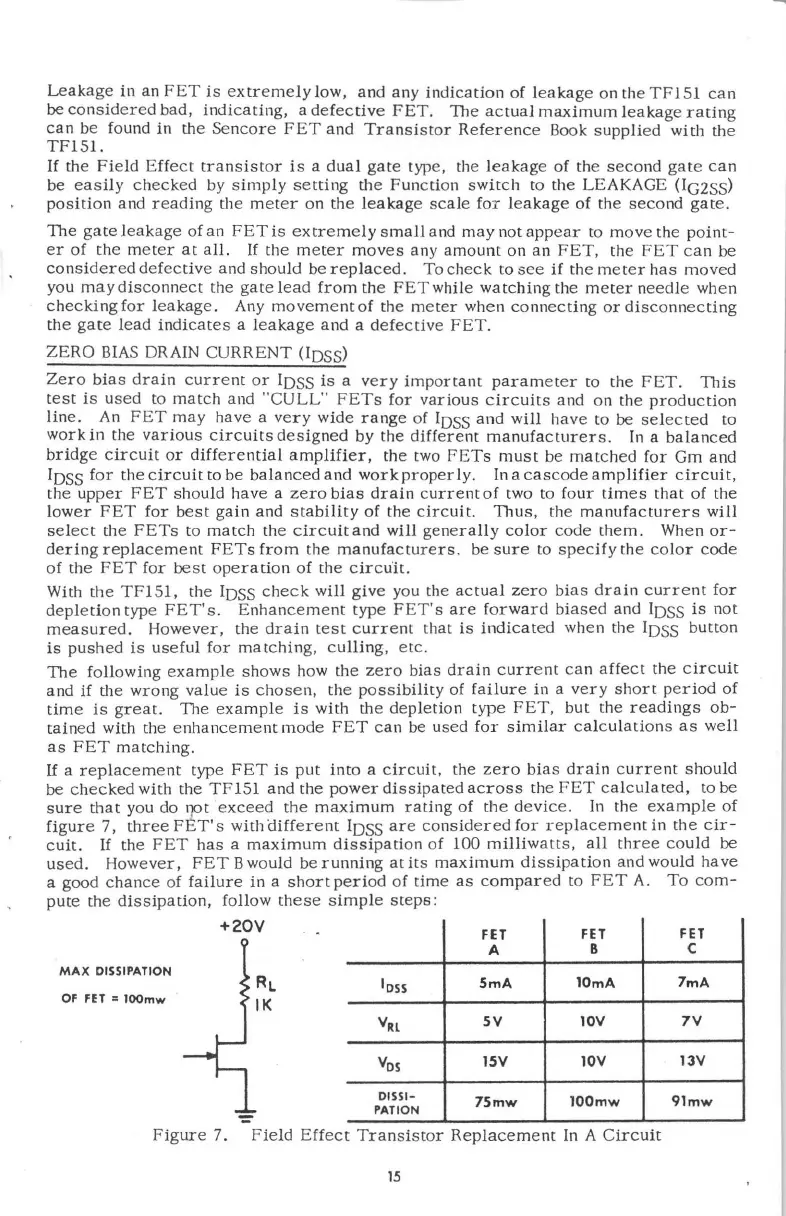
In the
example
of
figure
7,
three
FET'
s with
different
lOSS
are
considered
for
replacement
in
the
cir-
cuit.
If
the
FET
has
a
maximum
dissipation
of
100
milliwatts,
all
three
could
be
used.
However,
FET
B would
be
running
at
its
maximum
dissipation
and
would
have
a good
chance
of
failure
in
a
short
period
of
time
as
compared
to
FET
A.
To
com-
pute
the
dissipation,
follow
these
simple
steps:
+20V
FEr
FET
FET
A
B
C
MAX
DISSIPATION
loss
SmA
lOrnA
7mA
OF
FH
= lOOmw
V
Rl
SV
IOV
7V
Vos
ISV
IOV
13V
01551-
7Smw
IOOmw
9lmw
PATION
Figure
7.
Field
Effect
Transistor
Replacement
In A
Circuit
15

Related product manuals