EasyManua.ls Logo

Sencore TF151 - Checking Diodes and Rectifiers Out of Circuit; Out-of-Circuit Diode Test Procedure; Zener Diode Testing; Varicap Diode Testing

Default Icon
24 pages
Print Icon
To Next Page IconTo Next Page
To Previous Page IconTo Previous Page
Loading...
CHECKING DIODE AND
RECTIFIERS
OUT
OF
CIRCUIT
A
more
accurate
check
out
of the
circuit
may
be
made
on
a
diode
or
rectifier
wi
th
the
leakage
position
on
the
TFl51.
The
actual
reverse
current
or
leakage
can
be
measured
and
compared
with the
forward
current
to
find the
actual
front
to
back
ratio
of
the
diode.
To
connect
the
diode
for
the
out
of
circuit
test,
see
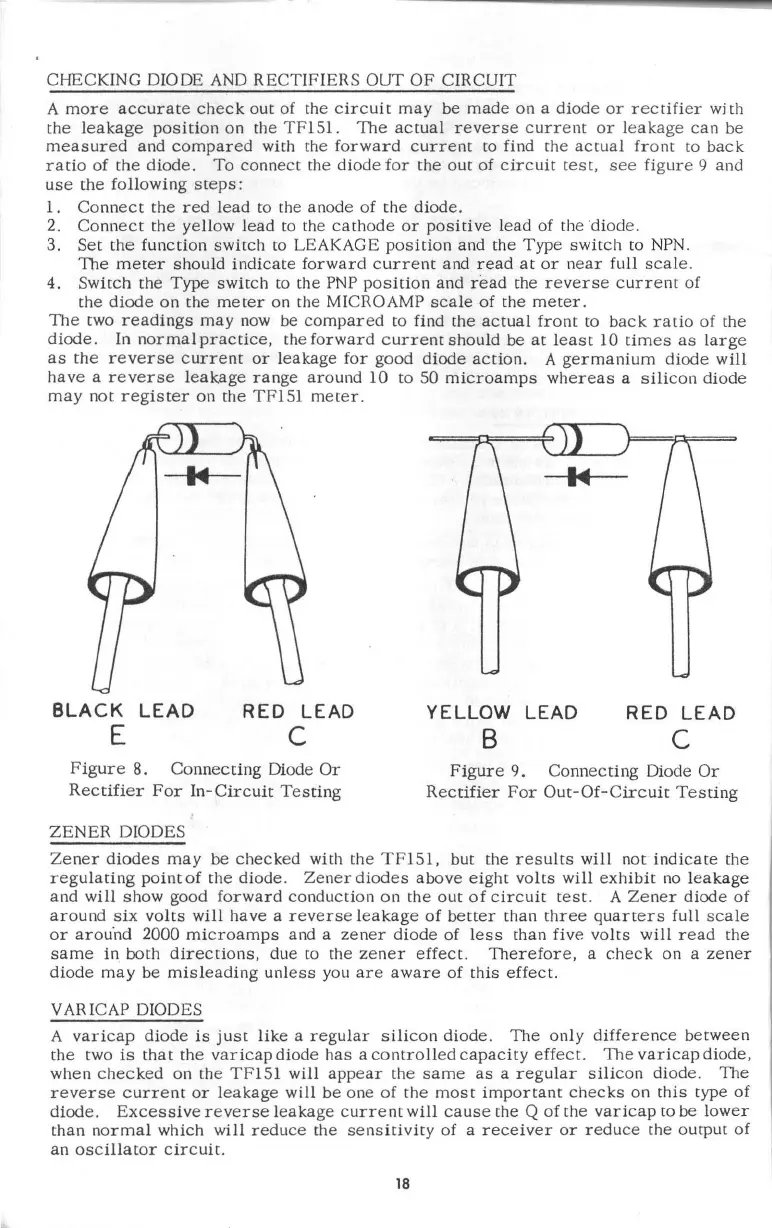
figure
9
and
use
the
following
steps:
1.
Connect
the
red
lead
to the
anode
of
the
diode.
2.
Connect
the
yellow
lead
to
the
cathode
or
positive
lead of the ·
diode.
3.
Set
the
function
switch
to
LEAKAGE
position
and the
Type
switch
to
NPN.
The
meter
should
indicate
forward
current
and
read
at
or
near
full
scale.
4.
Switch
the
Type
switch
to
the PNP
position
and
read
the
reverse
current
of
the
diode
on
the
meter
on the MICROAMP
scale
of
the
meter.
The
two
readings
may
now
be
compared
to find the
actual
front
to
back
ratio
of
the
diode.
In
normal
practice,
the
forward
current
should
be
at
least
10
times
as
large
as
the
reverse
current
or
leakage
for
good
diode
action.
A
germanium
diode
will
have
a
reverse
leakage
range
around
10 to 50
microamps
whereas
a
silicon
diode
may
not
register
on
the
TFl51
meter.
BLACK
LEAD
E
RED
LEAD
C
Figure
8.
Connecting
Diode
Or
Rectifier
For
In-
Circuit
Testing
ZENER
DIODES
YELLOW
LEAD
B
RED
LEAD
C
Figure
9.
Connecting
Diode
Or
Rectifier
For
Out-Of-Circuit
Testing
Zener
diodes
may
be
checked
with the
TF151,
but the
results
will
not
indicate
the
regulating
point
of
the
diode
.
Zener
diodes
above
eight
volts
will
exhibit
no
leakage
and
will
show
good
forward
conduction
on
the
out
of
circuit
test.
A
Zener
diode
of
around
six
volts
will
have
a
reverse
leakage
of
better
than
three
quarters
full
scale
or
arou·nd 2000
microamps
and a
zener
diode
of
less
than
five
volts
will
read
the
same
in
both
directions,
due
to
the
zener
effect.
Therefore,
a
check
on
a
zener
diode
may
be
misleading
unless
you
are
aware
of
this
effect.
VARICAP DIODES
A
varicap
diode
is
just
like
a
regular
silicon
diode.
The
only
difference
between
the
two
is
that
the
varicap
diode
has
a
controlled
capacity
effect.
The
varicap
diode,
when
checked
on
the
TF151
will
appear
the
same
as
a
regular
silicon
diode.
The
reverse
current
or
leakage
will
be
one
of
the
most
important
checks
on
this
type
of
diode.
Excessive
reverse
leakage
current
will
cause
the Q
of
the
varicap
to
be
lower
than
normal
which
will
reduce
the
sensirivity
of
a
receiver
or
reduce
the
output
of
an
oscillator
circuit.
18

Related product manuals