10
WWW.SENIXTOOLS.COM
Figure 3 - Tree limbing
Make the felling back cut at least 50 mm
higher than the horizontal notching cut (Figure
2). Keep the felling back cut parallel to the
horizontal notching cut. Make the felling back
cut so enough wood is left to act as a hinge.
The hinge wood keeps the tree from twisting
and falling in the wrong direction. Do not cut
through the hinge.
As the felling gets close to the hinge, the tree
should begin to fall. If there is any chance that
the tree may not fall in desired direction or it
may rock back and bind the saw chain, stop
cutting before the felling back cut is complete
and use wedges of wood, plastic or aluminium
to open the cut and drop the tree along the
desired line of fall.
When the tree begins to fall remove the chain
saw from the cut, stop the motor, put the chain
saw down, then use the retreat path planned.
Be alert for overhead limbs falling and watch
your footing.
Bucking is cutting a log into lengths. It is
your weight is evenly distributed on both feet.
When possible, the log should be raised and
supported by the use of limbs, logs or chocks.
Follow the simple directions for easy cutting.
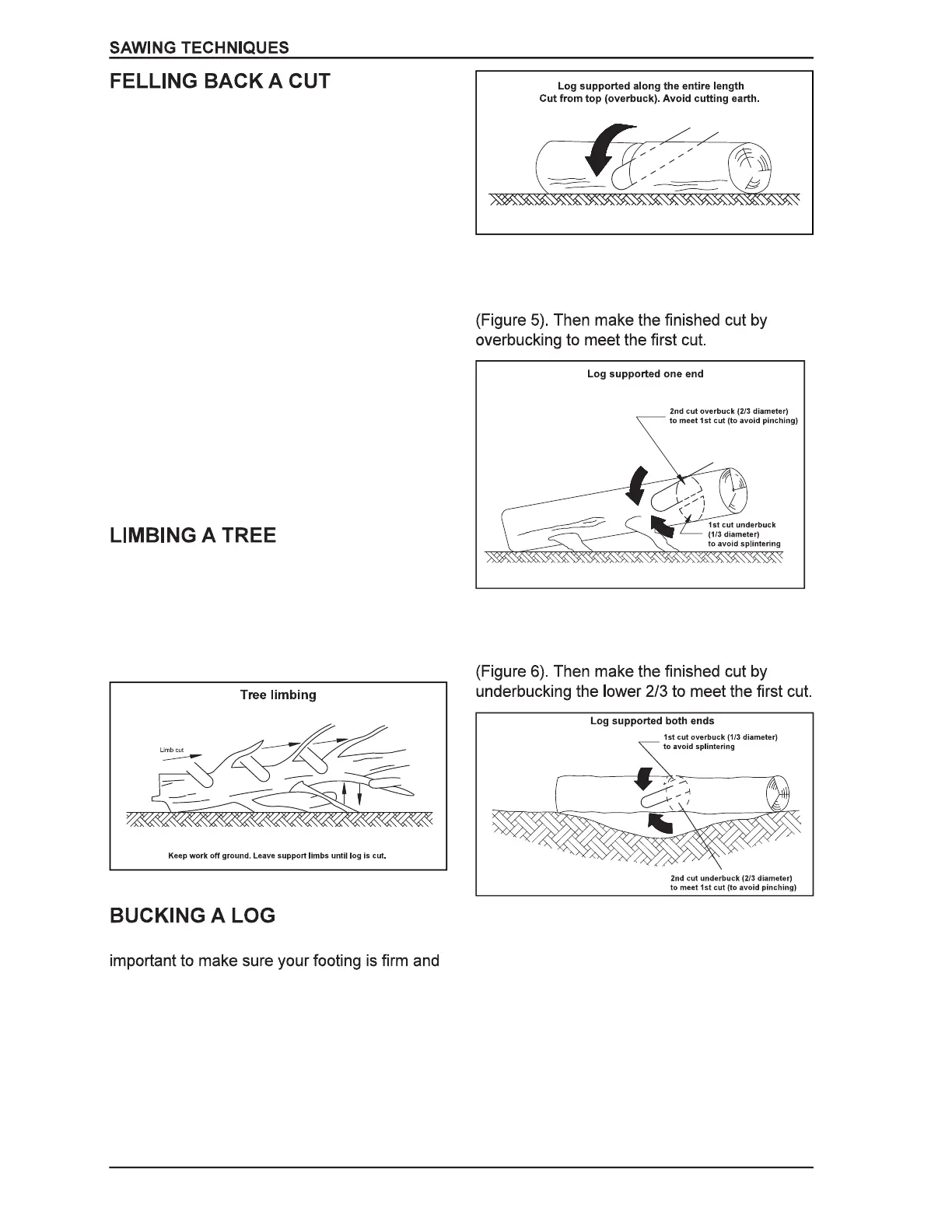
When the log is supported along its entire
length, it is cut from the top (overbuck) (Figure
4).
Limbing is removing the branches from a fallen
tree. When limbing, leave larger lower limbs
to support the log off the ground. Remove the
small limbs in one cut (Figure 3).
Branches under tension should be cut from the
bottom up to avoid binding the chain saw.
Figure 4 - Log fully supported
Figure 5 - Log supported on one end
Figure 6 - Log supported on both ends
When the log is supported on one end, cut 1/3
the diameter from the underside (underbuck)
When the log is supported on both ends,
cut 1/3 the diameter from the top (overbuck)
When bucking on a slope always stand on the
uphill side of the log (Figure 7).


 To Next Page
 Loading...