Need help?
Do you have a question about the Senix CS4QL-L3 and is the answer not in the manual?
Explains common safety symbols like caution, warning, and read manual.
Details symbols related to choke, primer bulb, and cutting teeth direction.
Covers safe work area, lubrication, ventilation, protective gear, and operator training.
Lists limitations such as not modifying the product or operating without proper footing.
Details procedures for refueling, including cooling the engine and avoiding ignition sources.
Addresses risks of fuel vapor pressure, leaks, and proper storage of fuel.
Warns against operating indoors due to poisonous exhaust fumes.
Outlines steps for starting the engine, including using the starter rope and choke.
Covers avoiding foreign objects, secure footing, and two-handed operation.
Discusses avoiding fatigue, drugs, alcohol, and operating at shoulder height.
Emphasizes using the product in good condition and checking for leaks.
Covers securing the product, attaching the guide bar cover, and handling during transport.
Details storing the product safely, away from children and ignition sources.
Explains how kickback occurs from tip contact or pinching the saw chain.
Provides methods to reduce kickback, like firm grip and avoiding obstructions.
Lists specific actions like cutting at a flat angle and using a low kickback chain.
Advises limiting operation time and wearing protective gloves.
Describes symptoms and risks associated with prolonged vibration exposure.
Covers immediate actions for malfunctions, fires, and general alertness.
Specifies using special agents, not water, for fuel fires.
Defines the intended use for homeowners and campers, not prolonged use.
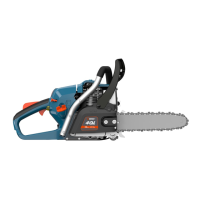
Illustrates and labels the main components of the chain saw.
Lists and describes the function of each numbered part of the unit.
Lists engine displacement, speeds, capacities, and weights of the saw.
Advises checking the saw, chain, and bar for damage before use.
Lists the items included in the package with the chainsaw.
Explains why proper chain tension is critical for safety and performance.
Details how to adjust the chain tension using specific tools.
Describes how to check the slack in the saw chain for proper tension.
Provides steps to loosen bar nuts and adjust the tension screw.
Covers inspecting the saw, checking fluid levels, and ensuring the air filter is clear.
Details how to check and fill the engine oil, including first-time use.
Explains the importance of chain oil and how to check and fill the oil tank.
Emphasizes hazards of gasoline, fire risks, and handling outdoors.
Outlines steps for safely filling the fuel tank, including proper fuel type and level.
Describes engaging the chain brake and using the primer bulb.
Details pulling the starter rope with choke and throttle settings.
Explains setting the choke to FULL CHOKE and then to RUN.
Describes switching the choke to RUN by pressing the throttle trigger.
Outlines steps for starting a warm engine, including primer bulb usage.
Explains the chain brake as a safety mechanism to stop the chain.
Details how to test the chain brake for proper function before use.
Advises attending training, firm grip, secure stance, and correct object.
Describes how to check the automatic oiling system for proper bar and chain lubrication.
Covers teamwork, uphill positioning, escape paths, and preparing the tree.
Explains making the undercut notch and the felling back cut for controlled tree fall.
Guides on removing branches from a fallen tree, supporting logs, and cutting tensioned branches.
Details cutting supported logs from top or underside based on support.
Warns about cutting spring poles due to stored tension.
Explains cutting logs supported on both ends and using wedges for pinching.
Advises standing uphill when cutting on a slope and releasing pressure at the end of cuts.
Covers cleaning the product with a dry cloth, brush, or compressed air.
Details how to lubricate the sprocket wheel using grease.
Explains how to maintain the guide bar and saw chain for optimal performance.
Covers cleaning oiling ports, guide bar rails, and checking for wear.
Provides steps for re-assembling the saw chain and guide bar assembly.
Lists indicators for when the saw chain needs sharpening.
Details the process of sharpening the chain using a file and measuring tools.
Describes how to wash, dry, and replace the air filter.
Covers draining old engine oil and refilling with new oil.
Details checking the spark plug gap and replacing it if damaged.
Advises against adjusting the carburetor and to contact service if issues arise.
Outlines the terms and conditions of the limited two-year warranty.
Covers implied warranties, liability, and customer service contact details.
Covers securing the product during transport and attaching the guide bar cover.
Details storing the machine safely, out of reach, and protected from dust.
Advises on proper disposal of waste products and recycling.
Provides solutions for common problems like engine not starting or stopping.
Illustrates an exploded view of the chainsaw with numbered components.
Lists all parts with their corresponding numbers, part numbers, descriptions, and quantities.
 General
| Engine Type | 2-stroke |
|---|---|
| Bar Length | 16 in |
| Weight | 4.5 kg |
| Power Source | Gasoline |
| Chain Gauge | 0.050 inches |

 To Next Page