
 Need help?
Do you have a question about the Senter ST230 and is the answer not in the manual?
Identifies and describes the main components of the telephone line tester unit.
Explains the functions of the Phone/Tester, Talk, Call MΩ, and Mon buttons.
Provides the physical dimensions and weight of the ST230 Telephone Line Tester.
Specifies the recommended environmental conditions for operating the ST230 Telephone Line Tester.
Details how to use the tester for dialing, receiving, redialing, and caller ID display.
Instructions on how to dial a number using the telephone line tester.
How to answer an incoming call on the telephone line tester.
Procedure for redialing the last dialed telephone number.
Explains the display of incoming caller ID information.
How to activate and deactivate the mute function during a call.
Procedure for pulse/tone dialing transformation.
Indicates the presence of high DC voltage on the line.
Detailed procedures for performing various tests using the line tester.
How to test for AC and DC voltage levels on the telephone line.
Procedure for measuring the insulation resistance of the telephone line.
How to perform an open circuit test on the telephone line.
Procedure for testing the earth insulation of the telephone line.
Steps for calling a user and establishing a talk connection.
How to test the quality of a user's telephone line and voice communication.
Procedure for checking and identifying telephone line pairs.
How to monitor line activity without interrupting user communication.
Detects high AC voltage on the line and provides an alarm.
Indicates low battery voltage and prompts for charging.
Instructions for charging the internal NI-MH battery of the tester.
Important notes and safety precautions for operating the tester.
Description of the main test line and its terminal box and clamp.
Details the RJ11 linking line and its connection capabilities.
The ST230 Telephone Line Tester is a portable and intelligent line fault tester designed for telecommunication professionals. It integrates advanced technologies such as intelligent CPU, IC, and SMT to offer a comprehensive set of functions, including telephone capabilities, line performance testing, and safety checks.
The primary function of the ST230 is to diagnose faults in telephone lines. It acts as a full-featured telephone, allowing users to dial, receive calls, and engage in conversations directly from the device. This telephone functionality is enhanced by features such as redial, mute, and P/T (pulse/tone) transfer, making it versatile for various communication needs during line maintenance. A key safety feature is its ability to detect and indicate high DC voltage on the line, alerting the user to potential hazards before off-hook operations.
Beyond basic telephony, the ST230 excels in line performance testing. It can perform AC and DC voltage tests, providing automatic display of line voltage values. This is crucial for determining the ringing up/off voltage and distinguishing positive and negative ports, ensuring correct line connections. The device also conducts insulation tests, measuring the insulation resistance of the line to identify faults. An open test function helps detect breaks in the line, while an earth insulation test assesses the line's grounding quality.
The ST230 includes specialized testing capabilities such as "Call user & talk" and "Phone test." The "Call user & talk" function allows the user to call a passive user's telephone on the line, enabling direct communication to check line maintenance. The "Phone test" function assesses the quality of a user's phone by ringing it and evaluating the communication voice quality. Another practical feature is "Check wire pairs," which helps identify corresponding lines at two different ends, streamlining the process of tracing and verifying wire connections. The "Monitor" function allows for passive monitoring of line activity without interfering with ongoing communication.
For safety, the device incorporates a "High AC voltage detect and alarm" function. When the tester is near a line circuit with high AC voltage, it triggers an alarm sound and illuminates an LED, warning the user of dangerous conditions. This accessory function is vital for preventing accidents and ensuring the safety of the lineman.
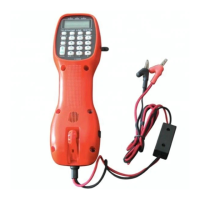
The ST230 is designed with human engineering in mind, featuring a barbell-like appearance that allows it to be carried on the shoulder, freeing up the lineman's hands for other tasks. It can also be hung on a tool belt via a pothook, making it convenient for use while climbing or performing other activities. The device supports an optional earphone, further enhancing hands-free operation.
The user interface is intuitive, with clearly labeled keys and an LCD display that shows telephone numbers, test results, and various indicators. The "Phone/Tester" button allows seamless switching between telephone and test modes. Dedicated buttons for "Talk," "Call MΩ" (for insulation testing), and "Mon" (for monitoring and AC voltage testing) simplify operation. The dial keys (1-9, *, #) are standard for telephone functions. LED indicators provide visual feedback for high DC voltage (H-DCV), high AC voltage (H-ACV), charging status, and talk status.
The incoming call number display function is compatible with both FSK and DTMF types, automatically refreshing to show caller ID information. It also indicates when a call number is secret or exceeds the display range, or if the signal is wrong. The P/T transfer function allows users to switch between pulse and tone dialing modes, providing flexibility for different telephone systems.
The ST230 is built with durability in mind, featuring a solid shell made of a new type of material. It is powered by an inner rechargeable Ni-MH battery, which can provide approximately one week of operation after a full charge. The device includes an "Under voltage self-checking" function that alerts the user when the battery is low, prompting them to recharge.
Charging is straightforward: the output plug of the charger is inserted into the charge jack, and the charger is connected to a 220V socket. A charger LED indicates the charging status. The recommended charging duration is 8 to 10 hours. To ensure battery longevity, it is advised not to press the "Phone/Tester" button during charging. For long-term storage, the battery should be fully charged and then recharged every 30 days to maintain its capacity.
Users are strongly advised to prioritize safety by always using the high AC voltage detect and alarm function and the voltage test function before operating other features. This precaution protects both the user and the tester from potential damage due to high AC or DC voltage. During tests, users should be mindful of dangerous voltages on the line and avoid touching the test clamps. If high DC voltage is detected, the clamps should be removed immediately. The manual also emphasizes the importance of releasing all keys when not in use to prevent battery discharge.
 General
| USB port | Micro USB |
|---|---|
| Operating Temperature | -10℃ ~ 50℃ |
| Dimensions | 152mm * 77mm * 28mm |
| Weight | <300g |
| Operating System | Android |
| Touch Screen | Capacitive |
| Camera | 8MP rear |
| Wi-Fi | 802.11 b/g/n |
| Bluetooth | Bluetooth 4.0 |
| GPS | Yes |
| Battery | 4000mAh |
| Expansion port | MicroSD up to 32GB |
| Drop Grade | 1.2m |

 To Next Page