Need help?
Do you have a question about the Separett Villa 9000 and is the answer not in the manual?
Details toilet capacity and emptying rate based on user numbers and usage frequency.
Describes the porcelain-like material and key differences between Villa 9000 and 9010 models.
Provides instructions on proper toilet usage, including the pressure seat and waste distribution.
Offers guidance on cleaning the urine bowl, using drain cleaner, and rinsing the fan filter.
General guidance on choosing a location and planning urine outlet and ventilation pipe routes.
Details requirements for the urine outlet, covering fall, pipe diameter, and winter use considerations.
A checklist of items to verify, potentially for installation, operation, or maintenance.
Instructions for preparing the toilet and necessary accessories before the initial use.
Provides guidelines for safe and effective processing, composting, or disposal of toilet waste.
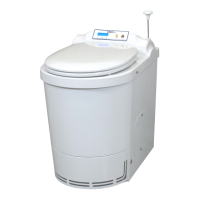
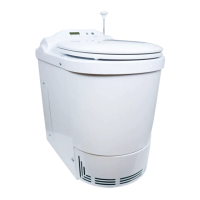
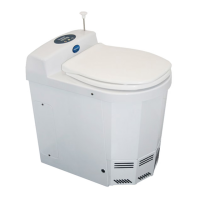
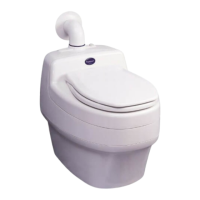
The Separett Villa is a waterless composting toilet designed for both warm and cold environments, offering an environmentally friendly and efficient waste management solution. The toilet is available in two models, Villa 9000 and Villa 9010, which share the same design and core functionality, differing primarily in their electrical equipment for the fan. The Villa 9000 is equipped with a 230 V fan with two speeds, while the Villa 9010 features a 12 V fan with a single speed.
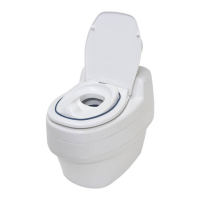
The Separett Villa operates on a urine-diverting principle, separating liquid and solid waste to facilitate easier and more hygienic handling. This separation is key to reducing odors and simplifying the composting process. When a user sits on the unique pressure seat, a view screen automatically opens, revealing the solid waste container. Simultaneously, the container rotates, ensuring that the solid waste is evenly distributed within the liner bag. This mechanism optimizes the use of the container's capacity and aids in the decomposition process.
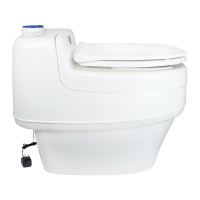
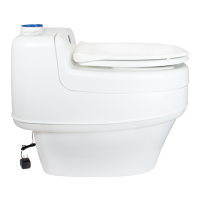
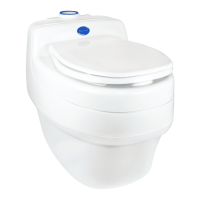
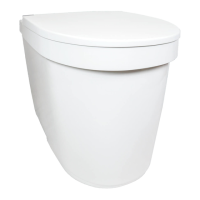
The toilet's design mimics porcelain, providing an aesthetic and easy-to-clean surface. All materials used in its construction, including high-impact, high-gloss polypropylene for the upper and lower sections, gloss polypropylene for the seat, and polypropylene for the inner bucket and cover, are recyclable. The inner bin also features UV stabilization, with 2% of PE 28A10 containing 2000 ppm UV stabilizer, contributing to its durability.
Ventilation is a critical component of the Separett Villa's odor control system. The fan, whether 230V or 12V, runs continuously to draw air from the toilet, preventing odors from escaping into the bathroom. This air is then expelled through a ventilation pipe, which can be routed through a wall or roof. Horizontal ventilation pipes should be installed with a slight fall to ensure that any condensation runs back towards the toilet and out through the urine outlet, preventing moisture buildup in the pipework.
The urine outlet system requires a continuous fall along its entire length to ensure proper drainage. For outdoor installations or long distances, a larger diameter pipe is recommended. In colder climates, increasing the pipe diameter to Ø50-75 mm or adding a heating loop may be necessary to prevent blockages due to freezing. The urine can be directed to a greywater system, a soak-away pit, or a collection tank, such as the Separett Ejektortank. Local environmental regulations should always be consulted regarding urine disposal.
The Separett Villa is designed for ease of use and hygiene. Users must always sit down when using the toilet to ensure proper separation of waste and activation of the pressure seat mechanism. After each use, pouring a cup of water into the urine bowl is recommended to help keep the urine drain clean and prevent blockages.
The toilet's capacity is unlimited, with the emptying rate depending on the number of users. For a household of two people with normal use, the solid waste container typically needs to be changed approximately every four weeks.
For children under the age of five, it is recommended to use the Separett Child Seat, an optional accessory, to ensure comfortable and proper positioning.
Regular maintenance is crucial for the optimal performance and longevity of the Separett Villa.
In case of operational issues, such as flies, odors, or blockages, a troubleshooting guide is provided, emphasizing the importance of disconnecting the electrical supply before any inspection or maintenance. This guide covers checks for insect nets, fan operation, sealed joints, water traps, and proper waste management practices.
 General
| Type | Composting toilet |
|---|---|
| Waterless | Yes |
| Urine separation | Yes |
| Max user weight | 150 kg |
| Voltage | 12V |
| Color | White |
| Material | Polypropylene |
| Ventilation | 12V fan |
| Power supply | 12V |
| Width | 456 mm |

 To Next Page